Long Ford recalls can take over half a year to remedy, report says
Published in Automotive News
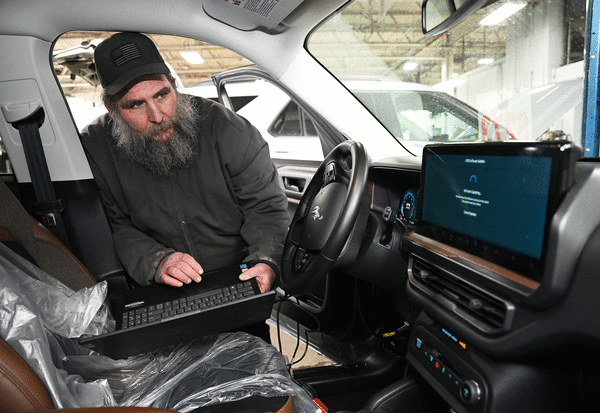
Ford Motor Co. last year set a record in the United States for the number of recalls issued in a single year, but some took longer than others to have a fix available, according to a recent report.
Recalls and warranty costs have weighed on the Dearborn automaker's balance sheets, but looking at the length of time it takes for a repair to be made available offers insights into the experience of consumers living with the defects. Although over-the-air updates can make some fixes speedier than ever, some problems carry collision and fire risks and even result in a warning that drivers park the vehicle outside — in some cases, for months.
The National Highway Traffic Safety Administration publishes information on recalls and remedies. The report defines a "significant" delay as more than the initial 60 days automakers have to notify customers that a recall has been issued. Ford's average was 198 days from 22 recalls with significant remedy delays issued in 2025 and through June of this year, according to a report from San Diego marketing firm 1Point21 Interactive and the Hearn Law Firm PLLC in Mississippi.
"I imagine it’s really frustrating to be issued a recall and not having much clarity from the manufacturers on when it will be repaired or clarity for when parts will be available," said Jake Sanborn, 1Point21's SEO team lead. "There's a lot of frustration there."
Ford has faced scrutiny in recent years for its quality and recalls. That prompted a transformation of its quality processes, which the automaker says is yielding results as shown in its top mass-market automaker ranking in JD Power's Initial Quality Study. Still, Ford has issued more than double the recalls this year of any other automaker after breaking a record in 2025 for the number of recalls issued in a year. Ford also remains under an independent federal monitor to oversee its recall processes, data analytics and compliance after NHTSA found it failed to recall defective rearview cameras in a timely manner.
"The cited report is misleading because it artificially inflates the recall delay rate average by excluding all recalls resolved within 60 days," Ford spokesperson Mike Levine said in a statement. "Our average time to remedy is significantly lower than what's estimated, with delays primarily occurring when we have to engineer new solutions or build new supplier production lines for old parts. To minimize customer wait times, a dedicated Ford team manages every open recall to actively eliminate delays and accelerate remedy availability."
For a comparison with other companies, looking between 2021 and 2025, Ford ranked third in significant recall delays with an average of 174 days. However, that number is from across 110 recalls where remedies took more than 60 days during that timeframe.
Nissan Motor Co. Ltd.'s and Chrysler and Jeep maker Stellantis NV's averages were 299 and 225 days, respectively. But the averages came from fewer recalls: Nissan had just 13 recalls that met the 60-day threshold in that timeframe; Stellantis had 27.
That means Ford's average significant remedy delays were among the longest for automakers and most frequent over the past few years.
Ford set the record for the number of recalls issued last year with 153. It's also leading recalls issued this year with 75, according to NHTSA.
"Because of the scale at which they’re issuing them," Sanborn said, "they're going to have more long recalls just because of how many they’re sending out."
Many of the 2021-2025 recalls also encompassed a larger number of vehicles — think in the hundreds of thousands. Overall for the industry between 2021 and 2025, 79% of recalls had a remedy within two months, but looking at the number of affected vehicles that had a remedy within two months, that drops to 53%, Sanborn said. Six million vehicles in that time range had no remedy for at least a year.
Parts availability can be a big hurdle, Sanborn said: "It can take months to ramp up the supply chain" for additional capacity, he said.
Ford has taken the lead over Tesla Inc. on annual over-the-air updates, a repair that automakers have highlighted as cost-effective and fast, Sanborn said. At least eight of the recalls Ford issued last year were over-the-air fixes.
Other fixes may need mobile service repairs or for the vehicle to go to the dealership for the repair. A recall covering hundreds of thousands of Bronco Sport SUVs and Escape crossovers for a fuel injector that could crack, leak and create a fire risk took 11 months to get a remedy after an initial software update to detect for cracks, Sanborn said.
"For a customer to think, 'Is my car going to catch fire on my way to work?'" Sanborn said, "I can’t imagine that’s a pleasant experience."
The time it takes to access parts has been one of the biggest challenges with recalls for Jim Seavitt, owner of the Village Ford dealership in Dearborn. With dealers unable to sell a vehicle with an open recall, that can be a burden to retailers. If Ford knows a recall is coming, it might hold vehicles at the manufacturing plant, which helps, he said.
"I’m not happy that it takes 90 days sometimes to get a part to fix a car," he said. "The other side of it is it keeps the public safer. It’s an inconvenience to a dealer, but if it saves lives, it's worth it."
He added that he hopes Ford's recent accomplishments like with the JD Power Initial Quality Study are indicative of a better quality future: "They're very focused on it now."
©2026 www.detroitnews.com. Visit at detroitnews.com. Distributed by Tribune Content Agency, LLC.







Comments