Larry Printz: Lamborghini Revuelto SV is the fastest and most extreme Super Veloce yet
Published in Automotive News
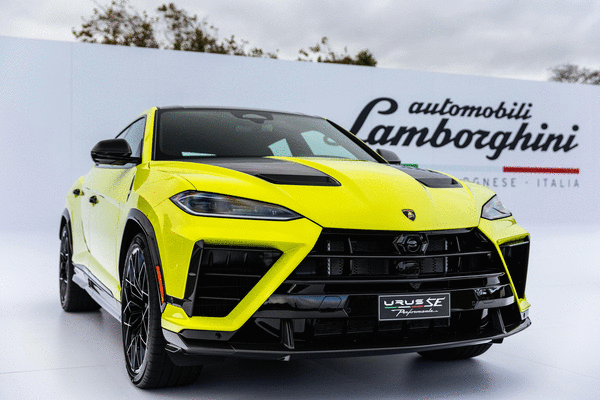
MONTEREY, California — There are worse problems for an automaker than having more customers than cars. Most automakers would regard this as a champagne problem. Lamborghini regards it as a business problem.
That was evident during Lamborghini’s unveiling of the Revuelto SV, the latest, loudest and most gloriously unnecessary version of its V-12 supercar. Limited to 1,963 examples, the Revuelto SV produces 1,001 horsepower and, Lamborghini says, is the most powerful and fastest production car ever built at its Sant’Agata Bolognese factory. The Revuelto SV is not merely another model. It’s another reason for someone who already wants a Lamborghini to want a more expensive Lamborghini.
In other words, it’s precisely the sort of car civilization needs least and wealthy people want most. Of course, nobody needs a Lamborghini. You can get to the supermarket in a Toyota without rear tires costing more than the groceries. You buy a Lamborghini because you want to reward yourself. And Lamborghini’s job is to make sure the reward remains sufficiently rare to feel like a reward.
Stephan Winkelmann, Lamborghini’s chairman and CEO, understands the peculiar economics of selling things nobody needs. “You buy our cars because you think about Lamborghini when you have a dream,” he told me. “It’s not because you need the car.”
Lamborghini delivered a record 10,747 cars in 2025, generating €3.20 billion in revenue and €768 million in operating profit. Those are spectacular numbers. It comes as the luxury market contends with tariffs, currency swings, geopolitical uncertainty and a Chinese market that has become rather less enthusiastic about buying extremely expensive Italian objects.
Winkelmann has spent more than 16 years at Lamborghini over two stints, including an initial 11-year run from 2005 to 2016 before returning as chairman and CEO four years later. During that time, the company has evolved from a small exotic-car manufacturer into one of the world’s most formidable luxury-performance brands. But he has resisted the temptation to sell more. “We always have to look into how to manage this balance between having a good financial result and scarcity on the other side,” he said.
For a normal automaker, having customers wait months for a car is a manufacturing headache. At Lamborghini, it’s practically part of the upholstery. The company’s 2025 results showed a record order bank, with Revuelto orders extending into the first quarter of 2027 and Urus SE and Temerario orders well into 2026. Lamborghini therefore possesses the automotive equivalent of a superpower: pricing power. The trick is not to abuse it.
The company does not need to sell millions of automobiles. It needs each automobile to seem as though it matters enormously. That’s why Lamborghini has essentially replaced its entire lineup in three years. The Revuelto arrived in 2023, replacing the Aventador with a naturally aspirated V-12 supplemented by three electric motors. In 2024 came the Urus SE plug-in hybrid, followed by the Temerario, which replaced the Huracán with a twin-turbo V-8 and three electric motors.
With the entire range now hybrid, Lamborghini is doing what luxury brands have discovered they can do extremely well: derivatives. As a result, 94% of Lamborghini deliveries in 2025 included at least one personalization option through its Ad Personam program. The customer isn't merely buying a Lamborghini. He, or increasingly she, is choosing which Lamborghini.
So far, the financial results suggest the formula works. In the first half of 2026, Lamborghini’s revenue rose 7.4% year-over-year, even as deliveries fell 4.6%. Operating profits produced a 22.7% margin. Fewer cars, more revenue; this is not the traditional automaker formula. It’s a luxury retailer formula.
There’s still a fourth model coming. Lamborghini has also announced a successor to the Urus toward the end of the decade, while the Lanzador concept previews an electric 2+2 grand tourer. That creates the biggest question facing the company: How much can Lamborghini grow before Lamborghini becomes commonplace?
Winkelmann says the product plan is already fixed. “I would like to see the fourth model coming up,” he said.
The changes are coming even as the Lamborghini buyer is changing. There are more women, Winkelmann says, and they are younger. Lamborghini is increasingly appearing in the same consideration set as Ferrari, with owners of one buying the other. That may be the clearest sign of success.
Yet Lamborghini isn't trying to become the world's biggest automaker. It’s trying to remain the automaker whose cars people dream about.
At Monterey Car Week, on a stage surrounded by people staring at a 1,001-horsepower V-12 they did not need, Lamborghini’s strategy is impossible to miss.
The problem for Lamborghini isn't selling cars. It’s making sure we never stop wanting them.
©2026 Tribune Content Agency, LLC







Comments