More F-Series trucks on dealer lots sets up critical 2027 for Ford
Published in Automotive News
Ford Motor Co. is betting a pick up in pickup production will set the stage in the second half of 2026 for next year when it has major product launches, hopes for trade clarity and the start of a new business vertical.
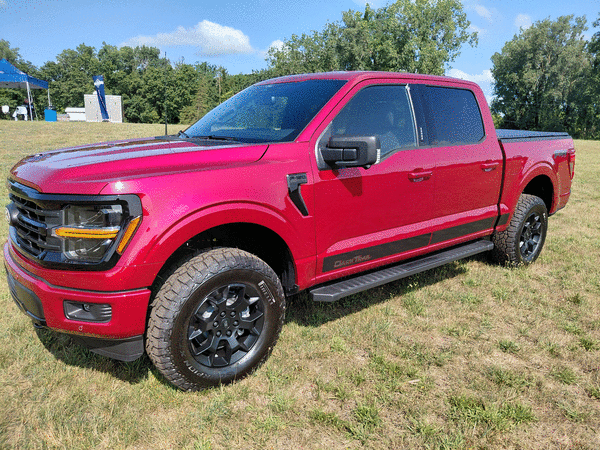
Second-quarter results that beat Wall Street expectations sent shares of the Dearborn automaker up almost 4% on Wednesday after the company increased its annual guidance. Strong pricing and high-margin product sales propelled the decision, executives said, despite declines in U.S. sales and global revenue. The circumstances, they said, set up F-Series trucks to come roaring back in the latter half of the year after U.S. sales fell 13% in the first half of 2026 amid an aluminum shortage due to multiple fires last fall at supplier Novelis Inc.
"We are seeing F-Series is around a 45-day supply, which for us is very lean," Ford CEO Jim Farley said on an investor call. "So, we have a lot of upside on the wholesale side, not just the retail side."
Novelis' hot mill in Oswego, New York, resumed production in early June after months being out of service, resulting in disrupted and limited production and Ford taking action to import materials from overseas. The automaker expects to get through qualification and validation of the new supply by third quarter and use 100% of Novelis' material around September.
The automaker originally expected $2.5 billion and $3 billion in performance improvement from the Novelis recovery, but Chief Financial Officer Sherry House guided toward the lower end of that. She, however, noted a year-over-year net operating earnings improvement of $1 billion remains intact.
"Costs have been coming down a bit," she told reporters in a media briefing. "Originally, we had guided that the cost would be between $1.5 (billion) and $2 billion, and those are coming in at the lower end of the range, so we feel quite comfortable with the $2.5 billion."
Production rates of the F-150 and Super Duty trucks became more normalized in June, she added and predicted monthly production to range between 90,000 and 95,000 vehicles through the rest of the year. That'll support a revenue recovery for Ford's Pro commercial vehicle division, House said, whose operating earnings fell 26% in the second quarter, but are expected to land between $7 billion and $7.5 billion for the full 2026. Ford's Oakville Assembly Complex in Ontario also remains on-track to launch Super Duty production in the fourth quarter after the company secured a three-year contract with Canadian autoworkers last week.
More: Unifor president says Ford contract sets expectations for job security
The hope is for strong pickup demand, including for the smaller Maverick, sets up Ford for the launch next year of its all-electric midsize truck expected to start at $30,000 on its new Universal Electric Vehicle Platform. Equipment installation is in its final stages at the Louisville Assembly Plant in Kentucky ahead of prototype launches, and the platform is expected to underpin a number of affordable vehicles.
"We think that we have what the customer wants, and we also are focused on affordability, and that's why we have our new Universal EV Platform," House said. "However, we are not seeing a disruption today."
Doug North, president of North Brothers Ford in Westland, said his F-Series inventory still is recovering, but demand for trucks remains robust with F-Series sales from his store up. Affordability, however, is affecting new-vehicle buyers of less-expensive vehicles, especially after Ford discontinued the Edge and Escape crossovers, he said.
"It's improving," North said of truck inventory. "However, we all wish we would have some more."
Executives also weren't shy about noting that an all-new lineup of Ford's existing trucks, including F-Series and Super Dutys, is on its way.
Also in 2027, Ford subsidiary Ford Energy will launch production of energy storage systems and their batteries at the former electric vehicle battery plant in Glendale, Kentucky, it operated with ex-South Korea joint venture partner SK On Ltd. Ford is redeploying the plant for energy storage output and expects to have 20 gigawatt hours of capacity by the end of 2027 with opportunity for expansion. That could power almost 1,900 average U.S. homes for a year.
France's EDF Group was the first to sign a framework agreement for production from there. Ford has emphasized the new business is high-margin. Similar lithium-iron-phosphate batteries production for the UEV has begun at Ford's battery plant in south-central Michigan's Marshall.
"We're kind of in the third inning of selling out the 2028 capacity," Farley said about Ford Energy. "Ford Energy can win because it's built on capabilities few companies can match: tariff resilient, world-class U.S. manufacturing, leading battery technology, an iconic American brand that is already familiar to communities who are most in need for grid support and infrastructure upgrades, and of course the ability to leverage our vast auto service expertise."
Emmanuel Rosner, an analyst at sell-side research firm Wolfe Research, during the investor call commended Ford on its progress in 2026: "It's good to see all this operational and execution traction this year."
Although the Q2 results were "resilient," prompting a price target increase by Edison Yu, an analyst at Deutsche Bank, the Blue Oval still has plenty to prove.
"At present, we think there is a fair amount of investment and complex execution still to come, specifically regarding the launch of the Universal EV (UEV) platform and the buildout of the Ford Energy ecosystem," Yu wrote in a note to investors. "We believe these transitions are already largely priced into the stock, thus execution will be key over the next few quarters as management navigates these capital deployments."
Product and Ford Energy launches will increase costs for the automaker, executives said. Meanwhile, Ford executives say the review of the U.S.-Mexico-Canada trade agreement should level the playing field with competitors who import millions of vehicles from Asia and other countries into the United States.
"We build the most in the U.S.," Farley said. "We have the best ratio between imports and our local production. We also export the most, and even for us, an improved USMCA could be a great opportunity for the industry and for Ford."
But right now, tariffs on vehicles and parts imported from Japan and South Korea have a 15% tariff on them compared to 25% on Canada and Mexico, though there are exceptions and offsets. Plus, weaker currencies offer an advantage in global exports.
"We are prepared to support revising the USMCA," Farley said, "so long as it allows the promotion of a more competitive U.S. auto sector, and that's really our lens for this negotiation."
©2026 www.detroitnews.com. Visit at detroitnews.com. Distributed by Tribune Content Agency, LLC.







Comments