Q&A: Ford CEO talks about shaping a long-term quality culture
Published in Automotive News
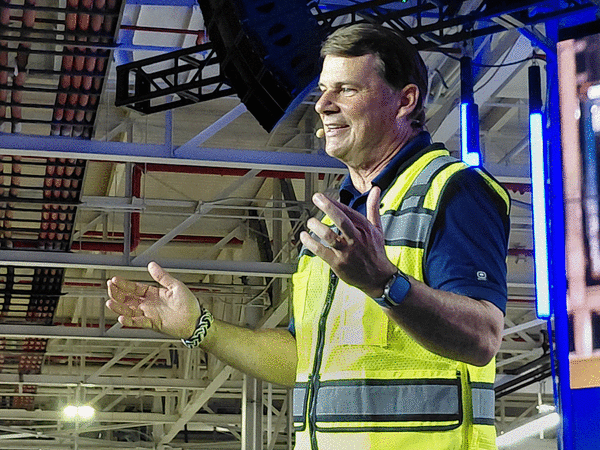
Ford Motor Co. CEO Jim Farley has visited 13 plants in the past year and plans to see at least two more before the year's end.
The plant visits are part of the Dearborn, Michigan, automaker's efforts to improve quality after warranty costs have hit financial results and it has posted record annual recalls. The work in rethinking its operations back in 2023 is starting to bear fruit, executives say, pointing to Ford ranking as the top mass-market automaker in JD Power's Initial Quality Study.
Farley brought his experience from Toyota Motor Corp. with "gemba" plant visits meant to show the "real place" and solve problems over prepared and scripted tours of the past. He also instituted leaders like Chief Manufacturing Officer Bryce Currie and Chief Operating Officer Kumar Galhotra to their current positions.
Farley, over a conference call, spoke with The Detroit News about how his approach to plant visits has changed, the work that's still needed to be done and what it means for the company's ability to compete.
This interview has been edited and condensed for clarity and brevity.
Q: What contributed to your decision to make plant visits a priority?
A: In the late '80s, when I joined Toyota, we made a huge decision to start Kentucky. We were building at NUMMI (New United Motors Manufacturing) on the West Coast, a Corolla with GM, and I was responsible for product planning. When we decided to build a new plant, it was a common expectation at Toyota, even if you were a Westerner, to spend time in the plant. That was the first time I went to do a gemba at NUMMI, and I watched very senior people at Toyota in Japan go to the line, find problems, go to the operator who is dealing with the problem, and then try to problem-solve to help the team.
Going to the line is not the important part. It's what you do when you're there that is the important part. When I became CEO of Ford, I think we were 25th in initial quality. It was very important for me to understand the real issues at the plant that went far beyond quality. What I found is that we were on the wrong side of the invisible line for the dignity of the workplace. How could we expect our American workers to beat the Japanese and South Korean imported workers, so to speak, in quality, if they didn't have the proper tools, or even felt pride in post-coronavirus to share their workspace?
One of the first things I did as a CEO was to go back to the beginning of my career and visit every plant I could every year. I've been doing this for a long time, and for me personally, I get to watch my team. I get to see if they're leading the right way, and if they're helping solve problems, or if it's a political process when they visit a plant. When I did my first plant tour with Bryce, I knew we were going to start to solve this quality problem. He had a philosophy of servant leadership and going to the plant with the control center, really understanding all the input metrics and output metrics that we should measure. For the last seven years, I've refined my plant visits, my gembas. They're quite different than I think what Kumar and Bryce have to do. So, each of these gembas is very different and personalized for each person to get what they need out of it.
Q: How have your gembas changed?
A: At first, I spent a lot of time in skip levels, meeting with the local union leadership, trying to understand whether people felt safe at work, and, more generally, whether quality was more important than output, or whether making production was more important than quality. As years have gone by, as we've made more and more changes, I first started to ask our engineers in the plant, our supply chain people in the plant, kind of more structural, organization, design and cultural issues. As the team continues to make progress beyond, I now go to the plants not to assess those things. It's really for me now to determine whether this is a sustained change, or if we're still holding our breath. During my career in the auto industry for 40 years, I watched Ford fall in love and fall out of love with quality like four times.
For me as a CEO, one of the most important things I think about is: Will this activity go away if my management team were to go away? Is it self-sustaining? So, I spend more time now on that, on answering that question when I go to each facility, and it always surprises me how different each facility is.
Q: What are the signs for which you look that this culture is self-sustaining?
A: What I'm looking for is: are my teammates tied to some greater responsibility than just winning awards? Are they trying to do this for our customers? Are they trying to do this for the Ford family? And when they talk about creating quality around the process, adherence to the process, improving the process, and in between those two things is a problem-solving culture.
Because in the end, defects require problem-solving. Sometimes it's whack-a-mole, like the beginning. Now it's getting ahead of the process, so we don't have to play whack-a-mole. I know it's those three things that I look for, kind of in that order: Are people obsessed about the process? Do I hear problem solving as a skill?
Q: What's your confidence on the number of plants that have reached that self-sustaining level?
A: I think we have 45 facilities around the world. Consistently, our China and Mexico plants are the most compliant with process and have the deepest problem-solving skills. I watch our AI token usage very carefully as a CEO, and I'm always impressed at the token usage, the correlation between AI token usage and quality and following the process. For example, it's not uncommon that our plants south of the border will have 10 to 100 times the token use as some of our other plants in North America.
There are cultural changes between different countries and even manufacturing culture within Ford and different countries that have a different commitment to the process, and problem-solving is a skill. I would say the U.S. plants have caught up the fastest. The most consistent have been some of our overseas plants that I mentioned.
And what one of the things I love about Bryce is that he has this philosophy of acting like "big Ford." In the past, Ford would have a great plant in Mexico, for example, but we wouldn't take that learning and spread it to the U.S. or vice versa. We do some great 3D printing in Livonia, and we don't impact the plant in Argentina. One of the things that really makes Bryce a very unique leader is that he insists on scaling excellence to the world and acting like big Ford, not little Ford. Little Ford is: We're good in one place, but we have difficulty scaling that excellence around the globe, and that's one thing that I really admire about the skill of Bryce. He's able to really think of the manufacturing system across the world as big Ford.
Q: What is the importance of an AI token?
A: For an LLM, a large language model, or agentic AI, the one way to measure the utilization of an agent or an LLM — like you and I will go on (Microsoft) Copilot and ask it questions for your job or my job, and it generates a token. A compute token is a way to measure the usage of AI in a company like Ford. And I watch this. Now, tokens aren't perfect. People can be using tokens but not be great at AI deployment, but I literally watch as a CEO token usage across my company, across my teams. I watch engineering token usage per employee versus manufacturing. I watch token usage in our plants, 45 plants around the world, and it's fascinating to me because in the early early days of AI, token usage is kind of like a meritocracy. The cultures that have the best quality operating system are trying to use AI to improve their quality and costs, and the best culture manufacturing-wise relative to the quality operating system, they reach out to AI models and agents in a meritocracy. They do it to accelerate their excellence and do it leanly.
Q: Ford also has spoken about the insufficiency of AI and other technologies in addressing its quality issues, prompting it to hire hundreds of technical specialist "gray beards" to share their knowledge and train younger engineers and talent. How did it become clear that was needed?
A: Our whole industry is not only suffering from a deficit of skilled trades, but also specific know-how that technology cannot substitute, like low-pressure casting. Low-pressure casting is very critical in how we're training supply chain for us, and it's a skill. It's a complicated skill. We find in low-pressure casting that our team is world-class, but that's a technical skill that Kumar and Bryce and Liz (Door, chief supply chain officer) all understand is a deficit at a company like Ford or our supply chain.
Half the vehicles in the U.S. are imported. Really, the best in the business are those imported vehicles, and we're effectively competing with the South Korean and the Japanese supply chain engineering ecosystem and their manufacturing plants overseas, and their workforce. And for us as an American company, where we make 80-85% here in the U.S., the most UAW employees, as well, we have to think about our capability relative to theirs overseas to be better than them. This is not a PR headline of technology replaces humans. It's not that simple. Making what we do, it's not that simple, and we absolutely need a whole army of technical experts that have real-world experience in solving problems with specific know-how, like preventive maintenance or low-pressure casting, as I mentioned. There's no substitute. AI tools are great, but they're not sufficient. They're necessary.
Q: Is there a particular example from a plant visit that showcases the impact of the gemba?
A: My favorite thing I watch at a plant is when I go to a workstation, and they present to me their kaizen for their workstation. We're trying to do this everywhere in the plant, all plants. It's really the enabler for our next level of performance. I wish I could take you to the plant visits I go to. Now have my vest, I have the goggles I wear, and I have my steel-toe shoes. And my family always laughs at me, because I lay them out the night before I go to a plant visit, and they're like, "Oh, Dad's going to be at plants tomorrow."
My obsession during my plant visits is seeing our team present their kaizen work. So basically, the operator thinks of their operation as if they're the CEO of the operation, and they think of their customers downstream, and they think of the people that are sending the process before them. It may be a completed car in final assembly, as they are the customer. They basically kaizen their entire workspace: what it looks like, how they move, how the materials come into the workstation, how efficient they are at doing their final assembly. They're shooting the bolts or fasteners, and they find like 5%-10% on efficiency, or they use less materials, or they're more comfortable, or they have less ergonomic risk, and they kaizen the entire process as like an entrepreneur, and then they present to me and the team, "Here's my revised workspace."
And it's awesome, because imagine if we can do that across the company with all the 100,000 operators, and they have the empowerment to actually change Ford, what that must feel like for them. To me, this is what gets me up in the morning after seven years as CEO: seeing our people's creativity and commitment to perfection come to life in front of our eyes.
And the most important part of that is when we leave, and they do it without any help, without being asked. They do it because they just want to do the right thing. That's the culture of lean: always improving, trying to get to perfection, putting quality and safety first.
I think that that's what I love about my plant visits, and I love to see their creativity and their pride. Literally, I'm the CEO, right? So, they're a little nervous. As soon as they start talking about the changes they made, they loosen up. They're themselves. They're smiling. They're proud. They feel like they're doing the right thing for the company. It's kind of a beautiful moment. And what I'm most proud of is that's happening without anyone doing a gemba. We want an army of problem solvers.
Q: Given the discussions over the United States-Canada-Mexico trade agreement happening right now and the reported push to institute a U.S. content requirement, how could this work on quality position Ford under changes to those rules?
A: USMCA is critical for America's top auto producer. Without the USMCA, it would be much harder for us to compete with global rivals, as I mentioned, such as Japan and South Korea, which have their own strong regional supply chains. They have weaker currencies. Look at the yen right now; it's at an all-time low, so they export that huge, enormous advantage, and they only have 12½-15% tariffs. If they have onerous tariffs for our parts, and they can import at 15%, and they have a weaker currency, that is another 20% cost advantage, and they have local steel and aluminum production that is not tariffed.
You can imagine the significant economic deficit we face as the most American company, and I think the main message for me as a CEO to you and to the readers is that as this USMCA negotiation plays out in the third and fourth quarter, it is imperative that any new agreement make it easier for Ford, not harder for Ford, to compete against imported Japanese and South Korean products with a strong USMCA local content. We can absolutely start to level the playing field between Japan and South Korea, and this is a very urgent topic, given the very weak currencies today.
©2026 www.detroitnews.com. Visit at detroitnews.com. Distributed by Tribune Content Agency, LLC.






Comments