How two Michigan stamping plants power Stellantis turnaround plan
Published in Automotive News
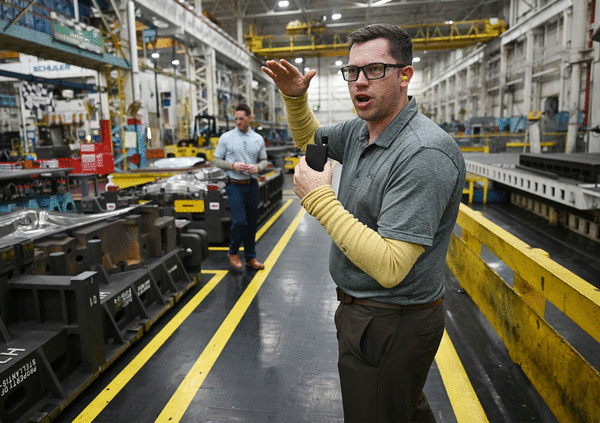
WARREN, Michigan — Hulking metal presses line one wall of Stellantis NV's cavernous stamping plant here, punching out the raw shapes of Jeep doors, Dodge hoods and Ram tailgates in rapid succession.
Nearby, swinging yellow robots continue the tightly choreographed work, gluing and pressing and welding smaller components to the sheet metal that eventually will start to resemble the shape of a truck or SUV.
Seven miles north, in Sterling Heights, Stellantis operates an even larger stamping plant — the biggest in the world, at 2.7 million square feet — that does much of the same work, churning out various shapes of steel and aluminum 24 hours a day.
Together, these lesser-known links in the manufacturing supply chain support all of Stellantis' big North American assembly plants — from next-door Warren Truck Assembly Plant, where the Jeep Grand Wagoneer SUV is built, to facilities in Windsor and Mexico that make minivans and pickups.
The Metro Detroit stamping plants, the automaker's only two such facilities in the United States, have at times struggled in recent years, facing major job cuts and worker morale issues amid slowing sales and shifting production plans. But under Stellantis CEO Antonio Filosa, the facilities are expected to cram in more workload — and add staff — as Stellantis begins a new five-year strategic turnaround plan, which includes a heavy focus on its most profitable North American market.
The carmaker's goal: grow sales by more than a third to 1.9 million annually by 2030 as it launches 23 vehicles, including 11 all-new models. The company also is directing billions of dollars of investment into its U.S. manufacturing footprint due to President Donald Trump's tariffs.
"Stamping has never really been viewed as the sexy side of automotive manufacturing, we're relatively invisible," said Ed Daniels Jr., vice president of North America injection and stamping operations. "Because when you look at the commercials and advertisements, it's always a beautiful Ram rolling off the assembly line or climbing the side of a mountain.
"But we're the inception of that vehicle," he said. "This is where raw materials are turned into commodities and parts."
The Detroit News recently got a rare look inside the two plants that combined employ about 3,000 people. The automaker wanted to show off a newly-installed blanking press at Warren Stamping and other machinery like a high-speed transfer press and a robot that spots flaws in the metal.
Hiring expected
The blanking press unspools long coils of metal and chops them up into pieces that can then be shaped into roofs, fenders and floor pans. Stellantis shipped the massive machine to Warren from its idled Belvidere Assembly Plant in Illinois last year.
After upgrades to the machine, executives said it's able to produce as many as 120,000 metal blanks per week. It will save Stellantis money since the plant will no longer need to pay a supplier to break down the coils before the metal arrives there.
The blanker addition is a big deal for the plant and signals that the company wants to bring more work in-house and invest in the facility over the coming years, said Romaine McKinney III, president of United Auto Workers Local 869, which represents workers at the factory.
The plant has already brought back all of its laid-off UAW workers, and McKinney said he anticipates more hiring to get underway if sales grow and new Stellantis vehicles come to market.
In another corner of the Warren facility, one of the fastest press lines in the world — known internally as the Hellcat — pushes as many as 15 pieces of metal through per minute. Dies that weigh up to 50 tons apiece squish the material into the shapes of doors and hoods before robotic arms snatch them out and place them on conveyor belts. Midway through a shift, workers can reconfigure the machine to make a different component, a process that takes just five minutes.
Robots check for quality
Curtis Booth, who manages Warren Stamping, said manual processes inside the plant have become increasingly automated, and safer, over the last couple decades, even as the automaker's two stamping factories still utilize some presses that were installed in the 1960s.
The latest high-tech addition is the Automated Body Inspection System, or ABIS. It's a camera system mounted on a robot that automatically checks the quality of components and flags anything in need of repair.
Auto plants of all kinds are increasingly turning to these types of camera systems, infused with artificial intelligence, to catch flaws in sheet metal and other components before they are shipped. Booth said worker visual inspections are still used. But in some cases the human eye has too much subjectivity, and the ABIS removes the guesswork.
Greg Bauer, who manages Sterling Stamping, said his plant has added staff over the past year, and expects to continue hiring as more work is assigned to the facility. There is no space at the plant to add more presses, but officials have figured out how to increase efficiency — quickly toggling back and forth between making doors for a Chrysler Pacifica and Dodge Charger on on a single machine, for example.
"We want to bring high-volume parts into the plant, and we want to maximize the capacity of the equipment," Daniels said.
©2026 www.detroitnews.com. Visit at detroitnews.com. Distributed by Tribune Content Agency, LLC.







Comments