UAW's Shawn Fain warns of AI threat: 'We are in a fight for humanity'
Published in Automotive News
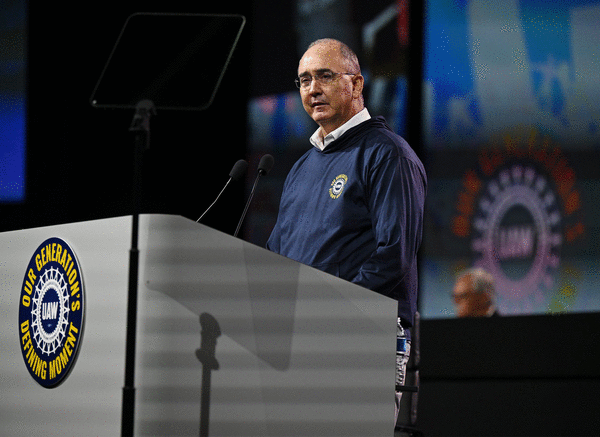
DETROIT — United Auto Workers President Shawn Fain on Tuesday called artificial intelligence and humanoid robots a "profound threat" that imperil more than just jobs.
"We need to be clear about this: We are in a fight for humanity," the labor leader told UAW members gathered at the union's quadrennial constitutional convention at Huntington Place downtown.
Protections around AI and other automation are set to be a central focus for the influential union heading into its next round of Detroit Three bargaining in 2028, alongside other key priorities such as winning back pensions. It will also be a major issue as the union decides who to support in upcoming elections — including in the race for the White House in two years.
On Monday at the same convention, AFL-CIO President Liz Shuler also underscored to members that stronger protections around AI were needed to protect jobs across all types of unionized industries. Though they raised concerns about the technology and called for an aggressive response, neither labor leader detailed specific policy plans or bargaining demands.
Worker productivity has soared in recent years, Fain said, including thanks to AI advancements in factories and elsewhere. But that means wages should also be going up in alignment with those productivity gains, and they have not.
"The fruits of our labor have multiplied like never before, but workers aren't reaping the harvest," Fain said. "And if AI continues to be used as an accessory to that crime, it has to be stopped. It doesn't have to be this way; in a just society, when workers create more value, they see more of the benefit."
Fain, as he has in the past, compared the emergence of AI to the implementation of the North American Free Trade Agreement in the 1990s. He and other labor advocates, scholars and even President Donald Trump have long railed against NAFTA as a job-killer in Michigan and elsewhere in the industrial Midwest while economic benefits accrued elsewhere.
NAFTA, Fain said Tuesday, destroyed millions of jobs "on the false promises of shared prosperity," and AI threatens to "finish the job."
He argued that the UAW should thwart company efforts to force a dwindling number of workers to use AI and other automation to "work harder, faster, and longer hours, typically for less money" — eventually reaching a point where worker dignity is robbed and the technology is leading the way, not the person.
With the pace of AI advancements, Fain made the case that the union needed to respond to automation concerns more quickly: "UAW family," he said, "the rainy day is now, it's here."
Fain in April had been in Washington, D.C. to discuss his concerns about AI alongside U.S. Sen. Bernie Sanders, I-Vermont, and U.S. Rep. Alexandria Ocasio-Cortez, D-New York, who earlier this year introduced legislation to stop or slow the buildout of AI data centers.
This week's four-day UAW convention, its 39th iteration, brings together about 900 delegates from union locals around the country to debate and vote on amendments to the organization's constitution. Hot topics are expected to cover raises to strike pay, member dues, how much to spend organizing new workplaces, and other questions around who qualifies as a member.
Delegates will also nominate candidates to run in International Executive Board elections this fall, with Fain expected to face four or five challengers for his seat as president.
In his keynote address on Tuesday — which frequently sounded much like a campaign speech — Fain spent significant time reminding attendees of the union's successful Stand Up Strike against the Detroit Three, which used a novel strike and communications strategy to earn hefty pay increases, secure cost-of-living pay adjustments and end wage tiers. He also talked at length about the union's successful organizing efforts of the past four years, including at a Volkswagen AG plant in Tennessee.
Fain described a vision for the future of the union where workers across the UAW's different industries team up to push companies for better contracts or fight a threatened plant closure.
"We have to get back to the early days of the union, where if they come for one of us, they come for all of us … When they come for one of our local plants, one of our locals, we got to hit them where we have leverage to get results," Fain said.
"That's my dream for this union," he added. "Where we get to a point where, on a college campus they're hammering away at one of our units, (then) we go and strike Ford Motor Co., and tell them until we get s--- taken care of there (at the university), you ain't making another vehicle … That's where our power comes from."
©2026 www.detroitnews.com. Visit at detroitnews.com. Distributed by Tribune Content Agency, LLC.


Comments