Ford lifts outlook as CFO cites gains beyond tariff refunds
Published in Automotive News
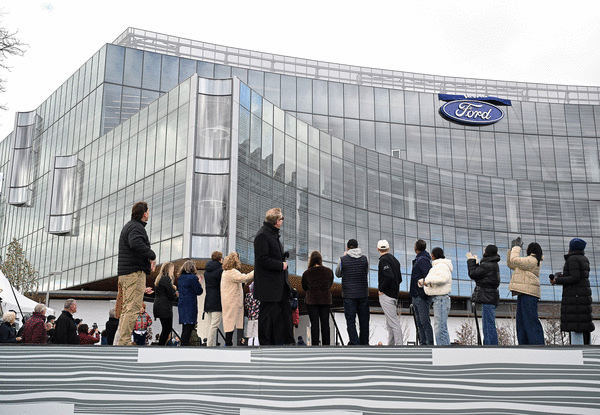
Ford Motor Co. raised its annual guidance by $500 million after it predicted it'll receive $1.3 billion from the U.S. federal government in tariff reimbursements, as it reported first-quarter results that beat Wall Street expectations.
The Dearborn automaker reflected the refund in its $2.5 billion net income in the first three months of 2026. It quadrupled results from a year ago that were hit by downtime at the company's largest manufacturing plant. A product mix of higher-margin trucks and SUVs, resilient pricing and higher software subscriptions also helped the results, according to the company.
Ford now expects adjusted operating income of $8.5 billion to $10.5 billion this year, reflecting the tariff benefits, but also absorbing a $1 billion increase in commodity costs. Aluminum prices, especially, are up from global shortages that are exacerbated by the Iran war, Chief Financial Officer Sherry House said. The outlook increase also underscores improvements in higher-margin sales of models such as off-road SUV variants and cancellation of lower-margin products like the Escape and the Focus in Europe
"The guidance raised isn't just the tariff benefit," she said on a conference call briefing with reporters. "The $500 million increase in guidance is attributed to the consistent performance in the underlying business."
The projection is up from the $8 billion to $10 billion Ford had projected in January, saying it would be fueled by rollbacks in emissions and fuel economy regulations easing sales of profit-heavy SUVs and trucks — though higher gas prices from the Iran war raise questions. The guidance doesn't include the potential impact of that or a downturn in the U.S. economy.
The impact of higher fuel prices is having some effect on consumers in southeast Asia and Australia that are more vulnerable to disruption in oil access from the Middle East, House said. That, however, hasn't become material for the international business, she noted, adding that the situation is different from years ago during fuel supply shocks because of access to more fuel-efficient powertrains like hybrids and EVs. She also emphasized the resilience of commercial customers because of their hauling and towing requirements.
Ford expects to receive back some of the net $2 billion in import taxes it paid last year because the U.S. Supreme Court in February struck down some of President Donald Trump's broad tariffs. The 25% duties on vehicles and automotive parts, however, remain in place.
The company predicts it will pay a net $1 billion in import duties this year, excluding costs related to importing aluminum as a replacement for a shortage of the metal in the United States spurred by fires in the fall at a major supplier. Net impact from tariffs year-over-year in the first quarter was roughly flat, House said.
General Motors Co. on Tuesday said it expects $500 million in tariff refunds after it paid about $3 billion in 2025. The company reported net income of $2.63 billion in the first quarter, a 5.7% decline, but increased its operating earnings guidance to $13.5 billion to $15.5 billion for 2026. Stellantis NV reports financial results on Thursday.
Ford in the first quarter recorded a $3.5 billion adjusted operating profit, an 8.1% margin on revenue of $40.7 billion, which was up 6% from a year ago. Operating profit rose two-and-a-half times, and margin was up from 1.2%.
Analysts were expecting revenue of $38.83 billion on average and earnings of 19 cents per share. Ford recorded adjusted earnings per share of 66 cents for the quarter.
"Today's results give Ford something it hasn't had in a while: momentum heading into the back half," Jesse Toprak, founder and CEO of OptiCar.ai, an artificial intelligence-equipped vehicle marketplace, said in a statement ahead of Ford posting its results. "The question now isn't whether 2026 is better than 2025. The question is whether Ford can prove this is a structural improvement and not just a tariff-relief bump."
Consensus on investment research platform Visible Alpha pointed to a sharp decline in the performance of the Model e electric vehicle division from lower volumes, widening its operating loss, with Ford leaning into its internal combustion engine Ford Blue and commercial vehicle Pro businesses.
First-quarter U.S. sales fell 8.8% amid shorter inventories of F-Series trucks from the fire-induced aluminum shortage, the discontinuation of the Escape crossover and lower electric vehicle sales after the end of a federal tax credit in September. Ford has increased production at its full-size truck plants and expects to make up 50,000 pickups lost from the fires at its supplier, Novelis Inc.
In the January-through-March quarter, Ford Blue, the Dearborn automaker's internal combustion engine and hybrid vehicle business, posted operating income of $1.942 million, nearly two times more than the period a year ago, and an 8.1% operating margin compared to 0.5% a year ago. In 2026, the automaker expects $4 billion to $4.5 billion in operating income as the company prioritizes production of Maverick hybrids, and V-8 Lariat and Raptor F-150 trucks.
Ford Pro reported $1.685 billion in operating income. That was up almost 30% year-over-year from strengths in trucks and SUVs, and an 11.4% operating margin compared to 8.6% a year ago. Ford predicts $6.5 billion to $7.5 billion in operating profit from the division this year.
And the loss posted by Ford Model e was $777 million compared to $849 million in the first quarter of 2025 on a nearly 35% improvement in first-generation EV losses. The company expects a $4 billion to $4.5 billion loss for the business this year, but wants profitability by 2029 following the launch of its next-generation electric vehicles starting in 2027 and its Ford Energy stationary energy storage business.
Ford also continues to address its cost structure, quality and warranty expenses after a record recall year in 2025. The company is on track for $1 billion in operating profit savings in 2026 from those measures.
Adjusted free cash flow was $1.9 billion, with the automaker predicting full-year results to be $5 billion to $6 billion. That doesn't include the tariff refund, given the uncertainty of when the company will receive that, House said. At the end of the quarter, Ford had $22 billion in cash and $43.1 billion in liquidity. The company is expecting capital expenditures of $9.5 billion to $10.5 billion, including around $1.5 billion to set up Ford Energy.
The company declared a second-quarter regular dividend of 15 cents per share on April 28. Ford's annual meeting will take place on May 14.
"The path to higher margins is clear, and Q1 shows those building blocks in action: steady cost improvements, strong execution across our profit pillars, growing recurring revenue from software and services and decisive action on EV performance," House said. "We're spending with discipline, protecting our financial strength and positioning Ford to deliver consistently higher returns."
©2026 www.detroitnews.com. Visit at detroitnews.com. Distributed by Tribune Content Agency, LLC.




Comments