Robotaxis could see 'public backlash' amid job loss fears, San Diego study says
Published in Automotive News
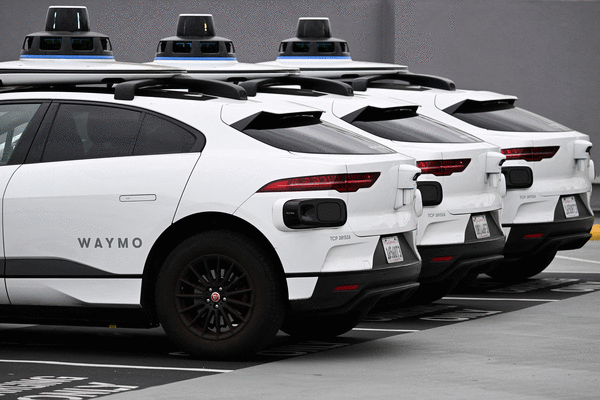
As San Diego awaits the state’s review of its anti-Waymo protest, a new study reveals widespread fear that robotaxis could cost jobs, exacerbate income inequality, and cause broader economic disruption.
“If we don’t address these fears in a forward-looking manner, we may end up in a situation where we see a public backlash against this technology,” said Behram Wali, assistant professor in the Department of Urban Studies and Planning at the UC San Diego School of Social Sciences. He conducted one of the first nationwide surveys that establishes a connection between autonomous vehicle adoption and concerns about job loss and economic security.
“I was not expecting the fears we ended up seeing,” he said.
The study analyzed responses from 4,631 U.S. adults in the Pew Research Center’s American Trends Panel, a nationally recruited survey.
About 85% of Americans believe widespread use of driverless cars would lead to job losses. More than 70% of respondents thought autonomous vehicles were a bad idea for society or said they were unsure about the technology.
Wali says studies like this can serve as evidence for decision-makers to begin a conversation they urgently need to have. “We need to look at the realities of people living alongside these machines.”
Today, Waymo vehicles are mapping local streets in preparation for a full San Diego deployment. The autonomous vehicles already operate in Los Angeles, San Francisco and Austin, Texas, among other cities.
Hoping to slow Waymo’s entrance into San Diego, the city’s transit board filed a protest to the California Public Utilities Commission, which oversees autonomous vehicle permits, to delegate some local control over operations.
“Autonomous vehicles don’t just change how people move. They literally replace people. That means lost jobs and lost income for families already struggling with the rising costs of housing, food and basic necessities in our region,” said San Diego City Councilmember Sean Elo-Rivera, who is also chair of the Taxi Advisory Committee of the Metropolitan Transit System. “The only winners are rich people. So I am fine saying wait a minute, you’ve got enough money. We’re going to figure out how this is going to work for us from a safety and worker perspective.”
Ride-hailing services like Uber and Lyft employ more than 800,000 Californians, not including taxi drivers.
The automation of some of those jobs is inevitable, Wali says, “but we have some lessons from history.”
In the past, waves of automation have prompted employment transitions and reskilling efforts.
“When computers first came in, of course, they had the potential to displace so much manual labor, and they did,” Wali said. “But humanity came up with innovative solutions to invest in sectors and provide education and training in areas that couldn’t be replaced by computers.”
The World Economic Forum estimates reskilling would cost an average of $24,000 per displaced worker.
The question of who would pick up that bill remains a question, Wali says, but the government should begin considering investments in reskilling workers for new occupations that can’t be automated.
“We need to train the next generation to think independently, to come up with creative ideas, rather than just replicating something that AI can do,” he said.
©2026 The San Diego Union-Tribune. Visit sandiegouniontribune.com. Distributed by Tribune Content Agency, LLC.







Comments