Tesla pushes back against California's regulators
Published in Automotive News
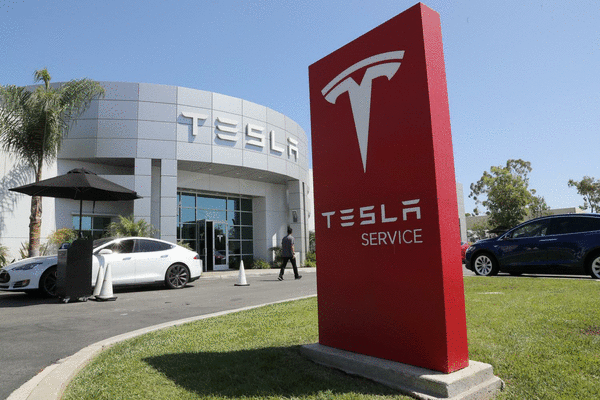
Tesla is pushing back against California bureaucrats, suing the state's Department of Motor Vehicles for accusing it of false advertising.
California regulators say Tesla has misled consumers about the capabilities of its "Autopilot" and "Full Self-Driving" modes, which cannot be used without an alert human driver. Late last year, an administrative judge found Tesla guilty of false advertising for suggesting its cars can drive themselves.
The DMV said it would suspend Tesla sales in California for one month if the company did not correct its false advertising within 90 days. In response, Tesla stopped using the term "Autopilot" in its marketing materials and added the term "supervised" to describe its Full Self-Driving mode.
In a case filed this month, Tesla is fighting back, claiming that the original ruling was "factually wrong" and "legally flawed," according to a court filing.
The company is seeking to reverse the DMV's order and regain the right to use the terms "Autopilot" and "Full Self-Driving capability."
According to Tesla's marketing materials for Autopilot and Full Self-Drive mode, "the system is designed to be able to conduct short and long-distance trips with no action required by the person in the driver's seat."
The DMV argued this messaging led to a dangerous over-reliance on the technology. Tesla, however, said its customers were made aware of the limitations of the features.
"It was impossible to buy a Tesla equipped with either Autopilot or Full Self-Driving Capability, or to use any of their associated features, without seeing clear and repeated statements that they do not make the vehicle autonomous," the company wrote in a Feb. 13 court filing.
The back and forth between Tesla and state regulators comes as Elon Musk bets the future of his company on autonomous technology and artificial intelligence. His electric vehicle sales have stumbled amid a reputation crisis and declining federal support.
Tesla's robotaxis rolled out in Austin, Texas, last summer, where witnesses said the vehicles glitched and made dangerous driving decisions. Musk is competing with Waymo, the Alphabet-owned ride-hailing service that operates fully driverless taxis in 10 cities, as well as Zoox, an Amazon-backed robotaxi effort.
Tesla did not respond to a request for comment.
Its shares closed at $417.33 on Wednesday, up nearly 2% for the day. Shares have risen 37% over the past year.
©2026 Los Angeles Times. Visit at latimes.com. Distributed by Tribune Content Agency, LLC.

Comments