Ford predicts improved 2026 after hits to 2025 earnings
Published in Automotive News
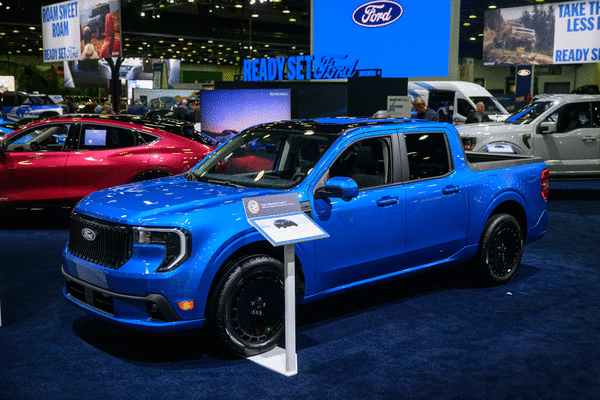
Ford Motor Co. is predicting a stronger 2026 after the automaker posted a net loss of $8.2 billion last year from special charges related to redeploying assets for its electric vehicle business.
Without those, the Dearborn automaker's adjusted operating profit was $6.8 billion. The company expects adjusted operating income of $8 billion to $10 billion this year and flat U.S. sales overall for the industry. Rollback of fuel-economy standards is expected to drive sales of profitable trucks and SUVs and fewer money-losing EVs in the United States.
An aluminum supplier is also in the process of returning to full operation after multiple fires that affected Ford's production of profit-heavy trucks. Operating profit was down by a third from 2024 and came in just below the roughly $7 billion the company had forecasted in a December update after the Trump administration clarified a later-than-expected effective date for tariff relief. Economic conditions are also challenging affordability for some buyers.
"Despite notable external pressures, including significant tariffs, supply chain disruption from the Novelis fires and a dynamic global regulatory environment," Ford Chief Financial Officer Sherry House said during an earnings briefing. "Ford successfully managed through it and improved execution, strengthened its industrial foundation and advanced the Ford+ strategy."
This comes as U.S. autoworker profit-sharing payouts fell to approximately $6,780, down from $10,208 in 2024.
Forecasters have said U.S. sales volumes could dip over affordability challenges and fewer electric vehicle sales following the end of the federal plug-in tax credit. Despite Ford's gains in U.S. market share last year, the end of the Ford Escape crossover and limited product launches position the Blue Oval for declines in 2026, according to analysts. January sales dropped 5.3% year-over-year. Ford's sales director has emphasized incentives, early consumer communication and prioritizing orders to mitigate sales impact.
Annual revenue for 2025 totaled a record $187.3 billion, up 1%, including $45.9 billion in the fourth quarter, which was down 5%. That beat average analyst expectations, according to Yahoo Finance, though adjusted earnings per share fell short. Ford on that metric was down. It posted $1.09 for 2025 compared with an average forecast of $1.13, and 13 cents for the final three months of the year compared with expectations of 19 cents.
"This was about what was expected given the challenges Ford is navigating," said Daniel Ives, an analyst at Wedbush Securities, in a statement. "There is hope Ford is turning the corner, and 2026 is a key year for (CEO Jim) Farley to prove the naysayers wrong. This is a small step in the right direction with a lot of wood to chop."
Shares on the New York Stock Exchange were increasing 1.3% in after-market trading to $13.76 following publication of the results.
For the October-to-December quarter, Ford's net loss was $11.1 billion and adjusted operating income was $1 billion, down 52%. A majority of the $19.5 billion in EV-related special charges fell in the fourth quarter. They covered product cancellations of a next-generation electric full-size pickup truck and commercial van, dissolution of its joint venture with South Korean battery partner SK On Ltd., and retooling of the joint venture's Kentucky battery park into a fully owned subsidiary of Ford for stationary energy storage systems.
Import tariffs cost the automaker a net $2 billion last year, more than the $1 billion House in October had forecasted after the Trump administration clarified changes to offer tariff relief for U.S. manufacturers would take effect Nov. 1, not May 1. Had that been the case, adjusted operating profit would've been $7.7 billion, House said. Although Ford builds more vehicles in the United States than any other automaker — 80% of the vehicles it sells here are assembled here — it faces duties on parts to build its trucks and SUVs.
Ford also absorbed $2 billion in costs from the aluminum shortage created by multiple fires at Novelis' facility in Oswego, New York, that impacted the hot mill there. For more than a decade, aluminum has made up the bodies of the Blue Oval's popular F-150s. Operations have resumed, and Ford vehicle retail sales aren't expected to be affected, but the hot mill isn't running at full capacity, which means Ford will source some aluminum globally through Novelis and other suppliers until production is fully up sometime between May and September. Those costs are expected to be about the same amount as the savings from President Donald Trump's tariff offset provision.
"Ultimately, you're going to see about a flat year-over-year change for tariffs," House said. "In 2026, we'll have a net tariff impact of about $2 billion again, but that wouldn't carry forward into '27 once the aluminum issue with Novelis is resolved and the hot mill is back up and running."
Ford is looking to make up for lost production at the end of 2025 by adding a third shift at Dearborn Truck Plant and increasing production at its Kentucky Truck Plant. That should contribute to operating profit by $2.5 billion with a net impact of $500 million to $1 billion range because of increased costs from that production, House said.
Ford's annual adjusted operating profit margin was 3.6% compared to 5.5% a year ago. The company is tracking for an 8% margin by 2029, Farley said in a statement.
Ford's hybrid and internal combustion engine business made $3.024 billion last year in operating profit, down 43%, and $727 million in the fourth quarter, down 54%. Annual operating profit margin fell to 3% from 5.2%. For 2026, Ford expects $4 billion to $4.5 billion in operating income.
The Model e division had an operating loss of $4.806 billion in 2025, an improvement from 2024's $5.105 billion, from higher sales of more profitable EVs in Europe. The loss attributable to the fourth quarter was $1.218 billion. The company is predicting a $4 billion to $4.5 billion loss for the business this year, but is expecting profitability by 2029.
The Ford Pro commercial unit's operating income last year was $6.843 billion, and $1.231 billion in the final three months, both down by almost a quarter. Annual operating profit margin fell to 10.3% from 13.5%. The company expects $6.5 billion to $7.5 billion in operating profit from the division this year.
Ford Credit delivered full-year earnings before taxes of $2.6 billion, a 55% increase for the year. It's expecting $2.5 billion in 2026. Ford expects $9.5 billion to $10.5 billion in capital expenditures this year and adjusted free cash flow of $5 billion to $6 billion.
Quality problems also plagued Ford last year. The Blue Oval issued more recalls than any other automaker, totaling 153. It's also leading in 2026 with seven so far. The automaker cut $1.5 billion in costs last year, excluding tariffs, beating its $1 billion goal. Warranty costs fell by about half a billion dollars, House said.
"Last year, our three months in service, quality performance improved significantly across our plants and supply chains," she said. "We had zero production losses during launch due to defects, and our industrial progress coincides with aggressive modernization."
Ford has said it'll pay a regular quarterly 15-cent dividend on March 2 to shareholders of record on Friday. No special dividend was announced for the year. The company will report first-quarter financial results on April 28.
At the end of January, General Motors Co., which had its own EV-related write-offs, said it pulled in a net income of $2.7 billion last year and posted $12.7 billion in adjusted pre-tax earnings. Chrysler and Jeep parent Stellantis NV will report 2025 financial results on Feb. 26.
©2026 www.detroitnews.com. Visit at detroitnews.com. Distributed by Tribune Content Agency, LLC.






Comments