San Diego Islamic Center suspects were self-radicalized, left manifesto behind, officials say
Published in Religious News
SAN DIEGO — The two gunmen who opened fire at a San Diego mosque on Monday, killing three people, had met online, where they were radicalized and left behind a hate-filled manifesto, authorities revealed Tuesday.
According to a witness, the pair were “fully armored” and rushed toward the entrance with handguns and rifles before a security guard shot at and struck one of them.
Now, authorities are investigating if the attack was livestreamed after receiving reports that their self-inflicted demise was shown online.
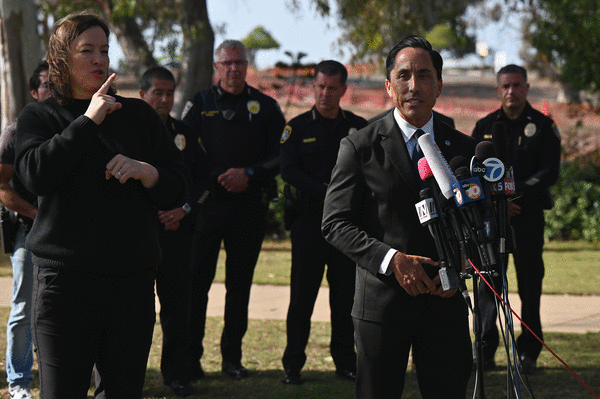
At a news conference Tuesday afternoon, authorities revealed more details they had learned about Monday’s violent attack on the Islamic Center of San Diego by two teenagers, who were then found dead by police in a vehicle some distance away.
The two suspects met and were radicalized online, said Mark Remily, FBI special agent in charge of the San Diego office. They left behind a manifesto, as well as other writings “outlining religious and racial beliefs about how the world they envision should look like.”
But officials didn’t provide any details about the writings or ideology, adding that they were still going through electronic devices and examining the teens’ online presence to determine how they were radicalized.
“These suspects did not discriminate on who they hated,” Remliy said.
San Diego police Chief Scott Wahl said the actions of the security guard, as well as the two other victims who were killed in the parking lot of the center, distracted and delayed the two suspects, who scoured the mosque only to find empty rooms.
During the gunfight, Wahl said, the security guard had called out on his walkie talkie for the school to be locked down, giving teachers, workers and more than 140 kids inside a chance to seek shelter.
“I had no idea how heroic those actions were,” Wahl said Tuesday, noting that officials had viewed security footage of the attack. “You can see the security guard reach for his radio and put out the lockdown protocol. The security guard then continued to engage in a gunbattle with these two suspects.”
In the exchange of gunfire, one of the gunmen who was shot by the security guard appeared unfazed, and continued to charge toward the mosque, a witness and member of the mosque said in an Instagram post.
“He heroically shot one of the victims, but they were fully armored so it did little to stop them,” said the man, identified by mosque Imam Taha Hassane as “Brother Os.”
In the video, the man identified as Brother Os described how the gunmen rushed toward the mosque “as soon as they parked their car.”
That’s when they exchanged gunfire with the security guard and sent the two other victims scrambling in the parking lot.
At one point, Wahl said, the suspects came within 15 feet of children at the center but, seeing nobody, instead went into the parking lot to attack the two other victims.
In the parking lot, the two victims were taking cover behind vehicles, calling police when they were chased and killed by the gunmen.
“All three of our victims did not die in vain,” Wahl said. “Without distracting the attention, without delaying the actions of these two individuals, without a question there would have been many more fatalities yesterday.”
On Tuesday, the entrance of the Islamic Center of San Diego was blocked with police tape, and a man stood outside the black iron gate, cradling his head in his hands while he wept.
The security guard to the building, one of the victims in the shooting, was his friend.
“He was a good man,” the man screamed toward the entrance but at no one in particular. He declined to provide his name.
An early focus has been on one of the assailants, a San Diego high school student whose mother reported that he was suicidal and potentially armed soon before the shooting occurred.
The student, 17, and a second person, 18, opened fire at the center Monday morning around 11:30 a.m., authorities said. They were found minutes later at a location not far from the center, dead of self-inflicted gunshot wounds, according to authorities.
One of the guns had hate speech written on it, law enforcement sources told the Los Angeles Times, and anti-Islamic writings were found in a vehicle.
“At least one of the suspects took a firearm from their parents’ home” and left a suicide note, “writing about racial pride,” sources said.
“In terms of how the radicalization occurred we’re still digging into all of that,” Remily said.
Law enforcement officials said they were conducting extensive interviews of the suspects’ family, friends and acquaintances. Federal officials also executed three search warrants, which resulted in the discovery of more than 30 firearms and a crossbow at two of the locations, Remily said.
Officials seized several pistols, rifles, shotguns, ammunition, tactical gear, as well as electronics, he said.
But the weapons were not registered to the two gunmen, Wahl said, but to one of their parents. He said investigators were looking into how the weapons were obtained.
According to law enforcement sources, the FBI is investigating a livestream feed of the attack or the aftermath from inside the BMW that captures the teens in combat outfits that include Nazi symbols with guns visible.
When asked about the livestream, Wahl declined to provide details and said “we are actively going through their electronics."
Monday afternoon, FBI agents were searching the suspect’s home on Lehrer Drive, according to law enforcement sources. The house is around two miles from the Islamic Center, which is in the Clairemont Mesa neighborhood.
The suspect was enrolled in a virtual learning academy at the San Diego Unified School District and was on track to graduate high school this semester, according to district spokesperson James Canning.
He previously participated in wrestling at Madison High School but did not take part in any on-campus activities this school year, said Canning.
“It’s important for people to understand this person wasn’t there on Friday and then all of a sudden Monday this is the situation,” Canning said. “They were in their virtual classroom.”
Although authorities have not named the first suspect, three sources identified him as Cain Clark. Two law enforcement sources identified the second suspect as Caleb Vazquez.
Wahl said Monday that his department got a call from the suspect’s mother about a “runaway juvenile.” He said the mother said guns were missing and that her son left with a companion wearing camouflage outfits.
Police were interviewing her when the first calls of the active shooter came in, he said.
Wahl did not specify the threats connected to the suspects.
“There was no specific threat, especially no specific threat to the Islamic Center. It was just general hate kind of speech that I think covered a wide gamut,” Wahl said. “Again, we are still actively investigating this as we speak, but it was more generalized.”
Authorities said that, when they arrived at the center at about 11:45 a.m., they found three adults dead in front of the building. Police then received additional calls about gunfire several blocks away. A landscaper was shot at but not injured in the 7100 block of Salerno Street. Minutes later, police also responded to the 3800 block of Salerno Street where, inside, officers found the two suspects dead. Little is known about the second suspect.
Clark attended an elementary and a middle school in person at the district, but following the pandemic his family enrolled him in online schooling full time, Canning said.
During the shooting, five of the district’s schools close to the Islamic Center were placed on lockdown. San Diego Unified Superintendent Fabi Bagula said in a statement Monday that “hate has no place in our community or schools” and that “every student family and community member deserves to feel safe, valued and able to worship and gather without fear.”
The district is making counselors available to all students and families affected by the tragedy.
Officials have not spoken of a specific motive, but San Diego Mayor Todd Gloria said: “Hate has no home in San Diego. Islamophobia has no home in San Diego. An attack on any one of our communities — on any San Diegan because of who they are, what they believe, or how they pray — is an attack on all of us.”
©2026 Los Angeles Times. Visit at latimes.com. Distributed by Tribune Content Agency, LLC.




Comments