Most drastic reduction of Catholic parishes ever seen in Minnesota is underway
Published in Religious News
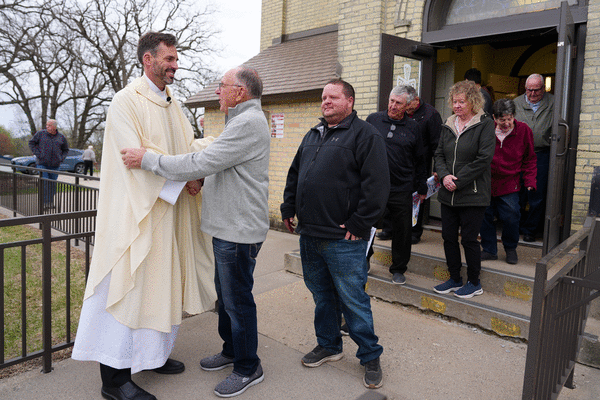
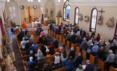
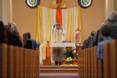
ST. CLOUD, Minn. – Growing up on a farm in Pearl Lake, John Wicker went to Holy Cross Catholic Church every Sunday.
He attended the church’s parochial school, played softball on the parish’s ballfield and still raises money for the annual fall fish fry. And he’s already purchased his plot in the parish cemetery.
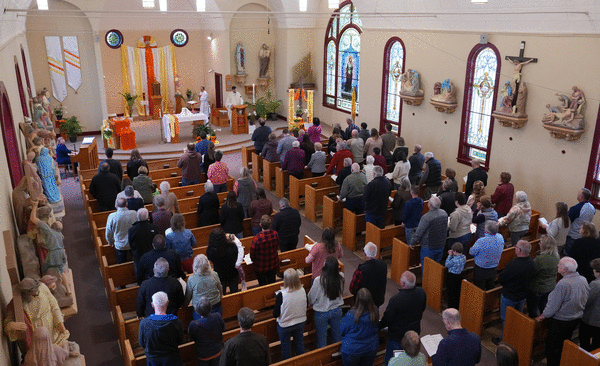
But now that church — built by his ancestors and their neighbors 130 years ago — is one of nearly three dozen in central Minnesota that is slated to close as part of the most drastic reduction of Catholic parishes ever seen in Minnesota: merging 131 parishes down to 48.
“It’s going to split up the community,” said Wicker, a trustee at the church about 20 miles southwest of St. Cloud. “What’s going to hurt the most is losing those connections over time.”
The St. Cloud Diocese, which stretches across 16 counties in central Minnesota, is planning the closures in response to steady declines in both the number of priests and parishioners, as well as trends of people becoming less religious, though there has been an uptick in devotion among young men in recent years.
The mergers will affect most of the 110,000 worshippers in the diocese stretching from the South Dakota border to Elk River, even some whose churches won’t be shuttered.
“Right now, all of our 131 parishes have Mass every weekend,” said Brenda Kresky, director of pastoral planning for the St. Cloud Diocese. “We’re reducing that by [about] a third and saying, even if you remain open, you won’t have Mass on the weekend.”
Bishop Patrick Neary plans to begin issuing merger decrees in the next few weeks. Though the order is coming from the diocese, the plans are based on proposals submitted within the last year by more than two dozen regional committees made up of priests and parishioners. That doesn’t mean everyone is happy.
“This is just devastating for us,” said Carly Serbus, a member of St. Anne’s in Kimball, another church that’s likely on the chopping block. “It’s ripping the heart out of our community.”
Smaller families, fewer religious
Stearns County has the most Catholic churches per capita in the state with 47, outnumbering townships by 13.
“Many of our churches are four miles apart, five miles apart,” Kresky said, noting a common local expression is that you can throw a rock and hit a church.
Many Catholic churches in central Minnesota were built over a century ago by immigrants, often German or Polish, to bolster their new communities.
But as generations passed, families have gotten smaller and people have moved away for opportunities in larger cities. In Minnesota, about 28% of adults identified as Catholic in 2007. Only 18% did in 2024, according to the Pew Research Center. Meanwhile, the percentage of people not affiliated with a religion more than doubled from 13% to 29% in that period.
Dioceses around the state and region have downsized over the past 15 years. Beginning in 2010, the Archdiocese of St. Paul and Minneapolis started merging parishes, going from 213 to 192. Around the same time, the Duluth Diocese winnowed about 92 parishes down to 70. And within the last decade, the New Ulm Diocese either merged or closed a handful of parishes.
After the mergers, Duluth and New Ulm have about one priest for every two parishes. In St. Cloud, there’s one priest for every three parishes.
“Everybody’s done something — and we didn’t," Kresky said. “What we are looking at now is how do we best serve our people right now with the resources that we have?”
Kresky attributes the delay in downsizing to a bishop who was ill for the last part of his tenure and another bishop whose priorities were guiding the diocese through the sex abuse scandal and bankruptcy.
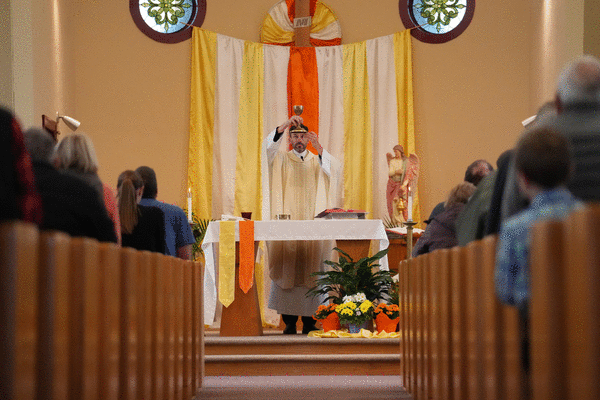
She said the discrepancy between priests and parishes is taking its toll on priests, who are tasked with leading services at three or four parishes each weekend, while churches are often less than half full at each Mass.
Fewer priests
The steep decline in priests is being seen across the globe, where the number of seminarians fell by about 12% between 2011 and 2023.
The paradox is that it comes at a time when more American men, particularly young Republicans, are becoming religious. A Gallup poll released this month shows 42% of men in the U.S. ages 18-29 said religion is very important to them, up from just 28% three years ago.
Jacob Hornecker, who teaches theology at the University of St. Thomas, attributes the decline in priests to cultural changes around the importance of faith and the growing demands on priests as they take on more parishes.
Hornecker, who grew up in Minnesota, spent two years in Rome training to become a priest but left after seeing the increasing demands on priests, which include holding marriage classes, overseeing church finances and being on call for emergencies in the parish — in addition to the weekend Mass schedule. Hornecker, 29, thinks his personal experience is similar to many considering the priesthood.
“I love the mission. I wanted to stick with it,” he said. “And, it turns out, in education, I get to talk about God just as much, if not more, than a priest.”
While some attribute the increase in people identifying as religious to the rise in Trump-era politics and Christian Nationalism, Hornecker said he hasn’t seen evidence of that in real life, only on social media. But he has seen people returning to religion because they are seeking community, seeking answers or seeking the ritual of a traditional Mass.
“People miss having something tangible in their relationship with God,” he said. “It’s a way to touch grass in spiritual life, for a lack of a better way to put it.”
Fighting to be spared
The mergers in Central Minnesota parishes don’t necessarily mean churches will be sold or torn down. Those decisions will come after plans are finalized in the coming months.
For many parishioners, the uncertainty is unsettling. Holdingford resident Diane Welle, 70, spent four decades going to Our Lady of Mount Carmel Church in Opole, about 20 miles northwest of St. Cloud. Welle said she worries the church will be razed. But even if the building is repurposed, she’s concerned about what will happen to the stained glass and artifacts.
“I don’t know what they’re going to do and it just kills me,” she said.
Wicker is now helping set up a preservation commission to buy the baseball diamonds that are currently owned by the diocese and raise enough money to keep the Pearl Lake church open as a sacred space for special occasions, even if Mass isn’t held there weekly.
“We do understand the reality of the priest shortage,” Wicker said. “But the nucleus of a lot of these small towns is the Catholic church. It’s been that way for generations.”
Some members of nearby St. Anne’s have said they plan to petition the bishop if their church is on the closure list. The bishop would then have about a month to consider the petition and make a determination, and if the parishioners are still unhappy, they can take the fight to Rome. Though rare, a Duluth church reopened in 2021 after being shuttered for two years after a successful Vatican appeal.
“I’m not going to go down without a fight,” Serbus said. “Whatever the decision is that is made, at least I will know that I gave it everything I had to fight to keep it open for my future generations.”
Kresky said she and the bishop acknowledge the angst and sorrow caused by closing churches. But she thinks, after the mergers, people will find the larger congregations will lead to a stronger sense of community.
“We are resurrection people,” Kresky said. “You have to go through Good Friday to get to the resurrection. You don’t get to skip Good Friday.”
©2026 The Minnesota Star Tribune. Visit at startribune.com. Distributed by Tribune Content Agency, LLC.




Comments