Florida bill opens door for armed volunteers to secure houses of worship
Published in Religious News
MIAMI — Armed volunteers would be permitted to provide security services at houses of worship without having to obtain licenses that normally apply to professional security officers under proposed legislation that is advancing in the Florida Legislature. The bill passed unanimously through a Senate committee on Tuesday.
The bill, which has similar versions in the House and in the Senate, would exempt volunteers who provide armed security services at churches, synagogues, mosques and other houses of worship from the required Class D and G licenses held by professional security services.
Proponents of the bill argue that since shootings have become commonplace at religious institutions across the country, all houses of worship should be able to provide security for their congregants.
“Some houses of worship can’t afford to hire outside security services, and they’re now beginning to use volunteers,” Sen. Don Gaetz (R-Niceville) said as he introduced the bill during a Senate Rules Committee meeting on Tuesday. But without the proper licensing, this exposes houses of worship who use volunteer armed security to a world of liability.
Under current law, a licensed gun owner can carry concealed firearms on religious property as long as the house of worship allows it.
If passed, the bill would amend Florida’s statute that regulates private investigative services, private security services, and repossession services, essentially opening the door for unpaid volunteers to protect religious institutions with their own firearms if they hold a valid license to carry a concealed weapon or concealed firearm.
The bill specifies that the armed volunteers would be able to provide services on any property owned or leased by a religious institution, including property used for education.
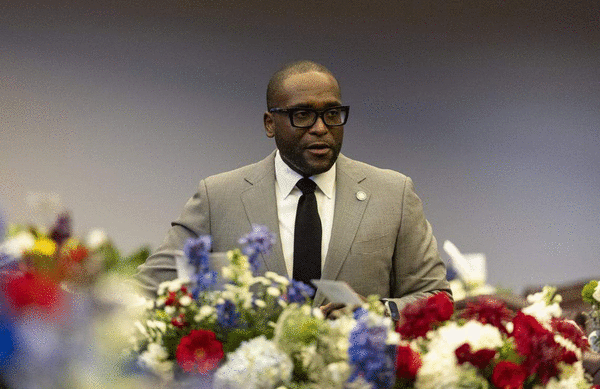
“People just want to be able to go to church and feel protected while they go to church,” said Sen. Shevrin Jones, D-Miami Gardens, at Tuesday’s meeting. “This just clarifies and makes churches feel much safer ... as they allow these volunteers to concealed carry within the church, that they are fully protected under the law.”
The bill is backed by gun rights groups including Florida Carry Inc., National Rifle Association and the Gun Owners of America, Inc., and has also been supported by some faith leaders who spoke at the Capitol during the bill’s recent committee hearings.
The Florida Conference of Catholic Bishops appeared as a lobbyist of the House version of the bill, but a representative said the group hasn’t yet taken a position on the bill when the Miami Herald reached out for comment.
Pastors concerns
As the bill was debated this week and last, some faith leaders expressed concern that the bill could override a religious institution’s ability to make their own decisions about firearms and security.
Erika Rembert Smith, a pastor at Washington Shores Presbyterian Church in Orlando, said she is concerned about overreach.
“We’ve taken measures in my congregation to address the safety of those who enter our sanctuary and wouldn’t want a bill to override our ability to decide for ourselves,” Smith said at the Senate Rules Committee meeting on Tuesday.
She said the bill causes concerns — which were echoed by many others in her congregation — about how the bill would affect a church’s overall safety. She said houses of worship should be “places of peace” where people can gather without “concern or fear of encountering someone with a weapon” that may be used against them intentionally or unintentionally.
But Joshua Burdick, a pastor of Campus Church in Pensacola, said his church already has a group of armed volunteers that help protect the congregation. The volunteers operate under what Burdick calls a “gray area” of the current Florida statute, which this new bill will address.
“I’m grateful for their commitment to keeping our church safe. Yet I am deeply concerned,” he said. He told the committee that he had spoken with many faith leaders who were supportive of the measure.
Funding and training
The bill comes at a time when President Donald Trump’s Department of Homeland Security created stricter terms for security grants that benefit houses of worship, requiring beneficiaries to cooperate with federal immigration enforcement and prohibiting them from engaging in programs that “advance or promote” diversity, equity, and inclusion.
Many houses of worship relied on the Nonprofit Security Grant Program to fund things like security cameras, reinforced doors, bulletproof glass, safety training and security guards. The lion’s share of the program went to synagogues across the county, according to reporting from Jewish Currents magazine.
Sen. Rosalind Osgood, D-Fort Lauderdale, a co-sponsor of the bill, said that the bill may also allow some churches — such as her own church in Fort Lauderdale— to re-direct funding from their current security budget towards other initiatives, like serving the youth ministries. The new law stands to benefit smaller houses of worship with fewer resources.
But other legislators were concerned about the prospect of having armed guards with no training acting as a security guard.
At a House Criminal Justice Subcommittee hearing on Jan. 28, Rep. Dianne Hart-Lowman, D-Hillsborough, said she would feel “so much better if you would add that they were required to at least take a training.”
Others said the measure was necessary to have a first line of defense in remote areas.
Reggie Bartkowski, the chief of safety and security at Pensacola Christian College, said the armed volunteers are not there to “replace police” but are there to “buy time” until law enforcement arrives on the scene.
“Churches in rural areas may not get law enforcement response for up to 30 minutes. We know every second counts in an active shooter situation,” said Bartkowski.
The bill will be discussed again at the Industries & Professional Activities Subcommittee meeting Thursday.
©2026 Miami Herald. Visit at miamiherald.com. Distributed by Tribune Content Agency, LLC.




Comments