Muslim-run food pantry helps neighbors but faces halal meat shortage during Ramadan
Published in Religious News
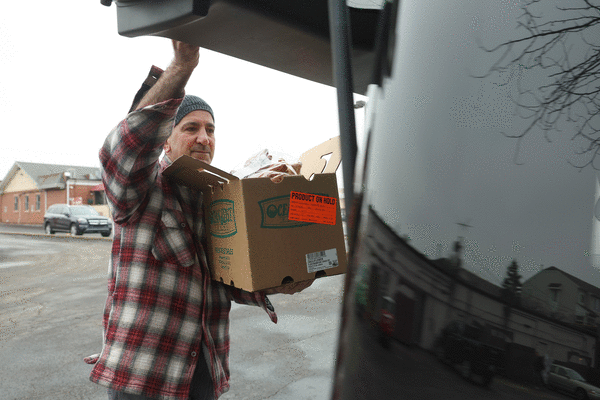
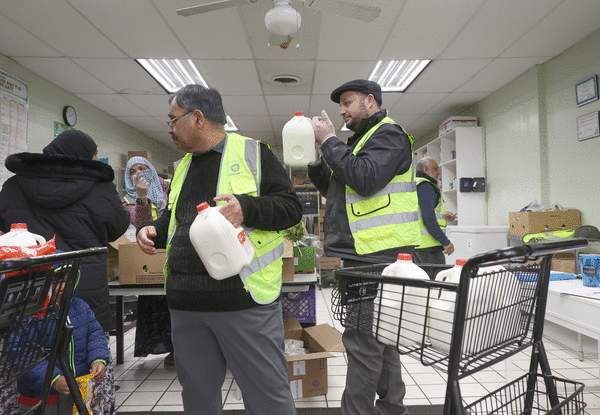
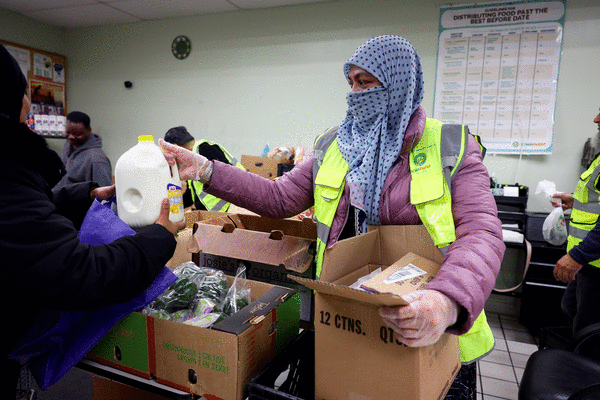


CHICAGO -- Before the doors swung open at the ICNA Relief Food Pantry in suburban Glendale Heights on a recent Thursday, volunteers in lime-yellow hi-vis vests were putting out large boxes of vegetables and fruit and trays of breads, buns and a few smatterings of cookies from a nearby bakery. Families were lining up, ready to come inside two or three at a time to prevent a traffic jam. The demand has been increasingly high lately, volunteers said, as they looked down at what they had to offer, hoping it would be enough.
That afternoon, Reem Almourad dug through the boxes of fresh produce. Most of the bananas were on the cusp of blotchy and overripe, the green bell peppers had gone slightly soft. The romaine lettuce was OK, but the small cartons of grape tomatoes were bright and plump. She took two.
Almourad, a Syrian mother of five who lives near the far western suburb, said it’s a struggle sometimes to stretch what she procures on weekly food pantry trips. It was her second visit that week, and she was hoping this time to grab dates, which Muslims traditionally eat at iftar to break their fasts during Ramadan. The fruit tends to be pricey, and even smaller boxes can run up to $6 at the grocery store, she said.
When she stressed that she hadn’t been able to buy dates all of Ramadan and missed an ICNA Relief Ramadan food box giveaway, pantry assistant manager Ibrahim Ali Shamseldin went to the back and returned with two boxes of medjool dates, one for Almourad and another for her friend, Najwa Hechmi.
Both women leapt in joy.
ICNA Relief Chicago, the faith-based organization, sees staggering numbers of families in need of food aid throughout the year, but Ramadan often brings new challenges. The pantry’s usual hum of serving about 400 families a week on Tuesdays, Thursdays and Saturdays was kicked into even higher gear to make sure Muslim families have what they need to start and break their days-long fast — embodying the quieter side of Ramadan service.
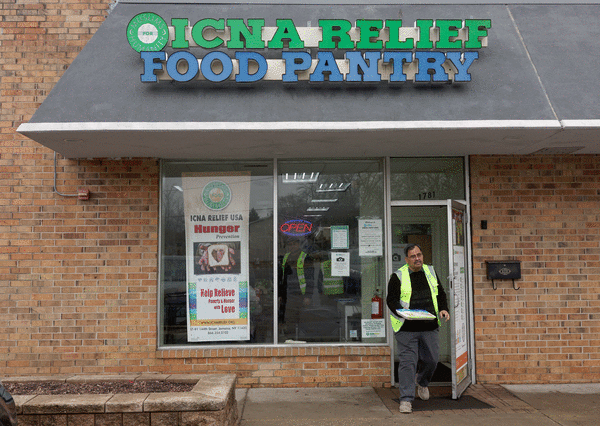
“Our duty is to make sure that we serve the community, there is a big emphasis on giving in Islam,” said Shamseldin, who is one of two staff members at the ICNA Relief pantry on Bloomingdale Road. The four other people working were volunteers.
Almourad, who resettled in Glendale Heights after arriving from Syria five years ago, said she tries to stop by other local pantries as well, but had hoped ICNA Relief would provide most of the Ramadan essentials so she could limit her family’s spending. Almourad’s husband recently suffered a heart attack and hasn’t been able to return to his job. She has to stay home to care for her children, all below the age of 10.
“I cannot work, we have no income right now… whatever we get I use for my children and for our (basic needs),” she said.
Over the course of the afternoon, the rows of canned mushroom soup, tomato sauce, peanut butter and boxes of macaroni and cheese went largely untouched. Hechmi, Almourad’s friend, noted that the pantry never runs out of these items. It’s expensive items like halal chicken and beef that families need help with, Hechmi said.
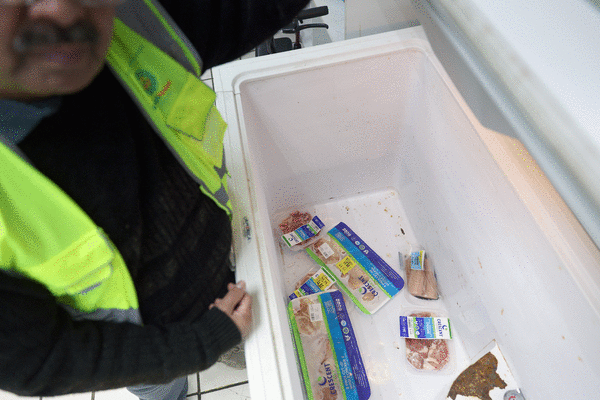
But that day, volunteers were having to reach deep into the bottom of the freezer to pull out packets of halal meat.
Almourad was also hoping to grab another helping, since the two-pound tray of Crescent brand halal chicken she took home Tuesday didn’t last more than one full family meal.
“I have kids, they need more, but I cannot afford to buy it so I come here,” Almourad said. “I asked them today if I could have another, but they said no… there isn’t enough.”
Halal meat runs out constantly, volunteers at the pantry said, because it is more expensive and restocked mainly through community donations. Sometimes, the pantry uses monetary funds to replenish supply, but the demand — both from Muslims and non-Muslims — often surpasses what’s available.
“It’s an interesting challenge because even our non-Muslim neighbors also prefer halal meat because they feel like it’s cleaner, it’s fresher — it’s just better quality and we like to give it if we can,” said Asma Jarad, content strategist for ICNA Relief Chicago, which has a community resource center down the street from the food pantry. “But when supplies are limited, we have to limit halal for Muslim clientele.”
On distribution days, the Glendale Heights pantry serves about 50 people from noon to 4 p.m. By 2 p.m. on one Thursday, only 12 trays of Crescent Foods chicken were left. The brand is certified halal and its products are individually hand-slaughtered by Muslims according to strict Islamic guidelines that emphasize humane animal treatment.
The pantry — one of two ICNA Relief pantries in Chicagoland — is located next to Masjid Ibrahim. Because of its proximity to the mosque, many don’t realize that 50% of the pantry’s clientele is non-Muslim.
“Especially here in Glendale Heights, it’s very, very diverse. You have Black, brown, Asian, Arab and people of all religious backgrounds,” Jarad said. “Yes, we’re Islamic-based, but our doors are open to anyone in need.”
Jarad said that except for non-halal meat offered to non-Muslim clients, the staff tries to make the pantry’s shelves 100% halal.
“A lot of our clients are refugees, they have limited English capacity. So if you’re giving them a can of food, and they can’t read it, they’re not going to know if it has ham or pork,” Jarad added.
During distribution days, the pantry is typically staffed by a group of four volunteers who help dig through boxes to find the least-bruised apple or check to ensure none of the eggs in a carton are cracked.
While filing some paperwork at his front desk, Shamseldin quietly got up to replace a yellow-bottled low-fat milk a volunteer placed in an elderly Asian woman’s cart with a Kirkland whole milk. She didn’t even notice.
“People usually want the red milk, even if they don’t want to ask for it,” he said.
Fareed Uddin, manager of the food pantry in Glendale Heights, said there’s been an added tension lately of wanting to fulfill the requests of those in need, but having to limit some items so there’s enough to go around.
“You see, as long as we are receiving more food, we can give them extra items — we don’t have any problem giving them what they need, but we are not receiving enough,” Uddin said. “Hum bhi kya karsakthe?”
What can we do, he added, in Urdu.
“Otherwise some families won’t get to have any halal meat for this week, that’s why we try to limit… but it’s not easy,” he said. “We wish we could give everyone more, but sometimes it’s not possible until we get more donations.”
Uddin said there are challenges to operating a food pantry at a high volume, but none more dispiriting than having to say no.
The back of the building, not accessible to clients, is essentially the pantry’s pantry. Uddin pointed to loaves of extra bread, a few boxes of tea, large sacks of flour, bottles of oil and packets of yellow lentils.
“The big bags of flour we try to save for our Afghani families when they come. They have eight, nine children, really big families,” Uddin said, noting that he’s gotten to know who needs what over the years, having worked at the pantry since 2017. “The basmati rice, usually our Indian families or Asian families ask for that, so we will save it for them if we can.”
Recently, the Northern Illinois Food Bank asked the pantry to collect demographic information. That data helps the pantry receive enough food from the food bank, which gets most of its produce donations from grocery stores and farmers.
The day before Ramadan began, ICNA Relief hosted its annual Ramadan Food Box giveaway, where families came for $75 worth of items like dates, lentils, flour, oil, vermicelli and other essentials commonly used during the holy month. They gave away 400 boxes at the organization’s West Ridge pantry.
“We were done with the 400 boxes within two hours and people were still coming. I’ve been part of this for the past few years — this has never happened where we run out completely before the time is done, there were at least 30 families coming up and saying, ‘we didn’t get a box,’” Jarad said. “And it’s really sad to see because they might have seen it on social media, maybe a live video. And because it was open distribution, any family could come.”
The organization hosted two more drops after seeing the interest. To celebrate Eid, marking the end of Ramadan, ICNA Relief is distributing about 400 toys at its West Ridge office and pantry on Saturday.
Outside of Ramadan, ICNA Relief has a food box program where qualifying community members can redeem a box of essential pantry items every month. Jarad said they do vet people’s low-income status for the monthly box since the supply is limited.
Jarad said any food pantry is meant to be a supplemental source of food, but it’s not always how the community perceives it. To make matters worse, ICNA Relief was hit with federal funding cuts, and its usual roster of SNAP recipients now need more food aid with those benefits beholden to new federal work requirements.
Plus, increased immigration enforcement over the last several months have only deepened community troubles around food insecurity, Jarad said.
“But because food is such a human, urgent need, most people are still going to come despite what risks they fear, or they’re going to send a proxy to get the food, maybe a family member or a friend, if they’re worried about their immigration status,” she added.
Shamseldin knows many of the clients by name and tends to anticipate what they might need between weekly visits. He said he often thinks back to growing up in the northern countryside in Egypt. His uncle was the mayor of their village and his family’s home was always open to strangers and travelers in need of a meal.
“There was a big room outside for visitors and everyone had to get fed, it was either lunch or dinner. The kitchen would be cooking every day from like eight in the morning to 11 at night,” Shamseldin remembered fondly. “Our duty is to make sure that we serve the people — young, old, anyone. And when you’re serving people in need, you’re serving Allah.”
Later in the afternoon, a small boy walked into the food pantry holding his mother’s hand, his eyes scanning the room while his mom quickly grabbed bread and looked for a lime. He retreated to slinking around beside her. Softly, Shamseldin handed him a plastic bag with peanut M&M’s, crackers, a Caprisun juice box and a tiny toy truck. The boy sat down on a nearby chair, dangling his feet, until his mom found the groceries she needed.
©2026 Chicago Tribune. Visit at chicagotribune.com. Distributed by Tribune Content Agency, LLC.








Comments