Tiny, raucous monk parakeets from South America thrive in Chicago. But why?
Published in Cats & Dogs News

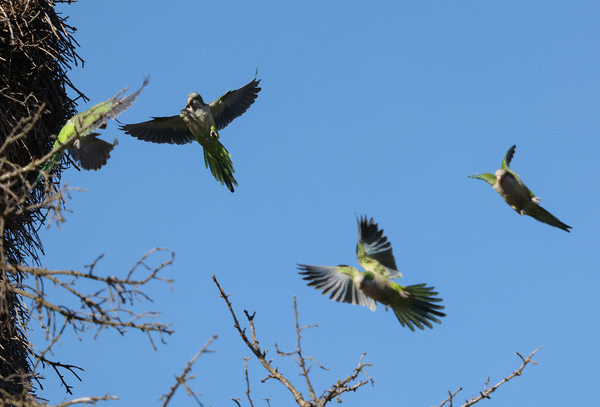
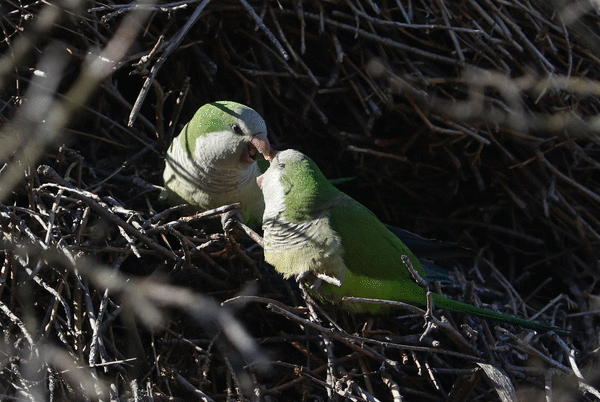





CHICAGO — At a quiet street intersection in Chicago's Englewood neighborhood, the imposing figure of a pine tree is only outweighed by the massive collection of sticks and twigs carefully placed on its branches. It’s a huge communal nest for monk or Quaker parakeets, who have called the structure home for the last 25 years or so.
Generations of these tiny, raucous, bright green birds from South America have survived, even thrived, in Chicago, beginning when likely escapees of the exotic pet trade first put down roots in some south suburbs in the 1960s and Hyde Park in the 1970s — and through every unforgiving winter in the Windy City since.
Despite their well-standing local presence, in many ways, the species remains a mystery to bird experts and enthusiasts alike. The inaccessibility of their nests, difficulties catching them to be banded, a priority focus on researching vulnerable and native species, and emerging factors, like human-made climate change, present old and new challenges to their study.
“Clearly, people are drawn to them. They’re excited about them,” said Edward Warden, president of the Chicago Ornithological Society. “And it often ends up being the kind of thing where people (are) asking questions in these forums and trying to sort of cobble together answers themselves.”
Steven Pruett-Jones, a professor emeritus of ecology and evolution at the University of Chicago who researched the parakeets for 35 years until his retirement, has given dozens of interviews on the topic since the late 1980s.
“I think it keeps coming up because they are an interesting species,” Pruett-Jones said. “They’re very novel in the Chicago region. And there are a lot of immediate questions. And the questions keep arising, because the species keeps changing.”
For instance, how long do the birds survive here, compared with their native range? Why do they build their nests the way they do? Why did they leave their original colonies in Hyde Park around 2010? Why did their local population plummet in the mid-2005s before rebounding? How will climate change positively or negatively affect their biology and behavior?
A scientist who is still seeking answers is Christopher Appelt, an associate professor at St. Xavier University on the South Side, who has studied the parakeets since he began noticing them in the area 20 years ago.
“Wow, we’re surrounded,” he humorously recalls thinking as he found out about their presence in Chicago, across the south suburbs, in other U.S. cities, in Europe and elsewhere around the globe.
While the species is naturally found in warm tropical and cooler subtropical and temperate areas, as well as high altitudes in South America, Chicago might be one of the coldest places where the birds have become established, according to Appelt.
“In their native range, they don’t tolerate cold climates really at all, but they can tolerate that here because of backyard bird feeders,” Pruett-Jones said.
In Chicago, monk parakeets can persevere despite their urban environment, and because of it. To withstand the bitter cold, these birds rely mostly on bird feeders, something they wouldn’t find in as much supply in less densely populated areas. “It’s really about getting enough energy to keep yourself warm,” Appelt said.
When Gilberto Gutiérrez and his family — whose backyard houses the pine tree nest and its inhabitants — moved in 10 years ago and learned about the birds, he thought “Qué chulada,” he told the Tribune in Spanish. “How cool.” Hands in his pockets, he looked up as groups of the screeching birds flocked back to their home on a chilly afternoon.
But Gutiérrez also had some initial reservations. “Se me van a morir todos por el frío,” he said. “They’re all going to die because of the cold.” He was proven wrong, however, when he realized they could survive extreme temperatures. He soon began buying birdseed to put in a feeder that hangs from the tree’s branches.
“Especially in the depths of winter, they turn to humans,” Warden said. “These were birds that, in theory, really shouldn’t have lasted. But they did.”
It’s why the childhood memories of many South Side residents, like Edgar Florentino, are often peppered with the shrilly squawks and green airborne blurs of monk parakeets. His father, who worked as a tailor in Hyde Park in the early 2000s, would bring Florentino to the neighborhood on weekend errands to try and catch a glimpse of the birds.
“It was very beautiful,” Florentino said.
Despite popular fascination in these little birds around the city — former Chicago Mayor Harold Washington famously had a soft spot for the parakeets, a connection immortalized in a mural adjacent to the 53rd Street Metra viaduct — Appelt was surprised to find out there was a gap in scientific research regarding their possible effects on native species.
“That was my starting point,” Appelt said. “My knee-jerk reaction is always: A nonnative species is a potential problem.”
For instance, he thought maybe the big groups of monk parakeets could be coming in as a “noisy motorcycle gang,” intimidating other birds at feeders. But his research found that was not the case — in a city, food sources for birds often abound in ornamental plants, feeders and food waste.
The parakeets are also unusual in that they don’t compete with other species for a place to raise their young. Other nonnative species, such as European starlings and house sparrows, nest in crevices and cavities like roof overhangs, usually pushing out native species like bluebirds.
“Monk parakeets also buck that trend,” Warden said.
Their nests, built on trees and utility poles, can often weigh hundreds of pounds and grow several feet tall and act more like a multifamily apartment building.
“Imagine all the tunnels that criss-cross and all the little rooms they have inside there,” Florentino mused. A few weeks ago, he posted a now-viral video to TikTok of one of the massive nests in West Englewood — almost 2 miles away from the one at the Gutiérrez home — which Florentino often walks past on his way to work.
For right now, Appelt said, there’s no evidence that they are causing any problems. But research into the parakeets should not be one and done, he said: “They are so unique, so well-suited, to be a potentially invasive species or be a successful, nonnative colonizer.”
“That’s why science is important, right? Because we’re keeping an open mind,” he added. “We’re always trying to learn new things, and changing as we learn that the things we thought were right are wrong, and vice versa.”
As climate change warms and shortens winters, it could broaden the monk parakeets’ range of movement, allowing them to survive in more rural areas.
“One of the big questions about monk parakeets is, will they ever become an agricultural pest like they (are) in Argentina?” Pruett-Jones said. There, they damage crops like corn, sunflowers and fruits.
In Italy, for example, a warming climate has attracted the birds to the countryside, where they have devastated almond and fruit crops. In Chicago, the parakeets have recently descended into the industrial Calumet region on the city’s Southeast Side, right on the edge of agricultural land.
But Pruett-Jones thinks the parakeets won’t thrive where crops don’t grow during the winter, since that means no food.
“I suspect with climate change, eventually … they’ll spread north into Wisconsin, and I think they’ll spread north into Michigan, especially along the lakefront,” he said. “I don’t think they’ll spread into agricultural regions, but I do expect them to spread along the cities.”
On the other hand, climate change could negatively affect parakeet populations as winter storms grow more intense. Pruett-Jones recalled a die-off a decade or so ago when he received several reports of dead or frostbitten parakeets. He noted that, “even if the snowstorms are less frequent, they’re going to be more severe.”
“You have to keep an eye on these guys, not just because they’re interesting,” Appelt said. “You have to always be vigilant.”
To monitor them, however, scientists need better access to their nests, often using expensive trucks outfitted with lifts or booms that can reach over 30 feet tall. Catching the birds to band them is also usually very hard, as they are quick, swift flyers.
But the public delight these tiny creatures tend to generate can be a tool to garner support for further research, and to more generally get communities interested in birds.
“When people see them around, they take notice,” Warden said. “It doesn’t really matter if it’s a nonnative bird or a feeder raider or potentially risk (of) you having a power outage. It’s just a cool entry point.”
It gets people talking to and engaging with each other, he added.
“However many times people talk about monk parakeets, or however many articles are written about them, I don’t think the interest will ever truly die down,” Pruett-Jones said.
©2026 Chicago Tribune. Visit at chicagotribune.com. Distributed by Tribune Content Agency, LLC.








Comments