A magnitude 5 earthquake rattles Southern California, followed by 4.5 aftershock
Published in News & Features
LOS ANGELES — A magnitude 5.0 earthquake rattled Southern California on Saturday morning, the largest to hit the Los Angeles County-Orange County metro area in 12 years, and was followed by a magnitude 4.5 aftershock.
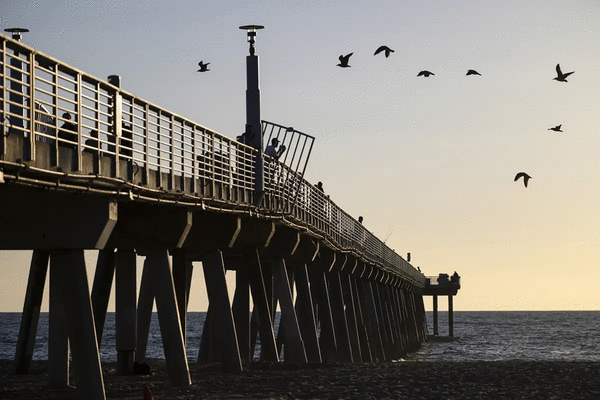
The aftershock at 11:41 a.m. caused Manhattan Beach to close its pier as a precaution, and the Redondo Beach Harbor Patrol to inspect its pier by boat. Hermosa Beach was closed to determine whether its pier was structurally safe. The Hermosa Beach pier had been closed two days earlier due to concerns about extreme king tides, and is considered to be in poor shape, with discussions underway about a possible replacement.
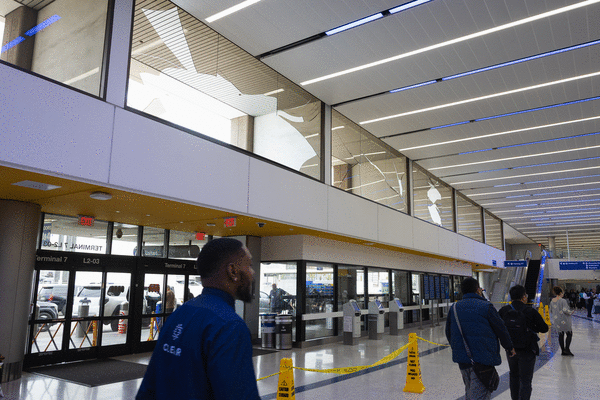
In the aftershock, moderate shaking was felt in Hermosa Beach, Redondo Beach and Torrance, the USGS said. At Los Angeles International Airport, a white ceiling panel in Terminal 7 fell in the aftershock.
“People were scared,” said Kenna Cramer, 27, a family law attorney from Maryland who was boarding a United flight home to Washington. “There was a minor scream coming from a woman, then everyone calmed down.”
The main temblor at 9:30 a.m., centered about 3 miles west of the Hermosa Beach Pier and southwest of the Manhattan Beach Pier, was felt over a wide swath of the region, though there were no immediate reports of major damage beyond broken glass and objects falling off shelves. A plume of smoke was seen rising from the Chevron refinery in El Segundo. The company said its automated safety systems were activated, “resulting in the intermittent use of the facility’s safety flares,” and that it “does not pose a safety risk to the community.”
Flaring is done to destroy any excess combustible gases that can develop in certain situations beyond a refinery’s control, according to the South Coast Air Quality Management District.
The quake was strong enough to be terrifying, frightening people in El Segundo as they saw billowing black smoke, breaking glass at Los Angeles International Airport and causing objects to fall at a HomeGoods store in Torrance. “Moderate” shaking was felt closest to the epicenter, in the Manhattan Beach and El Segundo areas, as well as at Los Angeles International Airport and southern Santa Monica, according to the U.S. Geological Survey, which uses the Modified Mercalli Intensity Scale to describe the level of shaking felt.
“It is one of the larger ones we’ve had in the Los Angeles area in quite a while,” seismologist Lucy Jones, a Caltech research associate, said of the first earthquake. The last magnitude 5-or-greater quake in the L.A. County-Orange County metropolitan area was the magnitude 5.1 quake in the Brea-La Habra area in 2014. A bit farther out, in Ventura County, a magnitude 5.1 quake southeast of Ojai hit in 2023, memorable for occurring as a former hurricane hit Southern California.
It’s highly improbable that the earthquake caused major damage, Jones said. The intensity of shaking closest to the epicenter “is the level that scares people a lot,” but wasn’t high enough to cause major damage, Jones said.
“I’m sure the folks in the areas of, say, Redondo Beach, Manhattan Beach, and along the coast there were pretty strongly shaken up,” said USGS seismologist Elizabeth Cochran. “But ... we wouldn’t expect to have major structural damage, and that’s typically what we are concerned about when we talk about damage from earthquakes.”
It’s too early to say for certain which fault Saturday’s quakes were on. It likely occurred on the Palos Verdes fault or on a secondary reverse fault that splays off the main Palos Verdes fault, according to USC earth sciences professor James Dolan. The Palos Verdes fault runs along the coast of Los Angeles and Orange counties and has the potential to cause a magnitude 7.8 earthquake.
Saturday’s 9:30 a.m. quake occurred on a thrust fault, “which means one side pushed up and over the other one,” Jones said.
Both the main 9:30 a.m. quake and the 11:41 a.m. aftershock occurred about 7.6 miles under the surface, both relatively deep quakes. Scientists said the aftershock sequence seemed pretty active, with about 40 aftershocks by midday.
“This is on the robust side,” Jones said. “The reality is that aftershocks vary considerably. If you remember last week, we had a [magnitude] 5 with hundreds of aftershocks in Soledad [near California’s Central Coast], and the 3.9 in Commerce with no aftershocks. That sort of variation is what we see. This is probably a bit more active than average, but well within the normal range.”
Saturday’s quake was preceded six days earlier by a magnitude 3.2 quake on Nov. 22, said USC earth sciences professor James Dolan.
Saturday’s two largest quakes were relatively deep, occurring 7.6 miles under the surface, while the 2014 Brea-La Habra quake was shallower, at about 3.2 miles under the surface. The 2014 quake produced 1.4 times more energy than Saturday’s biggest quake, and produced more intense shaking — classified as a “strong” intensity, compared to the “moderate” intensity felt in Saturday’s largest temblors.
During the first quake on Saturday, in El Segundo, pictures fell off a bookcase, including a ceramic cup and a photo frame. Objects also fell in Gardena. Long Beach felt a major jolt and rumble, and houses swayed, and dishes rattled in Inglewood.
Whether people felt the quake for a long time or a short time depends on where they were located.
“If you’re closer to the earthquake, you tend to feel the shaking as much sharper and shorter,” Cochran, of the USGS, said. “As you’re farther away from the earthquake, it will tend to feel like the shaking is going on for longer, and that’s just because the seismic waves travel at different speeds, and so they kind of spread out in time as you go farther away from the event.”
The first earthquake caused “light” shaking across downtown L.A., South L.A., the Eastside, Long Beach, Beverly Hills, southeast L.A. County and much of the San Fernando Valley. “Weak” shaking was felt in Orange County and the San Gabriel Valley.
Several dozen shoppers and employees huddled in the parking lot of a shopping complex across the street from the refinery, after being escorted outside. Some looked visibly shaken; a few had their cellphones trained on the large column of thick black smoke twisting into the sky. There was no visible structural damage to any of the buildings. A slightly acrid odor hung in the air.
Video showed horns blaring as a Delta Air Lines plane was told to abort a landing just as the quake began. The camera shakes, and horns blare. “Delta [flight] 1972, go around. Delta 1972, go around, we’re having a big earthquake,” a voice can be heard saying, according to Airline Videos Live, which airs live video of planes landing at Los Angeles International Airport. The website FlightAware shows the flight climbing back up over Malibu, and then over downtown L.A., before landing at 10:01 a.m.
Delta Air Lines said another of its planes, flight 1628, was also told to go-around while the quake struck as it approached LAX. Both flights landed safely, the airline said.
Lizzo said on social media that her plane landed as the earthquake hit. “I got the notification on my phone literally as wheels touched the ground,” Lizzo wrote. “Everyone please be careful!”
Broken glass was seen at Los Angeles International Airport, tumbling near a security check-in line, according to a Fox News crew at a terminal for an unrelated story. A Fox News reporter said she saw people running out of restrooms, running for cover.
The USGS’ ShakeAlert earthquake early warning system was activated by the 9:30 a.m. and the 11:41 a.m aftershock. Many people got the alerts, scientists said.
Jaime Prieto, 73, was with his family at home in Manhattan Beach when he felt a sudden jolt through the house and heard the dishes clattering slightly in the cupboards.
“It was very sudden and strong — very, very strong — but it was short,” he said. “That was the good part.”
They huddled together, waiting for an aftershock. After it came and went, they decided to take his young grandchildren, ages 4 and 7, outside “where it’s safer” and strolled over to nearby Live Oak Park.
Pedro Ramirez, 65, was on a morning walk with his wife along the beach when he started to hear windows rattling from the business stationed on the Redondo Beach Pier.
“Something felt off, but I wasn’t sure what it was,” he said. “Then I started to hear the pier moving, and I see the buildings moving and that’s how I knew we were just having an earthquake.”
The Hawthorne resident said he didn’t feel the ground move underneath him. It was the first time he had experienced a quake at the beach.
“It’s something,” he said, smiling.
A minute later, an aftershock struck. The pier swayed, but not enough to cause people concern, especially the fishermen.
“Are they biting?” a man yelled as he pulled a cart filled with fishing rods and buckets
“No!” another fisherman yelled back.
Nearby, three runners ran past the men. A worker unfolded boxes from a cart while a Redondo Beach firefighter inspected the pier.
Fishing next to an ice cream shop, John Masters, 82, of Torrance, said he was arriving on his boat at the nearby docks when the water started moving up and down.
Masters, who had felt other quakes along the beach, knew exactly what was happening:
“Must be an earthquake,“ he said chuckling. “It shook good.“
Living in greater L.A., where quakes are known to occur often, he said one gets used to them.
“But I don’t know what the quake does for the fishes,” he said. “Because they’re not having. They’re gone. I don’t know where they go.”
———
(Times staff writers Joseph Serna, Iliana Limon Romero, Robin Abcarian and Fidel Martinez contributed to this report.)
©2026 Los Angeles Times. Visit at latimes.com. Distributed by Tribune Content Agency, LLC.






Comments