The magnitude 5 earthquake should be a wake-up call for Southern California
Published in News & Features
LOS ANGELES — The magnitude 5 earthquake that rattled Southern California was far from the "Big One."
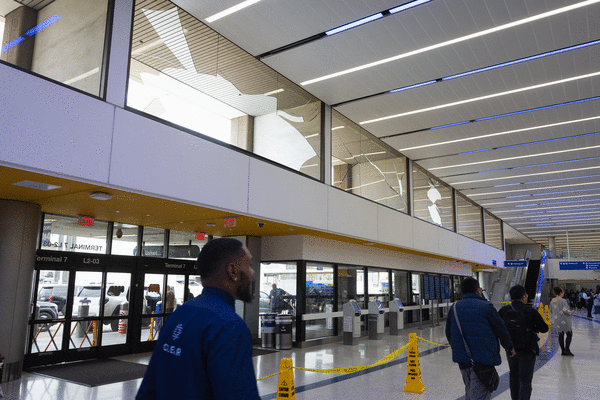
Still, the temblor was terrifying, and officials were still assessing possible damage. After a magnitude 4.5 aftershock two hours after the main quake, Manhattan Beach closed its pier as a precaution. Glass broke, and a ceiling panel fell at Los Angeles International Airport, and objects fell across the region, including at a HomeGoods store in Torrance and shelves at homes from El Segundo to Gardena.
But it was the strongest quake to hit the Los Angeles-Orange County region since 2014.
That year, a magnitude-5.1 earthquake hit the Brea-La Habra area in northern Orange County. Saturday's quake occurred beneath Santa Monica Bay, about 3 miles offshore of the Hermosa Beach and Manhattan Beach piers, and was on the deeper side, about 7.6 miles under the surface.
The Brea quake was centered directly under inhabited areas, and was shallower — 3.2 miles under the surface — and therefore closer to people and buildings. The 2014 quake produced about 1.4 times the energy as Saturday's quake, and resulted in "strong" shaking in areas closest to the epicenter, more intense than the "moderate" shaking felt closest to the epicenter in Saturday's quakes.
The 2014 earthquake caused more than $2.5 million in damage in La Habra, Fullerton and Brea. At least eight homes and 20 apartment units were red-tagged in Fullerton because they are deemed unsafe to occupy. In La Habra, about 38 people, including seven children, spent the night at a Red Cross shelter. In that quake, furniture tumbled, pictures fell off walls and glass broke; people suffered minor injuries in a rock slide that overturned their car; and several water mains and chimneys broke. In Brea, the civic center had to close because of a broken water pipe on the third floor, damaged ceiling tiles and toppled bookshelves.
Like in 2014, Saturday's quake was followed by aftershocks.
But these modest quakes are a reminder of the much greater seismic dangers Southern California faces.
The last major temblor to strike urban Southern California, the magnitude 6.7 Northridge earthquake of 1994, resulted in severe damage and the deaths of about 60 people. But it was also mostly limited to a relatively small area of Los Angeles County.
By comparison, a hypothetical magnitude 7.8 earthquake on the southern San Andreas would simultaneously bring violent shaking to L.A., Orange, Riverside, San Bernardino, Ventura and Imperial counties and could result in 1,800 deaths, according to a U.S. Geological Survey estimate published in 2008.
There's a 60% chance of a magnitude 6.7 or greater earthquake striking the Los Angeles region by 2045, according to USGS estimates published in 2015. There's about a 1-in-5 chance of such a quake striking on the San Andreas fault within L.A. County and the Inland Empire.
On Nov. 20, a 4.2-magnitude quake struck L.A. It occurred on the Puente Hills system, long cited as a major seismic hazard for Southern California because it runs through heavily populated areas and can produce a major quake.
The Puente Hills thrust fault system lies in a broad zone directly beneath the densest parts of the L.A. area, including downtown, which has many old, unretrofitted buildings, as well as broad swaths of southeast L.A. County, the San Gabriel Valley and northern Orange County. A magnitude 7.5 quake in the Puente Hills thrust fault system could kill 3,000 to 18,000 people, according to the U.S. Geological Survey and Southern California Earthquake Center. The economic loss could be up to $252 billion, which could be the costliest disaster in U.S. history.
The Newport-Inglewood fault, site of the 1933 Long Beach quake, is also considered highly dangerous in the event of a major temblor.
Officials warn a major quake would alter life, perhaps for months or longer, including:
—The region could see major interruptions in power, gas and other vital services due to quake damage.
—There are several types of buildings experts say are at greatest risk of collapse or major damage. They include brittle concrete towers ubiquitous in business districts such as downtown, Hollywood, Beverly Hills, and the Wilshire and Ventura Boulevard corridors; wood apartment buildings with "soft" first stories (which usually house carports) like the one that collapsed in Northridge in 1994, killing 16 people; and steel skyscrapers, potentially.
—Older single-family homes, by and large, are considered safer than bigger brittle concrete, unreinforced masonry and soft-story apartment buildings.
—But there are some risks — and solutions that experts have urged homeowners to consider. Brick chimneys are one: They account for a common form of damage during larger California quakes.
—Widespread cellphone network outages after hurricanes or major storms have been a consistent problem in the U.S., interfering with recovery efforts. In Puerto Rico after Hurricane Maria in 2017, residents roamed roads searching for signal; cellphone towers on the East Coast were disrupted after Superstorm Sandy in 2012.
©2026 Los Angeles Times. Visit latimes.com. Distributed by Tribune Content Agency, LLC.






Comments