Denver ICE officials end instant re-arrest policy after outcry from attorneys, federal judges
Published in News & Features
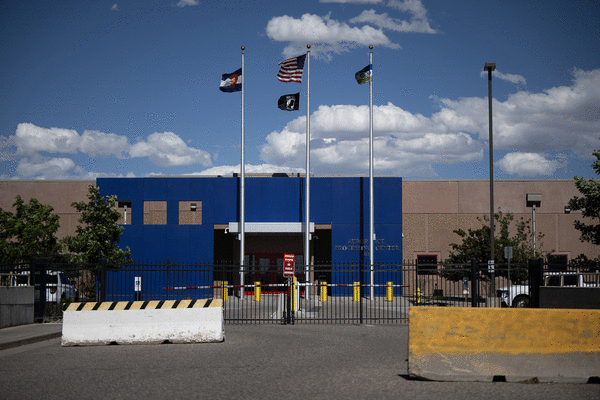
DENVER — Colorado’s senior immigration official testified Monday that he wanted to rectify a series of illegal arrests when he ordered his staff to re-detain people as soon as they were released from an Aurora detention facility, a practice he has since ended after it, too, was deemed unlawful.
Nathan Rasper, the acting director for Denver’s Immigration and Customs Enforcement field office, said he’d told his deputies last month to serve the re-arrested immigrants with corrected paperwork as they were led out of the detention facility, at which point the detainees would be marched back inside.
Attorneys have repeatedly — and successfully — sued ICE for improper warrantless arrests, in Colorado and elsewhere, and federal judges have ordered the release of some immigrants who were detained illegally.
At least 18 people were re-arrested in the scheme between late October and early November, government attorneys said Monday, four more than they’d initially disclosed last week.
Several of those re-arrested were either shown or given a new warrant as they were being detained, court records show. All of them had been ordered released by a federal judge, only to be led out of the Aurora facility and into the arms of waiting ICE agents. One told The Denver Post that he was repeatedly hit by ICE agents as they re-arrested him.
Rasper sat in the front of the packed Denver courtroom Monday after being ordered last week to appear and explain the policy. He testified he had spoken to colleagues and legal advisers within ICE, who said the re-arrests were a fix for specific cases in which a judge had ordered detainees released because of issues with their initial arrest. He said he thought the re-arrests would correct “technical” paperwork errors and that he did not intend to violate court orders.
Federal judges have disagreed, and they have demanded explanations from ICE's attorneys, who in turn have repeatedly declined to defend the re-arrests. Rasper, who was appointed acting field director on Oct. 14, was summoned to court by U.S. District Court Charlotte Sweeney, who had ripped into the agency and its lawyers last week after a man she'd ordered released was re-arrested in late October.
On Monday, Sweeney asked Rasper and Kevin Traskos, the civil division chief for the U.S. Attorney's Office for the District of Colorado, if the re-arrest policy was still in place. Both confirmed it had ceased, though Traskos acknowledged that at least one other person had been re-arrested after Sweeney's initial, blistering hearing last week.
Rasper said federal courts in Minnesota had upheld a similar policy in that state. But at least one federal judge in that district has been as displeased as his Colorado counterparts: According to Minnesota Public Radio, U.S. District Judge Jeffrey Bryan threatened to sanction the agency if it did not immediately release one man re-arrested last month.
Sweeney said last week that she was considering finding the government in contempt for re-arresting the man she'd ordered released, and she referenced similar issues in other courtrooms. On Monday, she said she would issue an order soon about whether to proceed with contempt proceedings. Echoing what one immigrant told The Post last week, Sweeney said she's received notes in immigration cases about detainees who are "terrified."
The re-arrest policy "has instilled a new level of fear at the facility that I find completely inappropriate, and it needs to be addressed," she said of ICE's immigrant detention center in Aurora.
While Rasper said the re-arrest policy is no longer in effect, other ICE officials have stood by it. An unnamed representative for the Department of Homeland Security told The Post last week that ICE could re-arrest people even if a judge ordered their release, and anyone suggesting otherwise was committing "sabotage" against the agency.
Trasko distanced himself from that statement Monday.
"My office did not know this statement was going to be submitted. I had not been provided with the statement that was submitted," he said.
Sweeney later asked Rasper whether he knew who had authored the statement. He said he didn't. He also said no one from within ICE had ordered him to implement the re-arrest policy.
Another judge in Colorado, U.S. District Judge Nina Wang, said in separate hearings last week that she thought ICE had repeatedly violated her release orders by requiring immigrants to wear GPS monitors. She directed government attorneys to explain to her why they shouldn't be held in contempt for that conduct, too.
The re-arrests have drawn widespread attention within the immigration legal community in Denver, and other attorneys, activists and government officials were present in Sweeney's courtroom Monday. After the details of the re-arrests became public knowledge last week, Liz Jordan, who works at the University of Denver, and Tim Macdonald, the legal director for the American Civil Liberties Union of Colorado, both asked Sweeney if they could lodge more arguments against ICE's practices.
Macdonald is part of another lawsuit that has challenged ICE's warrantless arrest practices, and another federal judge in Denver, U.S. District Judge R. Brooke Jackson, has ruled that many of ICE's arrests have violated the law. Jackson has subsequently found that ICE continued to illegally arrest people after his initial ruling.
On Monday, Macdonald argued that the re-arrests appeared to be another attempt at skirting Jackson's rulings.
"The court should not treat this as an accident or a one-off, isolated incident," Jordan told Sweeney. "That 18 people experienced this in this district alone is significant."
_____
©2026 MediaNews Group, Inc. Visit at denverpost.com. Distributed by Tribune Content Agency, LLC.






Comments