Florida's attorney general fights for religious freedom. Has he crossed a line?
Published in News & Features
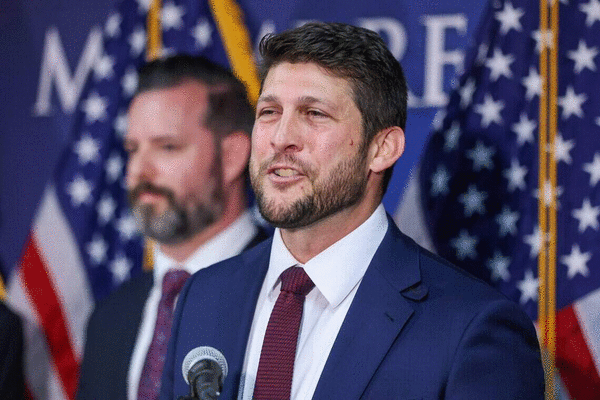
MIAMI — Florida Attorney General James Uthmeier wears his faith on his sleeve and shares it in legal opinions and threatening missives on state letterhead.
In the 20 months since he was appointed by Gov. Ron DeSantis, Uthmeier, who is Catholic, has made religion a centerpiece of his work, expanding protections for religious organizations and families and wading into cases of religious discrimination. At times, he has channeled his personal beliefs while shaping policies on education, public health and even artistic expression.
Now on the ballot for the first time, he is asking voters to bless his vision of a state where Christianity is treated as a key pillar of American identity and leaders are empowered to steer the government with full fidelity to their faith — even as critics contend he is trampling on theirs.
Historically, politicians have kept a firewall between church and state to keep from crossing the First Amendment’s prohibition on a national religion or government restrictions that interfere with an individual’s expression of faith. But Uthmeier contends an overly broad reading of the First Amendment’s Establishment Clause has been twisted into a tool to suppress Christians and other believers.
Uthmeier has been engaged in the fight over the Establishment Clause since he was a private attorney arguing a decade ago to keep a monument to the Ten Commandments on the lawn of a county courthouse in Maryland. Now with the power of the state behind him, he has accused Major League Baseball of discriminating against Christian players, told school districts they must release students who request to attend religious classes during the school day and declared unconstitutional the portion of the state Constitution that bans the diversion of public money to religious institutions.
He has also fought to tamp down ideas and events that offend his Christian sensibilities. Last November, he threatened the city of Pensacola over what he called a “demonic and sexually explicit” Christmas drag show, warning that hosting a performance “that openly disparages Christian beliefs is not only an affront to your Christian residents, but it may subject the city to further legal scrutiny.”
Anthony Verdugo, executive director of the conservative Christian Family Coalition, which advocates for faith-based policies, celebrated Uthmeier’s efforts, which he said have “made it easier to convey our message of Faith, Family and Freedom.”
“The fight for religious liberty and against faith-based discrimination is one way Attorney General James Uthmeier is honoring his oath [of] office and putting Constitutional justice at the forefront of his work,” said Verdugo.
But Uthmeier has rankled First Amendment experts and even the Catholic Church, which accused him of overstepping after he told the church to allow its students to opt out of vaccines based on religious beliefs or risk losing access to school vouchers.
Constitutional attorney John W. Whitehead said he’s happy the attorney general is prioritizing religious freedoms, so long as “those protections remain neutral and universal” without favoritism toward any particular faith.
“The question is whether the legal authority of the state is being exercised according to neutral constitutional principles that would apply equally to Christians, Muslims, Jews, atheists and everyone else,” said Whitehead, who is also the president of The Rutherford Institute, a nonprofit law firm that focuses on civil liberties and human rights litigation.
“That is the line I would watch.”
Uthmeier’s Opinion
The attorney general’s office declined to make Uthmeier available for an interview and did not answer questions emailed to a spokesman. But Uthmeier has been open about his views that religious people — Christians, particularly — have been wrongly constricted in their ability to express themselves and to participate in government programs.
Uthmeier laid out his philosophy on religion and government in an April 2 legal opinion in which he announced that he believes the portion of the Florida Constitution prohibiting public funds from flowing to religious organizations is unconstitutional — effectively rolling out the welcome mat to religious organizations interested in establishing the state’s first religious charter schools.
In that same opinion, Uthmeier explained that the federal constitution’s restrictions on established religion have been misread in a way that “is often used as a rhetorical cudgel for modern secularists bent on forcing believers to act as if their faith is meaningless while serving in public office.”
Christianity, he also argued, is at “the center of the nation’s religious identity,” and states have been free to encourage that religion as long as it doesn’t step on individual freedoms.
Uthmeier has been on the losing side of at least one fight for religious freedom, with the U.S. Supreme Court declining to hear his argument — joined by 16 other attorneys general — that the Florida High School Athletic Association was wrong to block two Christian high schools from saying a pre-game prayer over a stadium PA system before a state championship football game back in 2015.
But he is shaping law in other ways. In June, citing a recent Supreme Court opinion, he opined that school districts must allow students to leave school during the day to participate in religious teachings, known as Release Time Religious Instruction.
According to Uthmeier’s opinion, certain schools in Florida were providing “blanket denials” for RTRI programs or placing other types of restrictions on requests for off-campus religious instruction during the school day. Both violate Florida law, said Uthmeier.
“Florida law, consistent with the Supreme Court’s decisions in Zorach and Mahmoud, prohibits public schools from restricting parents’ efforts to direct the religious upbringing of their children, including participation in RTRI,” Uthmeier wrote.
Records obtained by the Miami Herald show that school officials from Collier, Osceola, Pinellas, and Sarasota counties had denied requests from parents to send children to a program called LifeWise Academy, an independent, privately funded nonprofit that describes itself as a “fully legal way” for parents to bring “Bible-based character classes into their child’s weekly public school routine,” during school hours.
“Crucially, RTRI enables parents to honor their sacred duties to raise their children in the faith,” Uthmeier wrote in his opinion. “The LORD—author of our natural rights and duties—requires nothing less.”
Since Uthmeier’s opinion in June, LifeWise has seen a significant spike in interest, with more than 1,500 people joining online community lists in support of bringing a LifeWise program to their area, according to Joel Penton, CEO of LifeWise Academy.
Based on The Gospel Project — an official entity of the Southern Baptist Convention — the LifeWise curriculum walks students through the Bible by teaching “a Bible passage, its connection to Jesus and a related character trait.” Lessons are typically 45-minutes to 1 hour and take place off school property.
Penton celebrated the attorney general’s opinion, saying that it “has been welcome news for Florida families who want their children to have the opportunity to receive religious instruction during the school day.”
Uthmeier and the Catholic Church
At times, Uthmeier’s writings have delved into his own personal views on God and constitutional freedoms.
In his letter to the Catholic Church, Uthmeier questioned the church’s policy that the use of vaccines, even those developed using the cells of aborted fetuses, are not “intrinsically evil.”
“As a Catholic, I am confident that the teachings of the Catholic Church do not require Catholic schools to compel students to take vaccines derived from the tissue of aborted children against the sincerely-held religious objections of their parents,” Uthmeier wrote in a letter to the Florida Conference of Catholic Bishops.
Uthmeier argued that it is against Florida law to not allow Catholic school students to opt out of vaccine mandates on religious grounds, and that this “may disqualify them from state scholarships and vouchers.”
Uthmeier stressed that the state of Florida is aiming to protect a parent’s ability to exempt their child from mandated vaccine requirements and that the Catholic Church is placing “an undue burden on parents” that would deny them their “fundamental right to choose a school that corresponds to their own convictions.”
A week later, the Catholic bishops responded to Uthmeier in their own letter, arguing that their differing interpretation of Catholic teachings is exactly what his office fights to protect in terms of constitutional rights and freedom of religion.
“Respectfully, any insinuation that a government official can dictate to the Catholic Church (or any religion) how to apply her tenets and dogma, violates well-established constitutional religious freedom rights,” wrote Michael B. Sheedy, executive director of the Florida Conference of Catholic Bishops.
In other words, don’t tell the Catholics how to be Catholic.
“Life and physical health are precious gifts entrusted to us by God. We must take reasonable care of them, taking into account the needs of others and the common good,” the letter from the Florida Conference of Catholic Bishops said.
The attorney general’s decision to push forward his personal views about Catholicism and vaccinations — which go against what many health experts recommend to slow the spread of deadly diseases — is a case where a “religious-based exemption” is actually doing more harm than good, said attorney Alex J. Luchenitser, associate vice president and associate legal director for Americans United for Separation of Church and State.
“People who don’t vaccinate their children end up harming other children, especially children who are immunocompromised or otherwise medically vulnerable,” Luchenitser said.
Whitehead, the constitutional attorney, highlighted a different issue at play with the exchange: He said the back-and-forth shows “what happens once substantial government funding begins flowing into private religious institutions,” raising questions about “oversight, regulation and the extent to which government may attach neutral conditions to participation.”
Threatening letters
Uthmeier has also disturbed Islamic organizations by questioning which religious schools should be allowed to participate in the state’s taxpayer-funded school voucher program.
Last year, the attorney general warned on social media that sending vouchers to two private Islamic schools likely violates Florida law and poses a national security threat after claiming the Tampa-area Muslim schools promoted Sharia Law, a legal system and code of conduct derived from the Quran.
Uthmeier didn’t follow through with his threat to the Islamic schools — which say they continue to accept voucher scholarships. But the signal he is sending about Islam has a damaging effect on Muslims, said Omar Saleh, an attorney for the Council on American-Islamic Relations in Florida who often represents individuals in religious discrimination cases.
“It’s not just favoring one religion, he’s excluding one religion,” Saleh said. “So other faith-based schools, they can get it, but not Islam because of his twisted and ignorant idea of what Islam is.”
Earlier this year, Uthmeier again used his platform to speak out against Islamic-related activity in the state — this time directing his ire at local officials who refused to cancel a Muslim conference in Broward.
Uthmeier warned Coral Springs city officials — including the city’s Jewish mayor — against supporting a Muslim conference and said the commission is “on notice” for allowing the event to move forward.
The conference’s organizer, the South Florida Muslim Federation, a hub for mosques, schools, organizations and businesses to support the region’s estimated 200,000 Muslims, is no stranger to protests. The conference has received allegations of antisemitism in the past — though local officials and Miami Herald reporters who have attended past conferences have not seen evidence of that — for its connections to CAIR, an organization that has been in a legal battle with the state after DeSantis declared it a terrorist organization. CAIR has denied alleged ties to terrorist groups, has been described as the “Muslim ACLU” by members of the community and has worked to protect citizens’ civil rights since its founding in the 2000s.
“It really is a blind bigotry,” said Saleh. “It is like ‘we don’t even want to know what Islam is about. We just want them out.’”
Walking a fine line
Whitehead, the constitutional attorney, said politicians are not asked to leave their faith at the door when they take office. For instance, Uthmeier has attended the Red Mass, which the Catholic Church hosts each year to seek holy guidance for lawmakers, elected leaders and judges during the annual legislative session. It is held at the Co-Cathedral of St. Thomas More in Tallahassee, where Uthmeier and his wife teach religious education classes.
Nor are Uthmeier’s moves towards protecting religious freedom out of step with what’s happening in the Supreme Court, now operating with a conservative majority. As a nation, the United States is moving toward knocking down longstanding walls separating religion and government, often ruling in favor of expanding the rights of religious groups.
But there is a stark difference between a public official whose work is guided by their religious beliefs and a public official who uses their personal faith to exercise governmental power in a way that favors one religious viewpoint, said Whitehead, The Rutherford Institute president.
“Government should neither discriminate against religion nor use its power to establish, coerce or favor a particular religious belief. Equal treatment of religious people and institutions is not establishment; government preference among religions is another matter,” he said. “The difficult constitutional work is preserving both principles at the same time.”
Luchenitser called Uthmeier’s legal arguments “radical” for an attorney general, describing Uthmeier as a “Christian Nationalist” who is misreading history and wading into constitutional waters that are out of his purview.
The country’s founders, especially Thomas Jefferson and James Madison, who Uthmeier cites in his opinions, “were strong supporters of the separation of church and state” who “did not view this country as a Christian country,” Luchenitser said.
Uthmeier, though, sees it differently. At his swearing-in ceremony in early 2025, he linked his public service to one of his favorite Bible verses.
“As I put my hand on that Bible I was reminded of a verse from Proverbs, a verse that I turn to daily: ‘To do what is right and just for the Lord is greater than any sacrifice. To do what is right and just.’” Uthmeier said. “As with all spiritual truths, these words hit a political mark. To do what is right and just. It’s easy to say the right things, but not everybody goes out and does them.”
©2026 Miami Herald. Visit at miamiherald.com. Distributed by Tribune Content Agency, LLC.





Comments