Court wipes out Hope Florida grand jury presentment that blasted DeSantis administration
Published in News & Features
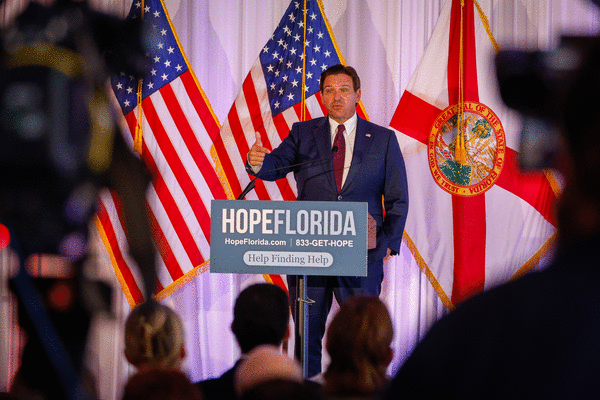
TALLAHASSEE — A state appeals court Wednesday expunged a confidential Hope Florida grand jury report leaked two months ago that described a “sophisticated scheme” to misappropriate $10 million in taxpayer dollars from a Medicaid settlement for political purposes.
The First District Court of Appeal ruled that the presentment produced by the Leon County grand jury convened by State Attorney Jack Campbell last year exceeded its authority. It also said state law was violated when the presentment was disclosed.
The jury criticized members of the DeSantis administration by name but declined to bring charges, saying no one interviewed would take responsibility for diverting the Medicaid settlement to help pay for a campaign against a statewide measure legalizing marijuana.
”A grand jury may investigate and report, but it may not declare conduct unlawful and then decline to charge it, and it may not condemn people by name without indicting them,” Appellate Judge Lance E. Neff wrote in the court’s opinion. “Nor may the State release a confidential presentment before those it impugns have had the opportunity Florida law guarantees to seek its repression or expungement.”
Gov. Ron DeSantis appointed Neff to the First DCA in March.
The opinion said it was also wrong to have named those involved in the scheme, “yet returned no indictment, conceding it lacked sufficient evidence to charge anyone.” The DCA also said the $10 million was not public money, and that the jury failed to establish it was misappropriated.
The court said the presentment was then distributed beyond those entitled to receive it. It has not been revealed who actually leaked the presentment to CBS News Miami.
The appeal was filed by Attorney General James Uthmeier, who was represented by Chris Kise, a former solicitor general of Florida who has also served as defense counsel for President Trump. Uthmeier, who was among those criticized in the presentment, appointed former First DCA Judge Brad Thomas as acting attorney general for these proceedings.
The court’s ruling reversed a Leon County Circuit Court ruling in July by Judge J. Lee Marsh denying full expungement.
“Long story short … The Democrat State Attorney’s weaponized grand jury was thrown out,” said Jeremy Redfern, Deputy Chief of Staff for Uthmeier.
Campbell said Wednesday he was “legally prohibited from discussing anything concerning the grand jury proceeding. The fact that others discuss it doesn’t change anything for me.”
Campbell convened the grand jury in August to begin investigating allegations of a conspiracy to commit fraud brought forward by state Rep. Alex Andrade, R-Pensacola. Andrade submitted information gathered during hearings he held during the 2025 legislative session on how $10 million of a $67 million Medicaid settlement agreement wound up being used to combat a citizen-driven ballot initiative to legalize marijuana.
Instead of issuing a true bill or indictment, the grand jury in January issued a 116-page presentment consisting of a 19-page report and 97 pages of exhibits. The report summarized confidential witness testimony and evidence, concluding that the $10 million was “misappropriated as part of a sophisticated scheme to fund political activities,”
The presentment named high-ranking state officials, including Uthmeier, who was DeSantis’ chief of staff at the time of the settlement negotiations and directed the movement of the funds to two nonprofits that in turn donated most of the money to a political committee he ran, according to the grand jury report.
The presentment reported that Jason Weida, then secretary of the Agency for Health Care Administration and the agency’s attorney Andrew Sheeran were involved in the negotiations that led to Hope Florida receiving $10 million of a $67 million settlement with the Centene Corp. for allegedly overbilling the state.
It also noted that Attorney General Ashley Moody’s deputy chief attorney signed off on the agreement at her instruction, and the Hope Florida board lacked proper due diligence.
While the grand jury blasted the administration for a lack of transparency it found insufficient evidence to bring criminal charges, saying people couldn’t remember whose decision it was to give a portion of the settlement to the Hope Florida Foundation, or wouldn’t take responsibility for the actions.
Instead, the grand jury recommended legislative reforms.
The presentment was automatically made confidential to give people named in the report a chance to seek to have their names removed or the document expunged from court records.
But after the grand jury issued its report, Campbell sent it to at least 49 recipients in two mass emails. In February, those named in the report moved to repress and expunge the report. Meanwhile, Marsh, the judge in the case, allowed the Florida Center for Government Accountability to intervene in any court action related to any motions to repress or expunge and ordered the state attorney to notify the organization of any appeal.
Marsh repressed and expunged the witness section with their names and titles, all 97 pages of exhibits and several findings, “but denied repression and expungement in full,” the DCA opinion said. “It held that the redactions did not change the Presentment’s tenor and that the Presentment did not allege that any named individual committed a crime.”
On August 12, the opinion said, the state petitioned the DCA for emergency relief from the notification orders. “The next day, this court stayed those orders,” the court said.
Campbell was served with a writ enjoining him from disclosing the grand jury matters to the putative intervenors or any other person pending further order of this court.
And on August 26, CBS News Miami published an unredacted copy of the report.
Michael Barfield, executive director of the Florida Center For Government Accountabliity, said it was “disappointing that this was a one-sided appellate procedure.”
Despite Marsh’s order giving the center the right to intervene, the court never notified them of the motions to appeal. “We had no opportunity to present our arguments on the issues.”
_____
©2026 Orlando Sentinel. Visit orlandosentinel.com. Distributed by Tribune Content Agency, LLC.




Comments