Ebola death tests Kenya's border screening and disease defenses
Published in News & Features
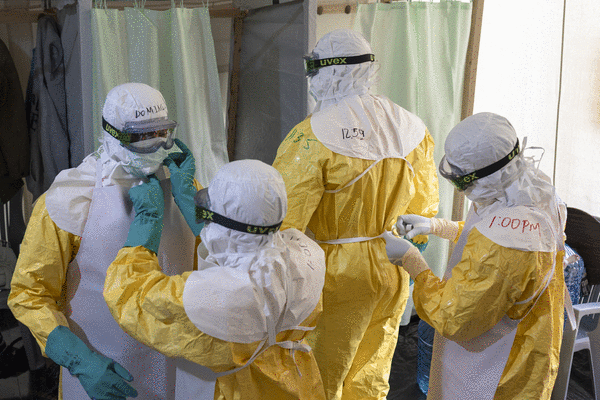
For weeks, a Kenyan man infected with Ebola kept moving, undetected.
He traveled through several cities in Democratic Republic of Congo, made the roughly nine-hour road journey from Beni to Uganda’s capital of Kampala, spending a night there. On Oct. 3, he boarded Jambojet flight 8523 from nearby Entebbe to Nairobi. By the time he reached a hospital there, he was suffering from fever, intense fatigue, muscle pain and bleeding at injection sites. Within a couple of days he was dead.
“This is something that we need to understand — why someone sick for one month flew and drove without screening,” Africa Centres for Disease Control and Prevention Director General Jean Kaseya said in an interview.
On arrival at Nairobi’s Jomo Kenyatta International Airport, he underwent routine health screening, but officials didn’t detect any abnormal findings. He was collected by a relative and a friend, who took him to a private hospital. Staff there recognized the symptoms, isolated him and alerted the authorities to Kenya’s first-ever Ebola case in its history.
Health authorities have identified 57 contacts linked to the case. Ten have been accounted for and placed in quarantine at the National Police Service Hospital in Nairobi, while authorities are still trying to trace and follow up with the remainder. Officials will be watching for infections among those exposed and, crucially, any evidence of sustained local transmission.
Africa CDC is also reconstructing the man’s movements and contacts in Congo and Uganda. Kaseya said the agency has indications he may have been a priest, though that is still being investigated.
The journey is a striking example of what some doctors have dubbed “walking Ebola” — the possibility that the Bundibugyo strain’s slower progression can leave infected people well enough to remain mobile while symptomatic. Africa CDC sent a multidisciplinary team to Nairobi late Tuesday to reconstruct the man’s movements and assess Kenya’s response capacity, including screening, laboratories, treatment facilities, supplies and health-worker preparedness.
The case also highlights the limitations of border screening: Kenya was well prepared, according to Kaseya, yet the infected traveler still entered undetected. The country had screened more than 652,000 travelers since the Congo outbreak began in May and trained almost 5,000 health workers in Ebola prevention and management.
Kenya has intensified screening for travelers from affected and at-risk countries and identified temporary isolation centers at Malaba and Kocholia, near its border with Uganda. Kaseya said strengthening screenings at airports is important but the main focus should still be on identifying and stopping infected people reaching the borders in the first place.
“If this person was identified at village level,” Kaseya said, “he could not move as he did.”
Kenya has 244 beds designated for Ebola isolation and treatment across five facilities, according to the Health Ministry, including 133 at Nairobi Hospital, where the patient was treated. The government said capacity can be expanded if necessary.
The man’s journey mirrors the broader challenge facing responders in Congo. Health workers have managed to suppress transmission in some individual hotspots, but Ebola continues to find new ones. More than 70% of new infections are being detected among people who hadn’t previously been identified and followed as contacts, according to Africa CDC.
Sign up here for the daily Next Africa newsletter and subscribe to the Next Africa podcast on Apple, Spotify or anywhere you listen.
—With assistance from Jason Gale and Eric Ombok.
©2026 Bloomberg L.P. Visit bloomberg.com. Distributed by Tribune Content Agency, LLC.





Comments