Trump admin transforms vehicle fuel economy rules, slashes MPG target
Published in News & Features
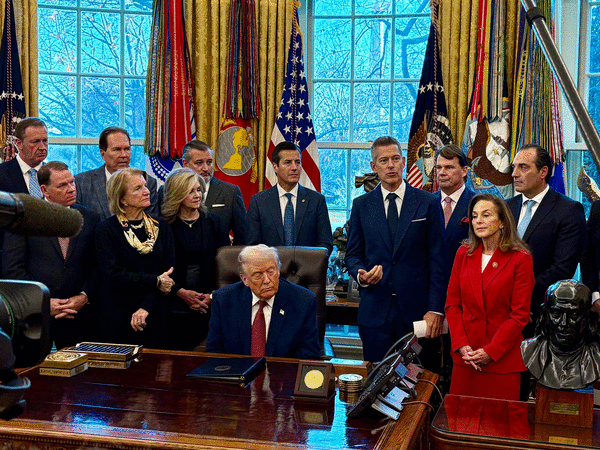
WASHINGTON — The Trump administration on Sept. 28 finalized an effort to set far looser environmental targets for new passenger vehicles while also transforming how cars and trucks are defined in the United States.
President Donald Trump's corporate average fuel economy rule, commonly known as CAFE, takes a much more relaxed approach than regulators did under the Biden administration. The new rule sets a fleetwide goal of roughly 34.9 miles per gallon by 2031, a level automakers already achieved in 2024. By contrast, the Biden target for 2031 was 52.5 mpg.
The latest standards, however, also adjust the auto sector's primary gas mileage regulation in ways that could cause shockwaves through the industry. The new rules make it harder for automakers to classify vehicles as trucks — which have ballooned to about 70% of the U.S. new vehicle market — and phase out the buying and selling of credits to achieve compliance. Most automakers lobbied against both of those changes.
The share of car vs. truck sales will essentially reverse in 2030 thanks to the reclassification, according to federal estimates. The current ratio of roughly 69 trucks to every 31 cars sold could flip to 27 and 73, respectively.
That shift — driven by government definitions rather than consumer behavior — could have significant ramifications for automakers because regulators set higher fuel economy expectations for cars than trucks. The new rule sets a 2030 goal of 40.2 mpg for cars and 26.4 mpg for trucks.
"While the CAFE program was intended to push manufacturers to improve fuel economy while preserving their ability to design and produce vehicles that meet market demands, the system has spun off its axis and requires recalibration," the National Highway Traffic Safety Administration wrote in a regulatory filing.
The agency added: "(T)he system has increasingly led manufacturers to try to fit square vehicle pegs in round classification holes to force the adoption of technologies that do not meet the demands of American families simply to obtain on-paper fuel economy improvements that may have little basis in reality."
Top administration officials — and President Trump himself — claim the rules will save consumers money, free them from a so-called electric vehicle mandate pursued under the Biden administration, and make roads safer by boosting the number of Americans who can buy newer, safer vehicles.
Environmental groups and consumer advocates, meanwhile, are raising doubts about those claims and decrying the administration's lighter touch on fossil fuel targets at a time of soaring gas prices thanks to Trump's war in Iran.
"With Americans struggling to afford gasoline that is more than $4 a gallon, the Trump administration is going to force them to pay more at the pump. Oil companies will get a windfall from gutting the fuel economy standards, but the rest of us are going to be handing over more of our hard-earned paychecks to fill up the tank," said Kathy Harris, director of clean vehicles for the Climate & Energy program at the Natural Resources Defense Council.
She added: “Congress established fuel economy standards five decades ago after Middle East unrest led to a spike in oil prices. But with the war with Iran driving up oil prices, the Trump administration is doing all it can to keep us dependent on gas guzzlers. In fact, most automakers would not need to make any fuel-economy improvements over the next five years to meet these new standards."
In Michigan, the average price for a gallon of regular gas reached $4.67 the morning of Sept. 28, per data from AAA. New vehicle prices have also been rising steeply under Trump. The average price for a new vehicle that morning was about $52,750 — up about $2,750 from a year earlier.
The new CAFE standards follow other major deregulatory environmental policies directed at the auto industry since Trump returned to office in January 2025. His administration also wiped out the legal basis for the Environmental Protection Agency's automotive greenhouse gas rules and zeroed out fines for CAFE violators, defanging the rules even as they became more lax.
"These new Standards will take the waste out of building cars in America. That means LOWER PRICES, saving families thousands on a new, beautiful, and safe car — Far better than the Environmental Monsters that we were building heretofore," Trump wrote in a Truth Social post over the weekend.
"Every Manufacturer, from General Motors to Ford to Stellantis, has called me wanting to build here, and now they can!"
Detroit automakers applaud Trump 'intention'
In a draft version of the CAFE rule last year, NHTSA suggested that many vehicles currently regulated as light trucks, a category that includes most popular SUV offerings, instead be treated as passenger cars to align with how Americans typically use their vehicles.
"Vehicles are very different than they used to be," said Stephanie Brinley, associate director of AutoIntelligence for S&P Global Mobility, in a phone interview ahead of the final rule's release.
"We used trucks differently than we do today. A work truck was a work truck," Brinley said, recalling the country's original CAFE standards from 1977. She continued: "The administration, in the first draft of the standards, said, 'Wait, we've got these things that are being called crossover utility vehicles that can't drive over a tall rock.' That's a good question. Is it really a car? Is it really a truck?"
The Detroit Three automakers mostly pushed back against the Trump administration effort to reclassify vehicles. General Motors Co. was the sharpest in its opposition, writing in a public comment on the proposal that NHTSA "underestimated the extent of this vehicle shift and the potential market distortions."
The industry's attempts to knock down the reclassification effort, evidently, had limited success. Commenting on the final rule, GM spokesperson Elizabeth Winter said in a statement that the company "supports the goals of NHTSA’s CAFE rule and its intention to better align fuel economy standards with market realities."
She continued: "We appreciate NHTSA’s recognition of the breadth of offerings present in the U.S. market, including those vehicles with increased capabilities to move families and cargo. We remain committed to offering the best and broadest portfolio of electric and gas-powered vehicles on the market."
Ford Motor Co. was also measured in its response. "We appreciate Secretary Duffy and the Administration's work to align regulations with market realities," spokesperson Robyn Jackson said. "As we evaluate the final rule's full impact on our business, we'll continue working with the Administration to build a strong American auto industry.”
Stellantis, in a company statement, said: "We welcome the Administration’s efforts to reset the CAFE regulations to more achievable targets that are better aligned with market realities."
New standards eliminate credit trading
The Trump administration's new rule makes two other structural changes to how CAFE rules operate. For one, it eliminates compliance credit trading between automakers like Tesla Inc. that easily meet federal standards and those that fall short.
Credit trades, NHTSA wrote in a regulatory filing, were "intended to improve the cost effectiveness of the CAFE program by allowing manufacturers that could improve the fuel economy of their fleets more cost effectively to earn credits for exceeding fuel economy standards and sell those credits to manufacturers that would need to incur higher costs to meet fuel economy standards."
Instead, the agency said, the multibillion-dollar credit trading system has "resulted in a windfall for EV-exclusive manufacturers that sell credits to other non-EV manufacturers, which in turn pay for those credits with capital that could be invested toward improving the fuel economy performance or other desirable attributes of their traditional fleets."
The new rule will officially halt the generation of new credits beginning in model year 2028, though trades already ended earlier in Trump's second term after he and the Republican-controlled Congress passed a law zeroing out all fines for automakers that failed to meet CAFE standards. That law rendered existing credit worthless.
Several top industry trade groups and automakers, like Hyundai Motor Co., Nissan Motor Co. and Volkswagen AG, lobbied against that change. The Detroit Three, which tend to rank near the bottom in fleetwide fuel economy, did not publicly oppose the end of credit trading.
The new CAFE standards also altered how battery-electric vehicles are used to set mileage goals.
NHTSA argued in 2025 that the Biden administration broke the law by considering EVs, which do not use gasoline, as part of its basis for fuel economy targets. The new rule instead allows automakers to use EV sales to boost fuel economy scores, but it did not assume adoption of non-gasoline powertrains in its process for setting targets.
Advocates, experts and policymakers clash on CAFE rules
Transportation Secretary Sean Duffy, whose department oversees NHTSA, cheered the new standards in a statement.
"Thanks to President Trump’s leadership, we have finally ended the illegal mandate that forced automakers to produce more expensive electric vehicles that American families didn’t want," he said. "While Joe Biden and Pete Buttigieg pushed a green agenda that made our roads less safe and drove up costs for hardworking Americans, this administration is delivering relief to families and reviving the beating heart of American manufacturing."
A press release from the DOT highlighting the new rule — officially titled the Safer Affordable Fuel Efficient Vehicles Rule III standards — said it would reduce the average cost of a new vehicle by $1,300 and prevent more than 300,000 serious injuries by encouraging new car sales.
A fuller analysis from NHTSA suggests a net benefit of $289 after accounting for the cost and burden of additional vehicle fueling.
Patrick Anderson, CEO of the East Lansing-based Anderson Economic Group, praised the new rule for eliminating "a very costly mandate for technology that consumers had not evidenced they wanted. This will result in lower costs over time, as manufacturers can optimize their vehicles for what customers want, not what a regulation requires."
Anderson noted Biden-era standards designed to push EV sales to 50% of the new vehicle market. Those standards, he said, were "clearly at odds with actual American car buyers. Since the elimination of the purchase tax credit, actual BEV market penetration has fallen to well under 10%. That is clear evidence that most American consumers did not believe the added cost and difficulties of electric vehicles were worth the higher upfront cost."
He added: "The new rule also brings a logical discipline back to CAFE standards: it treats many crossovers, SUVs, and pickups like the passenger vehicles they are, rather than a heavy duty truck. This change will incentivize manufacturers to make these vehicles more efficient over time."
Others warned that the new Trump rules would threaten American automotive competitiveness on the world stage by pulling back on environmental standards while rivals and allies alike forge ahead.
The Zero Emission Transportation Association, a pro-EV lobbying group with prominent members like automaker Tesla, battery giant LG Corp. and utility operator Duke Energy, was one critic of the new rule.
"The CAFE program was created in the 1970s in response to price shocks at the pump that raised costs for every American. Lowering these standards now, when so many families are already struggling with rising transportation costs, will only make things harder for them. At the same time, lowering the bar for innovation risks a future where the global auto market leaves American industry behind," executive director Albert Gore wrote in a statement.
He continued: “Over the past nine months, global auto sales have shifted rapidly toward alternative drivetrains, led by record EV sales that are on pace to account for 29% of all new vehicles sold this year. Here at home, rising gas prices are driving more interest in EVs and other alternative drivetrains. Now is not the time to lower the bar.”
U.S. Rep. Debbie Dingell, an Ann Arbor Democrat and longtime voice for the auto industry in Washington, said the new CAFE rule "risks putting the American automotive industry at a competitive disadvantage while the rest of the world races ahead. Americans should have the freedom to choose the vehicle that works best for them, whether that’s electric, hybrid, or an internal combustion engine.
"But consumer choice and American leadership are not mutually exclusive," she added. "The global auto industry is changing rapidly, and China and other countries are investing heavily in the technologies that will define the future. The global market wants electric vehicles, and we cannot afford to fall behind."
_____
©2026 www.detroitnews.com. Visit at detroitnews.com. Distributed by Tribune Content Agency, LLC.



Comments