What else is in your baby's diaper? California forces brands to reveal product ingredients
Published in News & Features
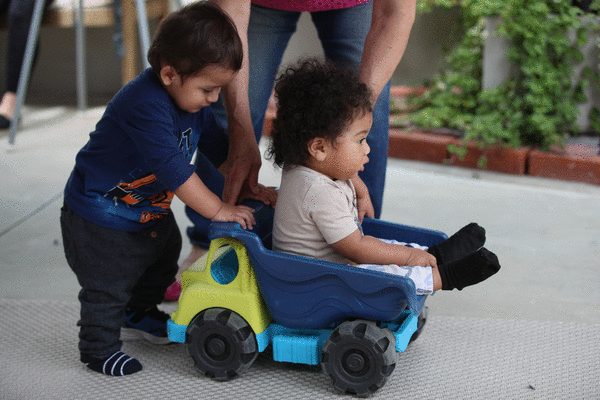
Parents will soon be able to find out what their baby's diaper is made of under a new law signed by Gov. Gavin Newsom Monday that requires companies to disclose ingredients both on packaging and online.
Babies can go through about 3,000 disposable diapers a year, a basic-need product that has increasingly drawn concern from child health, environmental and consumer advocates. Multiple studies link the chemicals, plastics and other ingredients often used in diapers with potential health and environmental risks.
Supporters of Assembly Bill 1901 say the new law will give parents more information for decision-making and pressure manufacturers to avoid using ingredients they wouldn't want to disclose. Companies will be required to provide disclosure online beginning in January 2029 and on packaging the following July. In its final form, the new law gives manufacturers more time to comply and sell the diapers currently on the market.
"Increasing transparency about the ingredients used in diapers is not a partisan issue; it is a pro-parent issue," Assemblymember Marc Berman, D-Menlo Park, said. Berman, who is a first-time father, believes it should be easier to access information regarding a product that touches his son's skin "every hour of every day for the first few years of his life."
Both packaging and online product detail pages are permitted to provide an outbound link to a dedicated webpage on the manufacturer's website to display the full list of ingredients.
Companies that do not comply will be fined up to $5,000 for the first nondisclosure violation and up to $10,000 for any subsequent violation.
In a signing message, Newsom said he supported the mission to increase ingredient transparency for families, but voiced concern over the lack of protections for businesses, which may be forced to divulge confidential information through this disclosure requirement.
"An absence of flexibility around proprietary information could put manufacturers in a difficult position with their suppliers or lead to public disclosure of legitimate confidential business information," he wrote. "I encourage the Department of Toxic Substances Control to initiate its rule-making authority under this bill to clarify these issues."
Infant skin is thinner and more absorbent, making babies more vulnerable to chemicals in disposable diapers, said Kelly Hardy, the senior managing director of health and research at the nonprofit Children Now, among the bill's sponsors.
Some diapers use synthetic musks to create fragrances and plastics that contain chemicals such as phthalates and volatile organic compounds, which studies have linked to developmental delays, reproductive harm, endocrine system disruption and cancer, according to Susan Little, the California legislative director for Environmental Working Group, a bill sponsor. Chemicals can also cause severe rashes and asthma.
"It's really important to many parents to understand what exactly is in the diapers, especially if their babies have sensitive skin or special needs," Hardy said.
Children Now, along with more than 300 organizations, signed a letter in August urging Newsom to sign the bill.
The California law builds off of a similar one passed in New York last year.
_____
©2026 Los Angeles Times. Visit latimes.com. Distributed by Tribune Content Agency, LLC.






Comments