Flock cameras watch South Carolina. But do they actually help solve crime? What study says
Published in News & Features
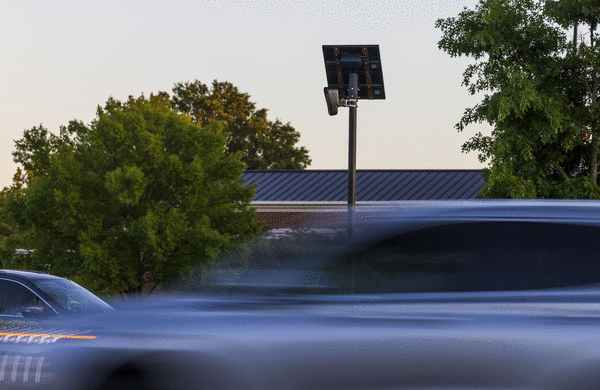
A new study from researchers at the University of South Carolina could be the first to show a link between crime reduction and the spread of Flock license-plate reading cameras.
The study by USC professors Ian Adams and Scott Mourtgos shows that, at least when looking specifically at motor vehicle thefts, cities that adopt Flock Safety cameras have an 11% drop in vehicle thefts in the year following the cameras’ introduction.
“If it’s true that this technology is having an effect on crime, then it would be biggest on motor vehicle thefts, because that’s closest to what the technology is processing,” Adams said in an interview with The State. “It’s a crime that is widespread as compared to more serious crimes, and it is historically one of the least solved crimes. They don’t often find the people responsible. Less than 18% of motor vehicle theft cases are solved, so it’s a very low ‘solved’ rate.”
The findings come as Flock’s cameras, which scan and record the license plates of passing cars and can share that data across connected agencies, have spread widely in recent years across the country, including among law enforcement agencies in the Midlands. Even as critics worry about the effects of mass surveillance and the potential for abuse, police have touted the system’s ability to help solve crimes.
The study looked at publicly reported crime data from 216 large agencies that added Flock cameras to their arsenal. The USC professors partnered with Flock Safety to get access to the company’s internal data, such as when cameras in specific locations were activated, but Adams stressed the study received no funding from Flock.
Flock Safety, the Atlanta-based manufacturer of the increasingly widespread and controversial license-plate reading camera, has spent money elsewhere to promote its technology, however. Last year, Flock spent $20,558 on lobbying in South Carolina, according to records filed with the S.C. Ethics Commission.
South Carolina is one of 34 states where Flock Safety spent at least $1 million in lobbying state lawmakers since January 2025, on top of nearly $1.4 million spent on federal lobbying, according to data put together by Open Secrets, a nonprofit that tracks political spending based on public reporting data.
Most of the company’s S.C. spending — $18,111 — was spent on lobbyists from McGuireWoods Consulting, a multi-state lobbying firm that employs a roster of former S.C. political insiders. Former Gov. Jim Hodges serves as the firm’s South Carolina president.
Flock has been less active in the Palmetto State so far in 2026. As of May 31, the company’s only reported spending in South Carolina was $104 in registration fees.
Data collected for the USC study wasn’t entirely clear on Flock cameras’ impact though. According to the study, law enforcement agencies using Flock have seen a 16% increase in clearances of vehicle thefts. But Adams said the data is ambiguous on how much the cameras contributed to that increase.
“Between the decision and the actual implementation, the data increases in the months leading up to installing the first camera, and then it continues to increase thereafter,” said Adams, an associate professor of criminology and criminal justice at the Columbia campus. That suggests Flock is just one part of “an elevated focus by the police department itself on these crimes. They could start up a motor vehicle theft specialty group and throw a couple investigators at it.”
The numbers did not show a significant increase in the number of vehicles recovered compared to law enforcement agencies that don’t use Flock, but for those cars that were found again, the data showed a faster recovery time, around six hours earlier compared to non-Flock departments.
“That’s a significant proportion of time when most vehicles are recovered within 24 to 48 hours,” Adams said.
Adams said he expects the debate around Flock’s use, and its potential tradeoffs, to continue. But he hopes the study’s findings can contribute to the public’s understanding of the issue.
“This study cannot answer the overall policy question because you have to try to balance crime control, public safety and privacy,” the USC professor said. “But before this study there was no empirical information at all. You had claims but not a showing. I hope this provides an anchoring point to the discussion ... This should be part of the discussions, but it can’t be the end of them.”
_____
©2026 The State. Visit thestate.com. Distributed by Tribune Content Agency, LLC.






Comments