Trump says Belarus potash deal in works amid Canada fight
Published in News & Features
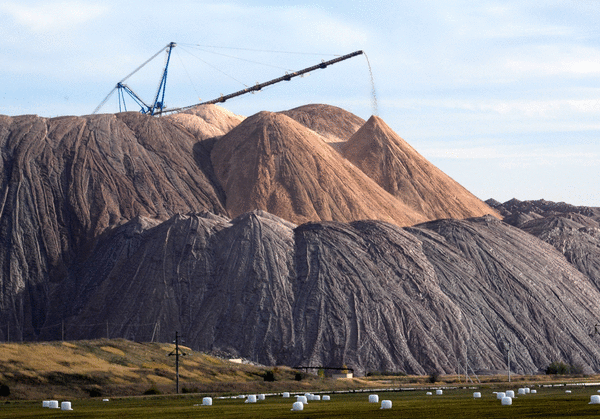
WASHINGTON — President Donald Trump said the U.S. is working with Belarus to secure more supplies of potash amid a trade fight with Canada, a major supplier of the critical ingredient used in fertilizers.
“The United States is working on a massive Deal with respect to the purchase of Potash from Belarus,” Trump said in a social media post Monday. “The pricing would be for substantially less than we are currently paying to Canada, very good news for our Farmers and Ranchers.”
However, Belarus has historically been a much smaller potash supplier to the U.S., and shipments out of the country could also face logistical hurdles. Belarus, prior to U.S. trade restrictions, shipped over 700,000 tons of potassium fertilizers to the U.S. in 2021. That’s a fraction of the roughly 13 million tons that the U.S. imported in 2025, with nearly 90% coming from Canada, according to the U.S. Department of Agriculture.
Trump’s comments come amid an escalating trade war with Canada that has seen the two countries impose tit-for-tat tariffs on imports. Trump’s levies, though, don’t apply to some of the most significant natural resources the U.S. buys from Canada, such as oil, potash and critical minerals — an indication of their importance to the U.S. economy.
The world’s largest reserves of potash, which is mined, are located in Saskatchewan. Shares of Canadian fertilizer producer Nutrien Ltd. dropped as much as 5.2%, while Tampa-based Mosaic Co. fell 5.9% intraday before paring losses. The two companies dominate North American potash production via their joint venture Canpotex.
Whether Trump will be able to tap additional supplies is unclear. Belarus doesn’t have enough capacity to supply large volumes to the U.S., because production for the year is already under contract, President Alexander Lukashenko said earlier on Monday. The transport of Belarusian fertilizers has also faced logistical hurdles in recent years, after Lithuania’s rail system ended its contract with state-run Belaruskali OAO in 2022.
The European Union has enforced sweeping sanctions against Belarus since its presidential election in 2020, which have only ramped up since Russia’s invasion of Ukraine in 2022.
Canada’s location allows it to deliver potash at prices about 35% lower than “landlocked Belarus, so without a corresponding European move at Baltic ports, the U.S. sanctions relief announced by President Trump will do little to restore Belarus’ advantage,” Bloomberg Intelligence analyst Alexis Maxwell said.
Trump has sought to rebuild ties with Belarus and Lukashenko, a close ally of Russian leader Vladimir Putin. The U.S. lifted more sanctions on Belarusian potash in March following the release of political prisoners, even while European Union restrictions remained in force, signaling a divergence of approaches toward Lukashenko amid the Russia-Ukraine conflict. The U.S. is pushing Ukraine to ease restrictions on imports of potash fertilizers from Belarus and has urged Kyiv to encourage other European allies to do the same.
Potash was a major source of foreign-currency revenue for Belarus before Western sanctions over the government’s political repression and its help for Moscow in the war on Ukraine.
U.S. farmers and ranchers, key constituencies for Trump’s Republican Party ahead of November’s midterm elections, are under strain from high costs for diesel, fertilizer and other inputs, as well as disruptions in export markets as the Iran war and Trump’s tariff policies squeeze supply chains. New Orleans potash spot prices are at their highest levels since July 2023, according to Bloomberg Green Markets.
Trump has taken steps to help ease the burden on those groups, with polls showing voters largely disapprove of his party’s handling of the economy and the war.
_____
With assistance from Michelle Jamrisko.
_____
©2026 Bloomberg L.P. Visit bloomberg.com. Distributed by Tribune Content Agency, LLC.



Comments