US and China hail talks as positive ahead of Trump-Xi summit
Published in News & Features
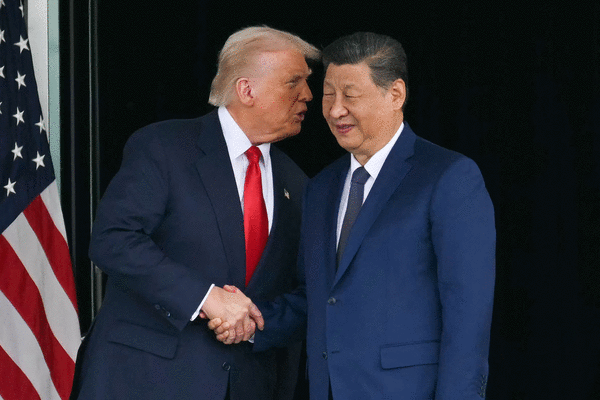
U.S. and Chinese officials offered upbeat assessments of their talks on artificial intelligence, trade and investment, signaling a mutual desire to steady ties ahead of this week’s summit between leaders Donald Trump and Xi Jinping.
China’s top trade negotiator, Li Chenggang, said the talks were held in a “good atmosphere” as he left JPMorgan Chase & Co.’s headquarters in New York on Sunday, while U.S. Treasury Secretary Scott Bessent lauded “very successful” discussions. China’s official Xinhua News Agency called the exchange “candid, in-depth and constructive.”
Hours later, China’s Ministry of Foreign Affairs formally announced Xi’s state visit to the U.S. from Sept. 23 to 25, his first since 2015. Official spokesman Guo Jiakun said the Chinese leader will have in-depth exchanges with Trump, who met Xi in Beijing earlier this year, and that those visits mark a “milestone of historic significance.”
The positive tone underscored how both governments are seeking ways to keep their rivalry from spilling into a broader confrontation, even as they remain far apart on technology controls, Taiwan and other national security issues.
The talks didn’t lead to an agreement to extend the countries’ trade truce, the Financial Times reported, citing people familiar with the talks. An announcement of new U.S. tariffs over allegations of trading partners’ excess manufacturing capacity has been delayed until after the meeting, according to people familiar with the matter.
Stocks rose after the talks, with increases in technology shares lifting Asian equities and futures pointing to gains spreading to Europe and Wall Street. Wheat and corn futures rose as traders anticipate more Chinese purchases of American agricultural products.
China bought more U.S. soybeans late last week, according to traders with knowledge of the deals, with state-owned firms booking at least four cargoes. Earlier this month, China passed the halfway mark of a pledge to purchase at least 25 million tons of U.S. soybeans annually through 2028, part of a broader trade truce struck during a summit in South Korea last October.
Bessent said the two sides agreed to create what he called a “U.S.-China AI dialogue” intended to develop a common understanding of the technology’s benefits and threats. Washington also proposed a notification mechanism covering AI incidents with national security implications.
The initiative appears aimed initially at managing risks rather than creating binding limits on AI development, despite calls from Anthropic PBC co-founder Dario Amodei and other American tech leaders to slow down frontier advances. Xinhua confirmed that the officials held a dialogue on AI but gave no further details.
Bessent told the FT that the U.S. also wants to address threats from non-state actors and concerns about the use of AI in creating biological weapons, adding that the two sides would probably meet again in two months.
Yet even a narrowly focused mechanism would have to overcome deep distrust over whether safety discussions could limit technological development.
“They are going to be reluctant to enter into anything that would constrain Chinese actions,” Kurt Campbell, a former U.S. deputy secretary of state and co-founder of The Asia Group, told Bloomberg TV. “They fundamentally distrust the United States here.”
Campbell said the AI discussions hadn’t reached a stage where the two sides were ready to act. Progress could come at subsequent meetings between the presidents, he said, including when China hosts the Asia-Pacific Economic Cooperation gathering in Shenzhen in November and when the U.S. hosts the Group of 20 in Florida in December.
Since Trump and Xi last met in May, AI has become a central flashpoint. U.S. officials, security agencies and technology companies have accused Chinese firms of systematically distilling from American models to build their own products. Beijing has rejected such accusations as groundless and vowed to retaliate if Washington moves to target Chinese AI companies.
Bessent, who recently warned that “there is no day after tomorrow” if China wins the AI race, said in a statement to Axios last week that “we are open to discussions on avoiding shared risks and avoiding bifurcation of our two systems.”
While the AI dialogue appears focused on containing strategic risks, officials also sought to carve out less sensitive areas where economic ties could expand, even without an immediate deal to extend the broader trade truce.
U.S. Trade Representative Jamieson Greer said the two sides are “preparing the groundwork” for a successful meeting between leaders of the world’s biggest economies, noting that the two sides “operationalized” a Board of Trade that can “create a kind of ballast for the relationship.”
The list of “non-sensitive” items would likely include consumer and low-tech goods from China, and energy, agricultural and medical products from the U.S., he said.
“There is a world where you have a relatively small subset of American and Chinese goods that can be traded in a balanced way, that are non-sensitive, that in the future, as trade actions come up, we can consider them as a class unto themselves,” Greer said.
The U.S. and China have been working to reduce levies on American energy and agricultural products, according to people familiar with the matter, part of a broader initiative to ease barriers on $30 billion worth of products from each side under the Board of Trade mechanism launched earlier this year.
—With assistance from Stephen Engle, Haidi Lun, Colum Murphy, Malcolm Scott and Paul Abelsky.
©2026 Bloomberg L.P. Visit bloomberg.com. Distributed by Tribune Content Agency, LLC.






Comments