Ambassador, Gordie Howe bridge traffic nearly neck and neck
Published in News & Features
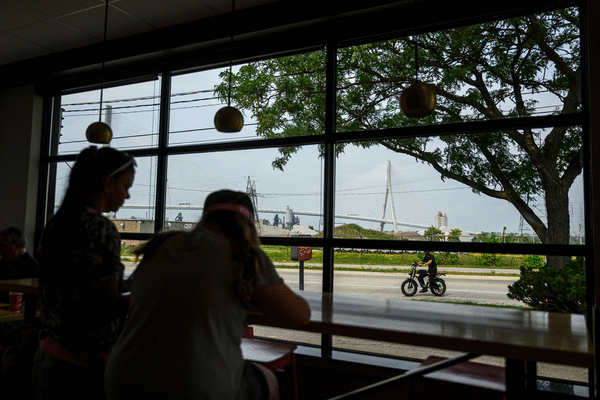
DETROIT — The Gordie Howe International Bridge, in its first full month of operation, nearly became Michigan's busiest border crossing with Canada.
About 343,500 vehicle trips were made across the new public span in August 2026, according to data from the Bridge and Tunnel Operators Association. That fell just short of the roughly 345,500 trips taken across the longstanding, privately owned Ambassador Bridge.
The Gordie quickly became a popular option after its long-awaited opening on July 27. Meanwhile, every other crossing linking southeast Michigan to Ontario, Canada, experienced declines.
The Ambassador Bridge saw total August traffic drop by about 30% compared to the prior year. Passenger cars were fully responsible for that decline as commuters and recreational travelers opted for a newer, wider and cheaper route. Passenger trips across the Ambassador plunged from about 345,000 in August 2025 to 196,000 last month — a decline of nearly 150,000 crossings.
The decline occurred even after operators of the almost century-old bridge slashed its cheapest tolls for passenger cars from $10 to $5.50 in April in anticipation of competition from the rival crossing. By comparison, the best available price for crossing the Gordie is $4.35.
The traffic drop-offs at other regional crossings were smaller but still significant. Total vehicle traffic through the Detroit-Windsor Tunnel was down about 17.5% (343,000 down to 283,00). The Blue Water Bridge — which connects Port Huron to Sarnia, Ontario — saw a 10.5% decrease (373,000 to 334,000).
Despite the August decline, the Detroit-Windsor Tunnel remained the top passenger-car crossing between Michigan and Canada. It recorded about 281,000 passenger trips last month (excluding buses and other non-passenger vehicles) compared to 270,000 for the Gordie.
"The goal of the Gordie Howe was to be the primary commercial and secondary passenger vehicle traffic facilitator connecting Windsor with Detroit and Michigan with Ontario," said Tal Czudner, who leads the BTOA and is also CEO of Windsor Detroit Borderlink Limited, the Canadian operator of the tunnel.
He added: "The tunnel has lost, you know, certainly a percentage of business, but not an overwhelming percentage. The tunnel still is the preferred passenger vehicle crossing connecting Windsor and Detroit."
Trucking showed a similar trend in August. The Gordie gained traffic share, but the freight industry mostly stuck to established routes. The Ambassador Bridge remained the No. 1 regional border crossing for trucks, with about 150,000 trips. The Blue Water Bridge ranked second with 132,000.
The Gordie Howe Bridge was well below both of those figures. It handled about 74,000 commercial shipping trips in August.
"As you've seen in the first month, the Ambassador Bridge was still able to retain a pretty high percentage of the truck traffic," Czudner said. He suggested that is because the operators of that crossing "did a pretty aggressive job signing up people to contracts."
"The folks at the Ambassador Bridge are astute business people," he said.
Jason Miller, a professor of supply chain management at Michigan State University, said it "jumped out" to him that the Gordie Howe Bridge "really picked up passenger traffic" while freight traffic was less responsive to the new option.
"This may point to some adjustment costs for shifting truck traffic, such as companies already having established contract prices with the Ambassador Bridge that are limiting adjustment," Miller said in an email. "Passenger vehicles wouldn't have the same type of adjustment costs."
"Consequently, the two bridges are handling very similar volumes but with a very different mix. Gordie Howe is 78.5% passenger and 21.5% truck. Ambassador was 56.7% passenger and 43.3% truck," he added.
The total number of vehicle trips of all kinds between Michigan and Ontario in August was about 1.3 million. That was an increase from the previous month (1.25 million) and the same month last year (1.2 million).
"The overall number is pretty decent for the region when you consider that there's, obviously, some challenges when it comes to tariffs and politics," Czudner said.
Patrick Anderson, CEO of the Lansing-based Anderson Economic Group, similarly said the August traffic numbers were encouraging.
"That's a lot of trips. It shows that no matter what was going on politically — not to mention the fact that people were still trying to find the exit — there was still a third of a million people traveling over this bridge," he said of the Gordie. "And we still had over a third of a million people on the Ambassador Bridge too. That certainly underlines the importance of these vital trade crossings to the economies of both Canada and the United States."
Canada's federal statistical agency previously announced on Sept. 11 that about 240,500 trips into Canada across the Gordie Howe Bridge took place in August, including 135,000 by Canadians and 101,000 by Americans. The new BTOA data accounts for trips in both directions by travelers of all nationalities.
The Windsor-Detroit Bridge Authority, the entity that operates the Gordie Howe Bridge, celebrated the release of its first full month of traffic data.
"The August results released by BTOA reflect data provided by WDBA for the Gordie Howe International Bridge. We are encouraged by the bridge's first full month of operations which saw approximately 269,700 passenger vehicles and 73,700 commercial vehicles," spokesperson Kathryn Segal said in an email.
"As a new crossing, the bridge provides options at the Windsor-Detroit border, adding capacity and redundancy while supporting long-term movement of people and goods between Canada and the United States."
The Detroit International Bridge Company, which operates the Ambassador Bridge, did not respond Sept. 14 to a request for comment.
_____
©2026 The Detroit News. Visit detroitnews.com. Distributed by Tribune Content Agency, LLC.





Comments