Mideast escalation risks an oil shock ahead of the midterms
Published in News & Features
WASHINGTON — A bold military push by Iran and its proxies to create a choke hold on global oil supplies has once again caught the Trump administration off guard, threatening a market shock and a steep political backlash in the U.S. midterm elections.
A drone attack on Saudi Arabia’s most crucial pipeline, which siphons crude oil from the Persian Gulf to the Red Sea to bypass the Strait of Hormuz, has led to the line’s closure, potentially taking 4% of the world’s supply off the market.
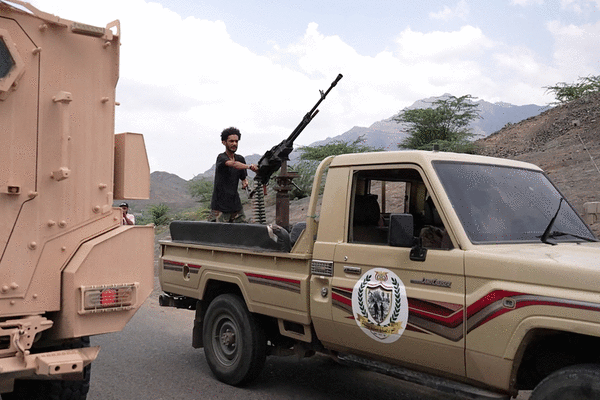
And a lightning advance by Iran-backed Houthi rebels along Yemen’s Red Sea coast threatens commercial traffic through the Bab el-Mandeb Strait, second only to Hormuz in its importance to regional shipping.
The strikes put the Trump administration in a newly precarious position less than two months until the November midterms. President Trump’s military advisers have warned him that any retaliation could lead to a further depletion of critically low U.S. munition stockpiles, endanger American personnel in the field and risk escalation that could spiral out of Washington’s control.
On Tuesday, the global price of oil topped $107 a barrel — the first time in U.S. campaign history that an incumbent president has faced rising pump prices at this stage of an election.
The Iranian strikes come as Europe and the United States are facing increased energy needs entering the fall and winter months, and as Ukrainian attacks on Russia’s energy infrastructure have surged, pushing diesel prices up to record highs.
Signs are emerging that the latest attacks could trigger an acute market panic, with Brent crude buyers paying a steep premium for early delivery — an indication that the industry fears an impending supply crisis.
“I fear there is a considerable risk of much higher gas and diesel prices in the weeks to come,” said Michael O’Hanlon, director of research of the foreign policy program at the Brookings Institution.
“No one is quite sure how to predict the fuel markets,” he added, “but the military dynamics are seriously worrisome.”
Last week, Trump told reporters that the Iranian government is “desperate to try and affect the election” and could be trying to keep oil prices elevated to hurt Republican prospects.
“Right after the election, oil prices are going to be tumbling downward,” Trump said. “I think it’s going to take a little bit longer than the midterm.”
Polls have found that likely voters are prioritizing the economy far beyond any other policy matter going into the fall election season, with a New York Times poll published Tuesday showing voters trusting Democrats to handle the economy more than Republicans.
Region on edge
The latest Iranian campaign threatens Saudi Arabia’s economic core, straining a long-standing alliance built on robust U.S. defense of Riyadh’s vital interests.
The attack on the East-West oil pipeline originated in Iraq, where Iran continues to operate proxy militias, according to government officials in Riyadh and Baghdad. Saudi Arabia agreed not to retaliate militarily against targets on Iraqi soil, temporarily staving off a regional conflagration.
While the Iraqi militia group denied involvement, it also praised the Houthi advance in Yemen and the militants’ “ongoing battlefield victories against Saudi forces.”
Israel has been providing Saudi Arabia with intelligence to help thwart further attacks, using American military intermediaries, according to Israeli media reports.
Active combat in the war between Iran and the United States eased after a ceasefire was brokered in June. While that truce collapsed in July, the two sides have opted for asymmetric tactics over the resumption of direct attacks, with the United States maintaining a full naval blockade of Iranian ports.
The Trump administration has since focused instead on targeting Iran’s economic partners with aggressive secondary sanctions, seeking to further pressure Tehran into a meaningful peace agreement. But negotiations have failed for months to get back off the ground.
When he first launched the war in February, Trump projected the mission would last roughly six weeks. He said the goal of the U.S. operation was to incapacitate Iran’s ballistic missile program, its navy and its nuclear program.
Trump was warned ahead of the war by his joint chiefs of staff that Iran could attempt to close the Strait of Hormuz in response. But he dismissed the threat, anticipating Tehran would quickly back down from a direct confrontation with the United States.
More than six months on, Iran’s ballistic missiles continue to pressure U.S. defense systems across the Middle East. Traffic through the Strait of Hormuz remains disrupted and discussions on Iran’s future nuclear work have broken down. In private, Trump administration officials fear the war could drag through the remainder of the president’s term.
_____
© 2026 Los Angeles Times. Visit at latimes.com. Distributed by Tribune Content Agency, LLC.






Comments