Lagarde wades into French election politics in Normandy
Published in News & Features
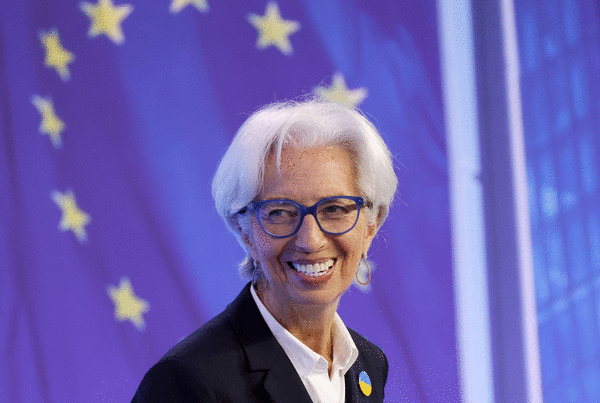
Christine Lagarde entered France’s presidential election fray at a political gathering on Saturday, as speculation builds that she’ll leave the European Central Bank early.
Her speech in rural Normandy transported her far from the technicalities of setting interest rates, just days after she and her ECB colleagues delivered a second hike to contain inflation spurred by the Iran war.
“Here at the Fête de la Pomme, we celebrate something distinctly Norman,” Lagarde said. “Europe has helped that regional identity become a greater source of prosperity, opening markets while protecting what makes local products distinctive.”
The annual event, hosted by the region’s president, Hervé Morin, has more to do with politics than apples. Past editions have featured conservative presidential hopefuls including Bruno Retailleau, who wants to feature in next year’s ballot.
While Lagarde has described being France’s president as a “terrible job,” she also said recently that she wants to make a European voice heard in campaigning.
She did just that on Saturday, highlighting how Europe is “helping Normandy build on its regional strengths to succeed” across the continent and internationally.
“European integration helps turn regional strengths, old and new, into global strengths,” she said. “Our task is to build on that achievement. By bringing more of our strengths together, we can give businesses greater scope to invest and households greater security in a more uncertain world.”
Lagarde has refused to rule out an exit from the ECB before her term ends in October 2027, and news that her memoir, "Lady First," will arrive in late January has added to chatter that she’s ready to open a new chapter away from Frankfurt, with the World Economic Forum considered a likely destination.
At the news conference following Thursday’s rate decision, she repeatedly dismissed questions about her future saying “there is nothing to report.”
In an interview with local newspaper Ouest-France published late Saturday, she rejected the suggestion of returning to national politics after leaving the ECB.
“I’ll be turning 71 soon,” she said. “You have to know when to call it a day.”
With less than eight months until the first round of voting, France’s election campaign is heating up. While outgoing President Emmanuel Macron has embraced and defended the European Union, the frontrunners in the race to replace him have sketched out policies that challenge its rules and institutions.
Polls currently show far-right leader Marine Le Pen, who wants to cut EU funding, has a strong lead. With a multitude of candidates splitting the centrist vote, some surveys point to the far left’s Jean-Luc Mélenchon as her opponent in a runoff on May 2.
Mélenchon has set the tone of the debate so far with calls to tackle France’s rising debt mountain by canceling bonds held at the ECB and the Bank of France. He has also slammed the ECB’s rate hikes, saying they’re driving the economy into a wall.
“When the central bank raises rates, it will worsen the situation and push us into a recession,” Mélenchon said at a rally on Saturday, calling for price increases to be blocked, including those for gasoline.
In a lengthy speech, he took aim at Lagarde for her past track record as finance minister as well as at Bank of France Governor Emmanuel Moulin, reiterating his calls to cancel or freeze debt because “our country needs to breathe.”
Lagarde had voiced her opinion on wiping out debt on Thursday, calling any such move legally impossible and “financially dangerous.”
For her part, Le Pen on Saturday suggested she would prefer to see the adoption of a flawed full budget law than a so-called special law mechanism, or Loi Spéciale, designed to keep the state operating, saying the former would be easier to modify if she won the election, according to Agence-France Presse.
France faces a growing risk of failing to pass a budget for 2027, as a fractured parliament leaves little room for compromise ahead of next year’s election.
Speaking before Lagarde on Saturday, the regional president Morin joked that he was looking forward to hearing whether debt needs to be paid back or not.
“I’ve got good news for you,” he said. “As Christine decides on the creation of money, I can announce that for us, the people of Normandy, the ECB has opened unlimited credit lines and we won’t need to pay them back.”
Morin is a veteran politician who’s played key roles in the formation, and collapse, of several center-right parties in France. But the 65-year-old has kept a distance from Macron’s governments, even joining calls for him to quit during recent turbulence.
Of late, Morin has advocated a primary to narrow the crowded field of moderate politicians vying to become president, a list that includes two of Macron’s former prime ministers, Edouard Philippe and Gabriel Attal. Morin and other centrists say the proliferation of candidates boosts the chances of Le Pen and Mélenchon.
Stopping at an oyster stand arriving at the event, Lagarde praised the quality of the shellfish, and complained to the local producer about those she’d eaten in the U.S., where she said they are washed in water containing bleach.
“It’s really good, I’ll take a second one,” she said.
The producer didn’t seem sure who she was, saying it was great to meet a “partner” of Morin. “We are fellow travelers,” she said. Morin then explained she’d sailed to greater things since they first met.
She also stopped to chat with a cider and calvados producer, but didn’t try anything.
Lagarde, who grew up in Normandy, served in the same cabinet as Morin for most of her four years as finance chief, before he lost his post as defense minister when President Nicolas Sarkozy shifted to the right in late 2010. Lagarde left French politics soon after to lead the International Monetary Fund.
“We think that inviting Christine made sense today in a pre-election context,” Morin said. “Having been finance minister and chief of the IMF and now the president of the ECB, she is at the crossroads of all the challenges of the 2027 presidential election.”
(Ros Krasny, Tara Patel, Ania Nussbaum and Angela Cullen contributed.)
©2026 Bloomberg L.P. Visit bloomberg.com. Distributed by Tribune Content Agency, LLC.





Comments