Eastern Shore judge weighs Maryland redistricting ballot challenge
Published in News & Features
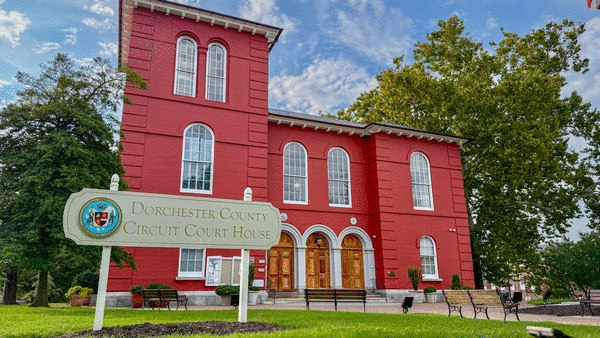
BALTIMORE — An Eastern Shore judge raised concerns Thursday about whether Maryland lawmakers followed their own election rules and accurately described a proposed congressional redistricting amendment to voters, as he prepares to rule by Friday afternoon on whether the measure should remain on the Nov. 3 ballot.
The lawsuit, filed Aug. 10 by Republican lawmakers and a Dorchester County voter, is the second legal challenge seeking to keep Question 3 off the ballot. An Anne Arundel County judge ruled Wednesday that the question should be removed, but paused his order while the state appeals to the Supreme Court of Maryland.
During Thursday’s hearing at Dorchester County Circuit Court, S. James Sarbanes, the administrative judge for Dorchester, Somerset, Wicomico and Worcester counties, interrupted the state’s argument that lawmakers were not bound by a July 1 deadline to certify statewide ballot questions. “They’re not complying with their own law,” he said of the General Assembly.
The state argues that the deadline applies to duties assigned to the secretary of state, not to the General Assembly when lawmakers exercise their constitutional authority to draft a ballot question themselves.
Assistant Attorney General Daniel Kobrin said the legislature’s main timing constraint is whether election officials can get the question on ballots in time. He argued that those conditions were met and that voters received adequate notice. The plaintiffs countered that the election rules are mandatory, not optional, and that lawmakers could not disregard them after realizing they had missed the deadlines.
What voters would see
The two sides also clashed over whether Question 3 accurately tells voters what they are being asked to approve.
The question says the amendment “clarifies” that certain standards in the Maryland Constitution apply only to districts used to elect members of the General Assembly. Plaintiffs argue the wording understates the proposal’s effect and fails to tell voters that it would change which state constitutional requirements apply to congressional districts.
“They’re trying to hide the ball on what’s happening here,” plaintiffs’ attorney Strider Dickson said during the hearing, arguing the wording “creates confusion” for voters.
The plaintiffs also pointed to the other two proposed constitutional amendments on the November ballot. Questions 1 and 2 include brief explanations of what a vote for or against each proposal would mean, while Question 3 does not, Dickson told the court.
The lawsuit also argues that Question 3 improperly combines multiple issues, including which constitutional standards apply to congressional districts and whether the General Assembly should be able to give the Supreme Court of Maryland original jurisdiction over challenges to congressional maps.
Two challenges, likely one destination
The Dorchester case overlaps with a separate challenge heard this week in Anne Arundel County, which focuses heavily on the process lawmakers used to put the question before voters, including the missed July 1 deadline and other notice requirements. The Dorchester lawsuit raises many of the same objections but more broadly challenges the substance and presentation of the amendment.
Del. Chris Adams, a Republican and one of the Dorchester plaintiffs, acknowledged that the cases are “substantially similar” on the central question of whether lawmakers must follow their own election rules but said they have proceeded on “two separate rails,” allowing for differences in the legal arguments. “The legislature has an obligation to be honest and transparent in its dealings, especially when it comes to amending Maryland’s Constitution,” he told reporters following the hearing.
Even if Sarbanes sides with the plaintiffs, he has agreed to pause any order blocking Question 3 while the state appeals, likely sending the dispute to Maryland’s highest court again.
Kobrin, who represented the state in both cases, said during a Wednesday State Board of Elections meeting that if they both reach the Supreme Court, he would “ideally” like them considered together and hopes both can be resolved by Sept. 3.
That timetable could extend beyond the State Board of Elections’ Aug. 31 deadline to certify ballots for printing. How the litigation would affect that process remains unclear.
_____
©2026 Baltimore Sun. Visit baltimoresun.com. Distributed by Tribune Content Agency, LLC.






Comments