At least 100 dead as flash flood hits Nepal-China border
Published in News & Features
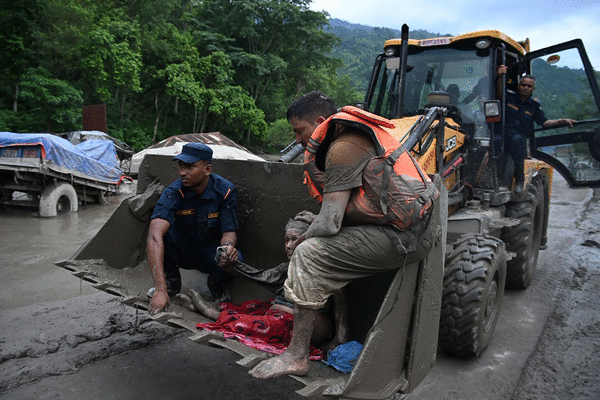
A violent flash flood at the Nepal-China border tore through a checkpoint, leaving at least 100 people dead and hundreds missing, including 291 foreigners who were identified by local authorities.
The mudslide struck at around 8:30 a.m. local time Wednesday, according to preliminary data released by the Nepal Tourism Board, with a total 384 travelers unaccounted for — including citizens of the United States, India, the United Kingdom, the Netherlands and Australia — along with 93 Nepalis. The latest death toll is from Nepal police.
An initial analysis of satellite images suggests a flood occurred in the Lhende River because of a landslide on the Nepal-China border, according to a post on X by Nepal’s National Disaster Risk Reduction and Management Authority.
Scientists from the International Center for Integrated Mountain Development and partner institutions in Nepal and China are investigating whether the flood may have been triggered by an ice-rock avalanche originating from a high-altitude area.
The Kathmandu-based group said in a statement that a preliminary assessment based on video footage and information from affected areas suggests a large volume of ice and rock debris may have entered the river. That could have generated a sudden surge that carried water, sentiment and large boulders downstream.
The disaster hit Tibet’s Gyirong county, with videos circulating online showing the torrent of mud and water sweeping through the area. Chinese President Xi Jinping called for an all-out rescue effort in Tibet, in what could become one of the deadliest natural disasters in the country this year.
The Chinese leader stressed the immediate priority was to spare no effort in searching for persons who are missing, as well as relocating and resettling any threatened residents, according to a statement on the government website.
Xi urged local governments and relevant agencies to prepare for worst-case scenarios, strengthen flood and typhoon control measures, and step up inspections of potential hazards.
China’s Ministry of Natural Resources has activated a Level-II emergency response for geological disasters, the second-highest in the country’s four-tier emergency response system, Xinhua News Agency reported.
Nepal’s security personnel have rescued more than 250 people through army helicopter, while police and the military continue searching in flood-affected areas, Nepal’s Prime Minister Balendra Shah said on a Facebook post. More than 50 citizens have lost their lives due to the flood so far, he said, while urging those in flood-affected areas to be patient.
“The government takes full responsibility for your rescue, treatment, food and shelter,” Shah said. “In times of such a disaster, we all need to stand together.”
Indian Prime Minister Narendra Modi spoke with his Nepali counterpart and conveyed his condolences, according to a post on X. “India is ready to provide all possible humanitarian assistance to Nepal,” he said. “Our teams are coordinating closely on rescue and relief efforts.”
Many Indian nationals in the area were undertaking the Kailash Manasarovar Yatra pilgrimage to Mount Kailash and Lake Manasarovar in Tibet, sites considered sacred by Hindus and Buddhists, according to the Press Trust of India.
Uttar Pradesh, India’s most populous state, which borders Nepal, is also preparing for possible flooding as river levels are expected to rise. “Instructions have been issued to the local administration to remain fully vigilant and ensure necessary preparations,” the state’s chief minister said in a post on X.
Chinese authorities announced some details of emergency funding for rescue and recovery efforts. The Ministry of Finance and Ministry of Natural Resources allocated 120 million yuan ($17.9 million) in central natural disaster relief funds to support Tibet in emergency rescue and disaster relief work. The National Development and Reform Commission earmarked 100 million yuan in central budget investment to support post-disaster emergency recovery and reconstruction efforts.
_____
(With assistance from Colum Murphy, Sudhi Ranjan Sen, Vikram Kumar, Phila Siu and Lili Pike.)
©2026 Bloomberg L.P. Visit bloomberg.com. Distributed by Tribune Content Agency, LLC.






Comments