Murder retrial in Sierra LaMar disappearance heads toward jury selection
Published in News & Features
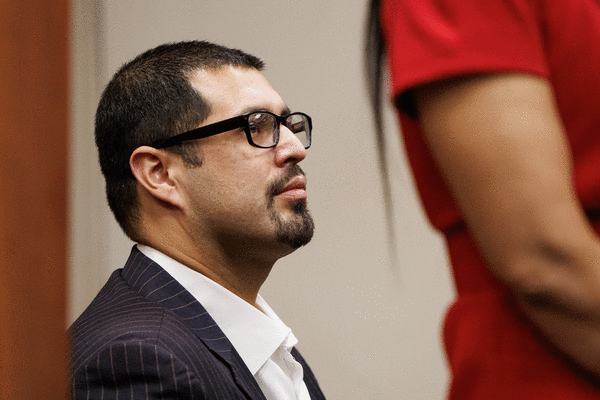
SAN JOSE, Calif. — The renewed murder case in the 2012 disappearance and presumed killing of Sierra LaMar is heading to jury selection this week, with defendant Antolin Garcia Torres telling a judge Monday that he’s ready to defend himself again following his conviction reversal earlier this year.
Prospective jurors will be evaluated in Santa Clara County Superior Court starting Wednesday, Judge Brian Buckelew said at a hearing Monday. He also affirmed that the court is aiming for opening trial statements, followed by the introduction of testimony and evidence, to commence the first week of October — consistent with a timeline he outlined over the summer.
In court Monday, Deputy District Attorney O’Bryan Kenney and deputy alternate defenders Al Lopez and Mishya Singh argued over whether the defense should get more time to present pretrial motions by either modestly pushing back the trial schedule or litigating them as jury selection proceeds. Ultimately, Garcia Torres agreed with his lawyer and told Buckelew that he was reluctantly conceding his position to keep the case moving toward trial.
“I understand the time constraints. I’m not trying to jam anyone up,” Garcia Torres said, as the judge confirmed that he understood the decision. “I want to move forward. I want to consistently move forward to trial.”
Also Monday, Buckelew denied a defense motion to recuse the district attorney’s office from prosecuting Garcia Torres, after Lopez and Singh argued in filings and in court that prosecutors in the first murder trial and in the intervening years concealed or delayed turning over evidence. They also argued that the office improperly charged Garcia Torres — a point underpinned by an appellate court’s central reasoning for overturning his 2017 murder conviction.
The judge said that for the misconduct allegations, even if true, recusal was not the correct remedy. The court was also evaluating several other pretrial matters — addressed through what are known as motions “in limine” — that will set the general ground rules for what can and cannot be presented to a jury at trial. Last week, Buckelew denied a defense motion for a gag order on public remarks by the trial attorneys, and also denied a prosecution motion requesting Garcia Torres’ prison file.
One outstanding issue, which Buckelew said he was still deciding, involves a defense dispute over the prosecution’s intention to commission the Pennsylvania-based DNA data firm Cybergenetics for consultation and potential DNA analysis, with the defense raising confidentiality and fairness concerns given the alternate defender’s office’s past consultation with the vendor.
Garcia Torres’ original murder and kidnapping convictions were reversed in February after the 6th District Court of Appeal ruled that the judge and prosecutors in his 2017 trial improperly consolidated three 2009 attempted kidnapping allegations against Garcia Torres alongside the charge that he abducted and killed Sierra on March 16, 2012 as she walked to a bus stop in unincorporated Morgan Hill.
After the reversal was finalized in May, Garcia Torres invoked his speedy trial rights and is being represented by a familiar face in Lopez, who defended him during the original trial.
The appellate decision found that the murder and attempted kidnapping charges in aggregate could have led jurors to judge the murder charge based on his alleged conduct in the other cases rather than just the evidence involving Sierra. The appellate ruling ordered that the attempted kidnapping allegations cannot be introduced in any retrial for the murder; they will now be tried separately.
That leaves forensics at the center of the case, revolving around DNA that authorities connected to Garcia Torres: a strand of Sierra’s hair found on a piece of rope in the trunk of his Volkswagen Jetta, and his genetic material found on Sierra’s pants that were found in a field near where she was last seen.
The defense is challenging the strength of that evidence, and, in the absence of a body, have characterized the prosecution’s murder theory as speculation. Prosecutors are in turn challenging the defense’s ability to present jurors with potential third-party culprits and evidence they say suggests that Sierra was still alive after her disappearance.
________
©2026 MediaNews Group, Inc. Visit at mercurynews.com. Distributed by Tribune Content Agency, LLC.





Comments