Supreme Court allows Trump's plan to regulate but not block use of mail ballots
Published in News & Features
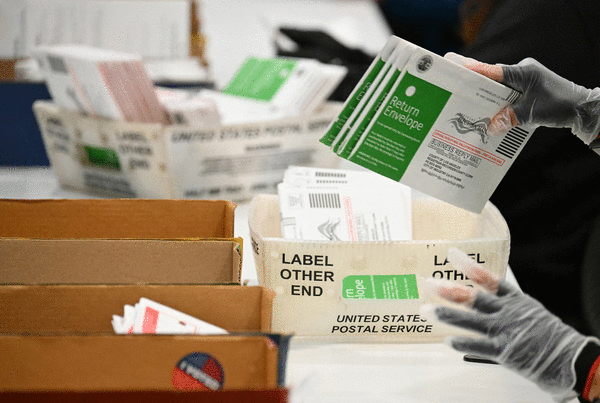
WASHINGTON — The Supreme Court cleared the way Monday for President Donald Trump to seek new limits on the use of mail ballots, but they are not likely to take effect this year.
Acting by a 6-3 vote, the court’s conservatives granted an emergency appeal from Trump’s lawyers and set aside a judge’s order that blocked new federal regulations on states and their use of mail ballots.
It’s not clear, however, what happens now, since the midterm elections are less than three months away.
About 30% of the nation’s voters — and 80% of Californians — cast their ballots by mail in 2024. Trump, however, has long maintained the voting by mail leads to fraud, including voting by noncitizens.
The court’s order stressed the new regulations do not put new requirements on the states this year.
Trump’s executive order “is internal directive from the President to his subordinates mandating that certain agencies pursue certain policies. It neither requires nor forbids anything of anyone outside the Executive Branch,” the court said.
The Department of Homeland Security will compile state-by-state lists of citizens who are over 18 and eligible to vote.
“States are not required to use the Lists,” the court said, although they could lead to future prosecutions.
The most disputed provision could have authorized the Postal Service to restrict mail ballots to those who are on the Homeland Security lists, but that is a future proposal, not a rule that will take effect this year.
The unsigned order spoke for the six Republican appointees. The three liberals, all Democratic appointees, dissented into two separate opinions.
Justice Ketanji Brown Jackson said Trump’s order was unlawful and should have been struck down. “It needlessly injects chaos and uncertainty into the upcoming midterm elections,” she said.
“Today’s decision does not address whether the President’s attempts to interfere with States’ administration of the November 2026 elections are lawful,” Justice Sonia Sotomayor wrote in a dissent joined by Justice Elena Kagan. “Nor does it suggest that the Executive Branch has any constitutional or statutory authority to implement the President’s directives. Instead, today’s decision merely postpones adjudication of those challenges.”
Trump issued his executive order on March 31 with the aim of “ensuring citizenship verification” in federal elections. California and 22 other Democratic-led states sued a few days later and said Trump sought to use the Postal Service to impose new restrictions on voting by mail. They also argued the Constitution gives states and Congress the power to regulate elections, not the president.
A federal judge in Boston and 1st Circuit Court agreed with the challengers and blocked Trump’s executive order from taking effect for the November elections.
The case on appeal was Trump v. California because California Attorney General Rob Bonta was a leader of the Democratic state attorneys who sued.
_____
©2026 Los Angeles Times. Visit at latimes.com. Distributed by Tribune Content Agency, LLC.



Comments