DOJ backs bid to undo sanctions against Trump-linked FIU law school dean
Published in News & Features
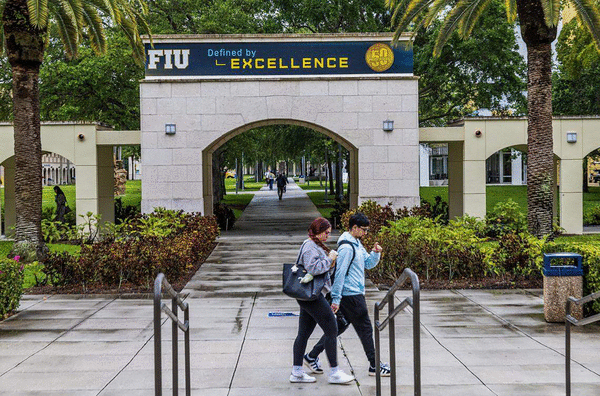
The Department of Justice recently filed a motion in federal court in support of vacating sanctions levied against Florida International University’s new law school dean Daniel Epstein while he was a personal attorney for President Donald Trump.
Epstein was sanctioned days after he was announced as the pick to lead FIU’s College of Law. The university’s president and provost declared the initial search for a dean failed earlier this year and picked Epstein, who applied for the position but was not named as one of the finalists or even a top 20 candidate by the initial search committee.
The Aug. 12 DOJ filing in the U.S. Court of Appeals for the 11th Circuit came as part of the Trump legal team’s appeal of a ruling by U.S. District Judge Kathleen Williams. In July, she ruled that Trump’s lawsuit and proposed settlement with the Internal Revenue Service was “brought for an improper purpose” and amounted to self-dealing.
Williams’ sanction against Epstein for his involvement in the case essentially barred him from appearing in the U.S. Southern District of Florida for one year. Williams referred another attorney for Trump, Alejandro Brito of Coral Gables, to the Florida Bar for potential discipline.
In the filing, Acting Deputy Attorney General Trent McCotter cited a 1990 ruling from the court in defending the attorneys “creative claims.”
“When it comes to sanctioning parties or attorneys for their legal positions, this Court has held that ‘we prefer that an attorney feel free to exercise (his) judgment without fear of reprisals should his lawsuit miscarry… creative claims, coupled even with ambiguous or inconsequential facts, may merit dismissal, but not punishment,’” McCotter wrote.
McCotter argued that Williams’ ruling appeared politically motivated, pointing to Williams’ criticism of U.S. Attorney General Todd Blanche, who was acting attorney general at the time and about to undergo confirmation hearings. Unlike Epstein, Blanche was not formally sanctioned, with Williams instead referring the matter to the New York Bar, where he is admitted.
All this led to the DOJ’s conclusion that the case should be “reassigned” away from Williams if it were to go back to district court.
“Surrounding circumstances give the strong appearance that the rushed issuance was done for an improper political motivation, which warrants reassignment,” McCotter wrote.
Epstein’s hiring for the role, on an interim, tenure-track basis, has sparked pushback and questions from FIU faculty. Some expressed concern about his vision for the law school and his ties to Trump as well as staunch conservative activists like White House adviser Stephen Miller – Epstein was vice president of Miller’s conservative litigation group, America First Legal.
America First Legal also filed an amicus brief arguing the sanctions should be undone.
Stephen Gillers, a professor of legal ethics at New York University’s law school, told the Herald that the DOJ’s intervention on the matter of Epstein’s sanctions was “unique,” but the department has the right to intervene if it believes there is a federal interest.
“But I stress that DOJ’s interest must be vindicating the interest of the United States, not Trump or Epstein personally,” Gillers added.
The proposed settlement originally intended to create a $1.8 billion fund intended to benefit Trump’s allies, possibly including people who stormed the U.S. Capitol as part of the Jan. 6, 2021 riots. Williams’ ruling technically blocked Epstein from appearing in the Southern District of Florida “pro hac vice,” which is a mechanism attorneys use to practice law in a state or jurisdiction where they’re not licensed to practice. Epstein is not a member of the Florida Bar Association.
One member of the FIU search committee, longtime civil rights attorney and founding director of the law school’s Trial Advocacy Program H.T. Smith, has spoken out directly against Epstein’s hiring. Williams’ ruling led Smith to call Epstein a “poster boy for ethical corruption.”
“Central to the values (of FIU) is preparing the law students to meet a high ethical and professional standard. Nothing could undermine these principles of ethics and professionalism than to have a poster boy for ethical corruption serving as the dean of the law school,” Smith told the Herald in an interview.
In an Aug. 21 filing in the I.R.S. case, Christopher Oprison, another Miami attorney representing Trump, wrote that Williams’ bar referrals for some of the attorneys result in “continuing stigma and institutional weight” against them.
“The same is true of Mr. Epstein’s wrongful one-year pro hac vice ban, which carries the ongoing professional stigma of an operative federal sanction every day it remains in force and may expire before appellate review can provide meaningful relief,” Oprison wrote.
Spokespeople for FIU did not respond immediately to requests for comment, or if Epstein’s status at FIU is at all contingent on how the appeals process unfolds.
_____
©2026 Miami Herald. Visit miamiherald.com. Distributed by Tribune Content Agency, LLC.





Comments