Gavin Newsom's plan to change wildfire liability faces blowback, impending deadline
Published in News & Features
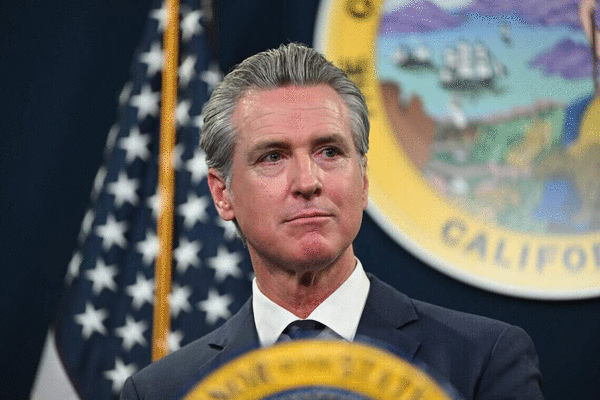
SACRAMENTO, Calif. — With just one week left until the end of the legislative year, California lawmakers and Gov. Gavin Newsom are negotiating a major change to how damages are paid for utility-caused wildfires that ravage homes and regional economies.
Newsom has kicked off debate over far-reaching proposals that could impact Californians’ home insurance prices, utility bills and who makes their community whole when electrical equipment sparks a wildfire that sweeps into their town. That debate has largely played out behind the scenes but has broken out into the open as the Legislature nears its presumptive end on Aug. 31.
Details have now begun to trickle out. A five-page list of Newsom’s aims references both bills already moving through the Legislature and new proposed statutes that are not yet in print. At the core of his proposal are efforts to limit what utilities are financially liable for when their equipment begins immensely costly wildfires and ensure survivors get compensated before financial institutions.
Newsom, during a recent news conference, said his proposals are just a starting point and part of an “iterative process.”
“This is part of the debate,” he said. “It’s part of the engagement.”
Legislative leaders are expected to counter the governor’s offer.
So far, the process has sparked a fierce backlash that poses a test of Newsom’s political might in the final months of his second term. He faces accusations of facilitating a bailout for major utility companies that benefit investors over Californians, particularly those who lost their homes in recent fires.
“It is another multi-billion dollar transfer of wealth from California families to utility executives and their Wall Street shareholders when they cause more catastrophic fires,” said Joy Chen, executive director of Every Fire Survivor’s Network, a group born out of the catastrophic 2025 fires in the Los Angeles area.
‘We need to move’
Newsom has said one of his main goals is to prevent another massive utility bankruptcy as a result of wildfires.
He and the Legislature created a state wildfire fund in 2019, the same year Pacific Gas & Electric Co. entered bankruptcy court after racking up massive liabilities for deadly fires including ones that burned Santa Rosa and Paradise.
Utility critics accused the company of invoking bankruptcy when it didn’t truly face insolvency, a process that left wildfire survivors unpaid for years while insurance companies and hedge funds were able to quickly secure large payouts from PG&E. Many of those wildfire survivors now feel they signed off on a bad settlement with the utility under pressure created by state leaders, including Newsom, who wanted to set up the state wildfire fund and keep PG&E operational.
Some of the practices that leave financial institutions to make a profit while survivors go underpaid or have to wait have continued in other California mega fires where a utility is found at fault. In Los Angeles after the Eaton Fire, Wall Street investors snapped up insurance claims, hoping to turn a profit, the Los Angeles Times reported.
The California Earthquake Authority oversees the wildfire fund. It said in a report published in April, the Eaton Fire, which local and state fire investigators have linked to an offline Southern California Edison tower, could impair or deplete the reserve. That is despite an $18 billion injection of money into the fund last year.
“That fund will be exhausted, and so we don’t have time to wait,” Newsom said at the recent news conference. “I feel very strongly that we need to move on this.”
The governor’s wishlist includes measures that would limit the amounts some entities, including insurers, corporations who lose profits through wildfires and public entities like hospitals or local governments, can secure from utilities. At the same time, he seeks to create a “fast pay program” that would issue payments to survivors within months and outside of court processes so they can begin to recover quicker.
So far, however, the bounds of that proposal are not public. That’s led some advocates to say they can’t weigh whether it’s truly a benefit to future fire survivors or is just a way for utilities to buy off survivors with smaller payments than what they’d secure in court.
“On the surface fast is good,” said Will Abrams, a 2017 fire survivor in Santa Rosa and advocate. But he worried the governor’s proposal would continue a trend of “stripping away your rights to the judicial system,” he said. “We have courts that are designed to evaluate someone’s pain and suffering.”
For survivors like Abrams, distrust of Newsom’s proposal is heightened by the publicity campaign of a group called Wildfire Victims First that has run a highly-visible ad campaign calling for reform. That group is funded in part by the same large investor-owned energy utilities — PG&E and Southern California Edison — responsible for some of the recent catastrophic fires.
The group is considered by many fire victims as a utility-driven effort hiding behind their tragic stories. This week, a council member in Paradise accused the group of duping him into appearing in a commercial without disclosing who was behind the campaign.
On Thursday, the board of the California State Association of Counties condemned the Wildfire Victims First campaign and called on utilities to shut it down.
Representatives for the major utilities directed questions to Nathan Click, a spokesperson for the Wildfire Victims First group. He did not directly respond to the county association’s call. But he said the group’s more than 250 member organizations were “urging state leaders to fix our broken wildfire recovery process and prioritize wildfire victims — not the hedge funds, insurance companies and trial attorneys who currently benefit from it.” Members include local chambers of commerce, labor organizations and building industry associations.
‘Behind closed doors’
Newsom’s proposal also includes accountability measures for utilities, such as requiring utility CEOs to forfeit their bonuses any year their equipment starts a catastrophic wildfire and taps into the state’s wildfire fund to pay for it. Under the terms on Newsom’s list, however, there are ways for a CEO to still get paid in a year the company starts a major fire — for one, there would have to be a fatality, which isn’t always the case.
The governor would also require utilities to tie executive pay more closely to safety metrics. The list also includes increasing the fines company shareholders could pay from $100,000 to $10 million per violation. Those violations are assessed by the California Public Utilities Commission after a utility-caused wildfire. The list would also create a mechanism for the state to directly oversee a utility company if necessary through receivership.
Those utility accountability measures don’t seem to placate those who accuse Newsom of trying to bail out the power companies. Particularly when outsiders remain in the dark about the potential details of the legislation.
“They try to keep things behind closed doors for as long as possible,” Abrams said. “This stuff is just too important for that.”
Assemblymember Cottie Petrie-Norris, D-Irvine, a key legislator involved in the negotiation, pushed back on the claim that this is an effort to give utilities a hand out.
“The goal of this isn’t to bail any of them out or enrich any of them,” she said. “The goal is to figure out what’s the right answer for Californians.”
Despite the criticism of a lack of transparency, Petrie-Norris said in her view the governor’s office has had meetings with “basically everybody,” as has she.
“The idea that people haven’t been at the table seems to me to be a bit of a red herring,” Petrie-Norris said. State policymakers have been building toward further action on wildfire liability for years, she said, and particularly in the last four months since publication of the Earthquake Authority report.
As for the late arrival of a bill package, which could leave that wide range of interested parties with just days to review the nuts and bolts of the policy?
“We’re a little bit like I guess high school students,” Petrie-Norris said. “You know, we’ve been working on it all year, but now we’re still going to have to pull an all-nighter to finish that term paper.”
Some of the proposals to insulate utilities from liabilities for fires they cause have alarmed local government advocates, as well as victims of utility-caused wildfires and the insurance industry. They are bringing together foes and deepening partnerships among allies, who have launched coordinated campaigns to publicly criticize the effort.
Representatives for Consumer Watchdog, an advocacy organization that closely watches insurance rates, and Every Fire Survivor’s Network recently publicly challenged Newsom’s claim that urgency was needed to make sure the state’s wildfire fund had enough money.
The wildfire fund’s recently published annual report said the reserve would remain viable for at least three more years, primarily because of the infusion of money in 2025.
“The governor, one week before the end of session, refuses to let anybody see the bill text and refuses to let anyone see his financial modeling,” Every Fire Survivor’s Network’s Chen said. “If he wants us to hand over another tens of billions of dollars, show us the math.”
Her group is urging the Legislature to investigate why utility-caused fires keep occurring, make the companies do more safety work and ensure fire survivors get to recover the full costs of having to rebuild their homes.
Denni Ritter, a lobbyist with the American Property Casualty Insurance Association, a national trade group, is especially concerned with the governor’s proposals to bar insurers from recovering money from a utility. The Personal Insurance Federation of California, another insurer trade group, said the proposal would cause premiums to rise up to 50%.
“If legislators are being asked to consider really massive changes to the way that utility-caused wildfires are treated in California, there are tradeoffs to that,” Ritter said. “And it’s really important that they understand the full suite of ramifications of those changes before they cast a vote.”
Newsom, at a recent news conference, said the pushback on the plan doesn’t change his belief that something needs to happen this year.
“Here’s my response to those that don’t want change: It’s untenable,” he said. “The status quo is not going to work. It’s not going to work for victims, who consistently are last in line, and that’s at the core of this reform.”
The governor has a week to get enough legislators behind him.
_____
©2026 The Sacramento Bee. Visit sacbee.com. Distributed by Tribune Content Agency, LLC.





Comments