Judge overturns Trump's visa ban for Cuba, Haiti, Nicaragua, and many Caribbean nations
Published in News & Features
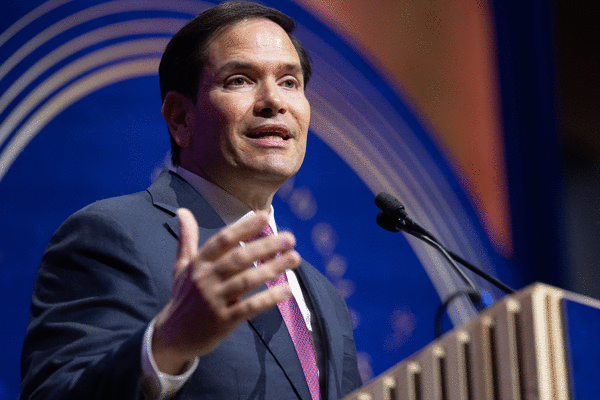
A federal judge in New York has rolled back a Trump administration policy that barred people from Haiti, Cuba and 73 other countries from receiving visas to permanently live and work in the United States.
U.S. District Judge Jeanette A. Vargas said that Secretary of State Marco Rubio’s directive from January telling agency officials to refuse applications from those countries — saying it was because there was a high risk of their eventually depending on government welfare — is unlawful.
She said that the ban was nationality-based and issued “in excess of Rubio’s authority,” vacating it under the federal laws that govern how agencies create and revise rules.
“This blatant repudiation of the elaborate statutory scheme enacted by Congress cannot withstand even the most cursory scrutiny … Notably, the government has not identified any provision of law that permits a consular officer to refuse a visa to an otherwise eligible applicant. Instead, the government engages in what is best described as an exercise in Orwellian logic,” wrote Vargas, a Biden-appointee who serves in the Southern District of New York.
Other countries affected by the policy include Antigua and Barbuda, the Bahamas, Barbados, Belize, Brazil, Colombia, Dominica, Grenada, Jamaica, Nicaragua, Saint Kitts and Nevis, Saint Lucia, Saint Vincent and the Grenadines, and Uruguay — hundreds of thousands of whose nationals live and work in South Florida. The Rubio directive barred many of them, or their loved ones, from applying for permanent, employment-based and family-based visas.
The ruling is a blow to the Trump administration, which has engineered overlapping policies to limit both legal and illegal migration. The January directive from Rubio’s agency came shortly after President Donald Trump issued a presidential proclamations banning entry of immigrants from multiple countries either partially or in full, including many that were among the 75 whose visas were suspended.
Experts liken the layers of restrictions to an immigration bureaucracy where people open one door only to encounter another, making it virtually impossible to come to the U.S. legally. The Cato Institute found that the policies combined to freeze more than a million immigration benefits for people from Cuba, Haiti and Venezuela.
When determining whether someone can legally immigrate to the U.S., officers review factors such as age, health, family status, financial resources and education to evaluate whether the applicant will become a “public charge,” or dependent on government welfare.
In January, Rubio announced a ban on immigrant visas from those 75 countries, arguing that applicants were “at a high risk for becoming a public charge and recourse to local, state, and federal government resources in the United States.” The State Department processes visas through consulates and embassies worldwide.
To decide which nations would be subject to the ban, the State Department evaluated what percentage of U.S. households with nationals from other countries received some form of government benefits. If that number was over 30%, they were included in the ban, though there were some foreign policy exceptions.
At the time, the agency said the freeze would remain active “until the U.S. can ensure that new immigrants will not extract wealth from the American people.”
In the ruling, Vargas said that “consular officers are required to conduct an individualized assessment of applicants and to refuse visas only to those whom the consular officer finds ineligible. The policy nonetheless directs consular officers to refuse eligible applicants.
“The core of the policy, the ban on issuance of visas to nationals of specified countries who were purportedly at high risk of becoming public charges,” the judge added, violates the Immigration and Nationality Act’s antidiscrimination provision, she continued. The act was passed by Congress in 1952 to govern immigration, residency and naturalization.
The plaintiffs in the case before Vargas included the Catholic Legal Immigration Network, which has a network of immigration legal services providers and immigration programs in 49 countries, as well as ACT, a Harlem-based group that supports African immigrants and their families nationwide. Also challenging the policy were six U.S. citizens with family members affected by the policy and five would-be immigrants with pending employment-based visa applications.
_____
©2026 Miami Herald. Visit miamiherald.com. Distributed by Tribune Content Agency, LLC.






Comments