Combative Díaz-Canel says Cuba won't make concessions to Trump, talks are 'very stalled'
Published in News & Features
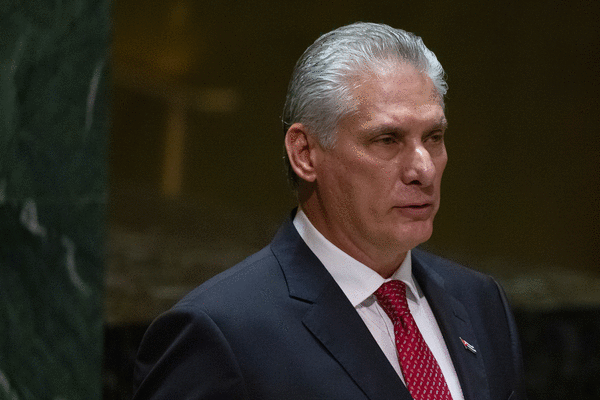
Cuban leader Miguel Díaz-Canel blamed the United States for the country’s severe crisis in an interview with a prominent Brazilian newspaper, saying his government will not make any concessions to the Trump administration, has “no alternative but to resist,” and that talks with Washington are “very stalled.”
In an interview with Folha de Sao Paulo published over the weekend, a defiant Díaz-Canel said does not fear being captured by U.S. forces, like Venezuelan strongman Nicolás Maduro.
“That decision has already been made,” he said. “If it comes for me, it comes. But it won’t be out of weakness, it won’t be out of cowardice; it will be fighting — fighting.”
His remarks confirm that the prospects for negotiations between the two countries have faded and that Cuban leaders believe they can dig in and survive U.S. pressure without making political changes.
Díaz-Canel said the pressure campaign by the Trump administration amounts to “genocide” but denied the country is on the brink of collapse. Asked how much he believed Cuba can resist without a deal with the U.S., he replied: “We have no choice but to resist. We have to resist.”
Cuba’s handpicked president said the Cuban government favors dialogue over confrontation with the United States. Still, he added, that does not mean “negotiating nor does it mean subordinating ourselves to the interests of imperialism."
“We have always said that neither our sovereignty nor our self-determination is on the negotiating table, that there can be no deals made under pressure; there are no concessions,” he added.
Still, he said his government has looked for a channel for dialogue, but the talks are stalled.
Díaz-Canel denied his government had responsibility for the humanitarian crisis in the country, falsely claiming Cuba had no blackouts before the Trump administration cut oil supplies to the Cuban government from Venezuela and Mexico.
“Even if we had done everything right, the main cause of what Cuba is experiencing is the blockade,” he said, referring to the U.S. embargo. “If we had fuel, we wouldn’t have blackouts, because in the past we haven’t had them.”
Fuel shortages this year have extended electricity cuts, but blackouts have been common on the island. They have worsened since 2024, when the national grid began collapsing frequently due to a lack of maintenance at old Soviet-era power stations.
Cubans have been protesting blackouts that, outside Havana, can go as long as two days. On Sunday, residents of Jaimanitas, a neighborhood in the capital, took to the streets banging pots and pans to protest after 25 hours without electricity.
Díaz-Canel also pushed back when the journalist mentioned that Cubans on the island were blaming the “internal blockade,” meaning the Cuban government, not the U.S. embargo, for the difficult situation they are facing. When asked why his government is arresting those who protest, he suggested that the U.S. government is paying Cubans to commit crimes.
He also denied that a package of economic reforms recently announced by the Cuban government signaled that the country is adopting capitalism, saying a market economy “has no solution for the problems of the world.” He then struggled to make a case for the lack of progress after more than six decades of socialism.
“If we had been a capitalist country, we would be like we were in the 1950s,” he said. “In the 1950s, what was the illiteracy rate in Cuba? Over 40%. Today we have blackouts because there is no oil to generate electricity, but today the country’s electrification rate is over 99%.”
In Brazil, the world’s tenth-largest economy, “not everyone lives well,” he added. “Capitalism has not been the solution for Brazil.”
Cuba’s illiteracy rate in 1953, the last census available before 1959, was 23%, and most countries in Latin America, regardless of their political system, have literacy rates over 90% nowadays. While Cuban government figures cite that 99% of the country has access to electricity, Cuban leaders can barely keep the lights on.
Video of the interview also included a bizarre moment when Díaz-Canel’s wife and unofficial first lady, Lis Cuesta, is seen using saliva to style his hair. While both smile, she is heard saying: “I am going to patent this product.”
_____
©2026 Miami Herald. Visit miamiherald.com. Distributed by Tribune Content Agency, LLC.





Comments