US tells Iran's trade partners to cut ties or face sanctions
Published in News & Features
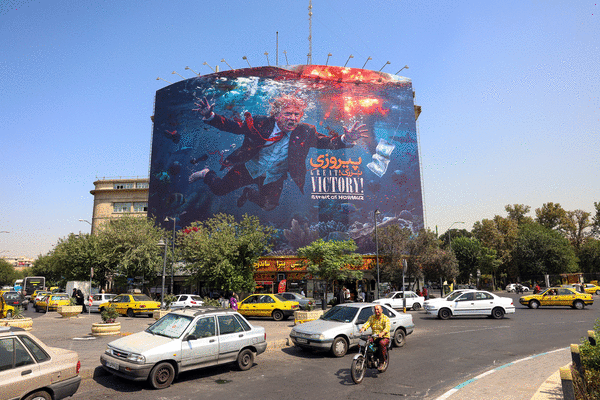
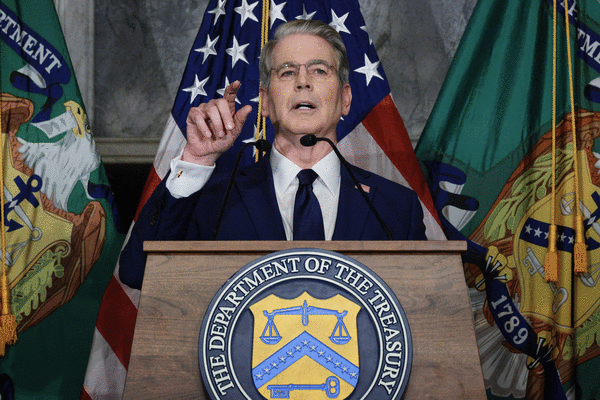

WASHINGTON — Treasury Secretary Scott Bessent threatened economic punishment against any country doing business with Iran as part of what he called an “economic D-Day” campaign to isolate the country and end nearly six months of war.
President Donald Trump is calling world leaders with “specific requests to cease their interactions with the regime” and countries will face a specific timeline to shut down links with Iran or face unilateral U.S. punishment, Bessent told a news conference.
“We are launching an economic onslaught against Iran’s financial connections around the globe,” Bessent said. He called the move “economic asphyxiation of this regime.”
The statement marked the latest U.S. bid to force capitulation from Iran, which has refused to bow to U.S. demands despite months of U.S. bombing that began in late February as well as decades of economic sanctions. It also underscored Trump’s growing impatience to end a war that’s deeply unpopular among Americans as midterm elections approach in November.
While Bessent’s announcements might help further isolate Iran from some of its trading partners, it was unclear whether the actions will be enough to get Tehran to loosen its stranglehold on the vital Strait of Hormuz.
“So far this appears to be just the threat of additional secondary sanctions under authorities that Treasury has had since 2020,” said Claire O’Neill McCleskey, a former Treasury official and co-founder of sanctions advisory firm Clarity Compliance Consulting.
His threats also risk putting the United States on a collision course with China, which buys the bulk of Iran’s oil and has so far refused to stop. Bessent acknowledged the risk of such a move when he was asked why the U.S. wasn’t imposing the punishment on Iran’s trading partners immediately.
“We are giving everyone the opportunity to remedy bad behavior,” Bessent said. “Why would I want to blow up the global financial system?”
Treasury unveiled sanctions against more than 60 entities on Monday, with Bessent saying the U.S. was focusing on five of Iran’s “most vital lifelines,” including digital assets, technology, gold, aviation and shipping. Bessent also threatened to sanction a major financial institution over Iran ties by the end of this week but didn’t name the target.
Iranian officials were unbowed. Shortly before Bessent spoke, Iran’s lead negotiator with the United States, Mohammad Bagher Ghalibaf, wrote on social media, “Americans know that no one buys their bombast.”
“The United States is not in an economic position to further restrict its relations with other countries,” he wrote.
In April, Bessent had announced what he called “Economic Fury” against Iran and warned that the administration was prepared to deploy secondary sanctions against foreign financial institutions “that continue to support Iran’s activities.” Trump also previously said the U.S. would impose secondary sanctions on any nation or company buying Iranian oil — a threat he did not carry out.
In an opinion piece published earlier on Monday, Bessent raised expectations of a major new U.S. campaign by likening the new sanctions effort to the Normandy landings that helped bring an end to World War II.
“This was a last warning — it wasn’t the actual dropping of any hammer, especially on the Chinese,” said Daniel Fried, a former veteran U.S. diplomat now at the Atlantic Council. “To use Bessent’s language, this isn’t D-Day. D-day is when you hit the beaches. This is warning that you’re preparing D-Day, which is not the same.”
U.S. stocks maintained their earlier losses following Bessent’s remarks, with the S&P 500 Index falling about 0.3%. The dollar touched a session high following Bessent’s comments, with the Bloomberg Dollar Spot Index gaining 0.2% for the day. Treasuries held steady with the yield on benchmark 10-year notes trading at 4.70%.
Asked Monday if the United States was prepared to cut off major Chinese banks for facilitating trade with Iran, Bessent said “no one is above the reach of U.S. sanctions.” He didn’t mention China — or any other country — by name, saying the best way to engage was through “quiet diplomacy.”
©2026 Bloomberg L.P. Visit bloomberg.com. Distributed by Tribune Content Agency, LLC.





Comments