Canada rejected US tariff deal. Now comes the economic cost
Published in News & Features
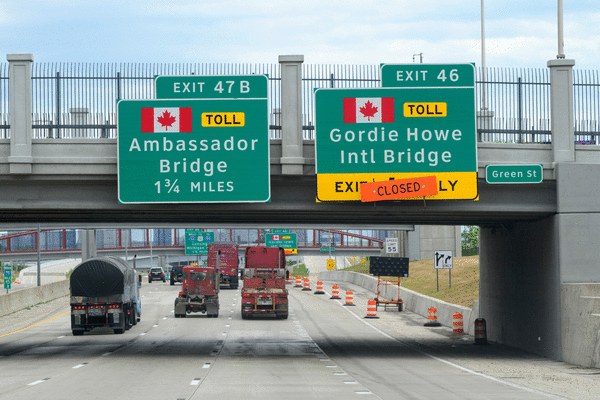
Canadians wanted their prime minister to stand tough and not sign a bad trade deal with the U.S. But the collapse of talks, and the escalation of the tariff war, will come at a price.
The U.S. implemented a new 50% tax on imports of hundreds of Canadian items including furniture, plastics, plywood and electrical equipment on Saturday. It’s such a high rate that it may cut off the world’s biggest market for some Canadian enterprises.
University of Calgary economics professor Trevor Tombe estimated that 90,000 jobs — about 0.4% of Canada’s labor force — may be lost if the new tariffs persist.
Markets are responding: The Canadian dollar fell as much as 0.6% to 1.3840 per U.S. dollar, leading losses among 31 major currencies tracked by Bloomberg. The move pared last week’s 0.8% rally that stemmed from a weaker greenback and indications that the two sides were nearing a deal.
Many small Canadian manufacturers were previously shielded from early rounds of U.S. tariffs, such as the initial so-called IEEPA tariffs, because the U.S. exempted goods compliant with the U.S.-Mexico-Canada Agreement that President Donald Trump signed in his first term.
But the new 50% levy, ordered by Trump under never-before-used provisions of the 1930 Tariff Act, ignores that trade deal. And Canada is likely to feel the effects of the dispute sooner than the U.S.
Carney’s government has pledged financial help for businesses caught in the crossfire. That may prove more complicated than previous aid packages for industries like steel that have been facing U.S. tariffs for more than a year.
The new tariffs are “very diffuse, and they hit, in particular, small and many medium enterprises in various parts of the country and in radically different supply chains,” said Matthew Holmes, chief of public policy at the Canadian Chamber of Commerce. “Very difficult for the federal government especially to create a package of supports for them.”
Prime Minister Mark Carney announced Canada will respond with counter-tariffs on $20 billion of U.S. steel, dairy, appliances, electronics and other products from Sept. 8. He didn’t shy away from acknowledging the trade war will hurt the economy, but emphasized that Canada didn’t start it.
“You’re at war when you get attacked. We got attacked,” Carney said during a 50-minute press conference in Ottawa, less than 12 hours after negotiations were officially called off.
Three out of four Canadians endorse Carney’s decision to walk away from talks, according to an online poll taken by the Angus Reid Institute since negotiations collapsed. But 38% of those in the workforce are also worried the fight will affect their job, and 89% worry it will worsen the cost of living.
The breakdown in talks reflects a permanent shift in American trade posture, former Canadian trade minister Mary Ng said in a Bloomberg Television interview.
“We don’t see the United States valuing the integration of our markets that we have developed for decades,” she said, noting that Canada is the top export customer for at least 25 U.S. states and among the top three customers for more than 40 states.
The defiant sentiment remains even after some parts of the economy, like Ontario’s auto plants and steel mills, have already faced significant pain and layoffs as a result of the sectoral tariffs that Trump ordered last year.
“We have seen the Canadian public ready to respond, not wanting to give in to what they perceive as bullying. And so this is going to hurt a little bit before it gets better,” Holmes said.
Carney’s government sees little chance of resuming negotiations before the U.S. midterm elections in November, according to people familiar with the matter.
The Canadian leader is designing measures aimed at helping businesses hurt by U.S. tariffs so they can ride out the balance of Trump’s term if necessary, added the people, who were granted anonymity to discuss sensitive deliberations.
Some of the people cautioned the situation remains fluid and the U.S. has not ruled out a restart of negotiations.
Carney said the USMCA deal had been “violated day in, day out” during Trump’s second term and that U.S. commitments are sometimes “written in pencil.”
“We cannot accept what they’ve offered and we will not give what they’ve asked,” said the prime minister, 61.
The provinces of British Columbia, Ontario and Quebec are particularly exposed to the new tariffs. Randall Bartlett, deputy chief economist at Desjardins, warned of a “substantial” fallout that would carve another 0.2 and 0.3 percentage points from Canada’s growth rate this year and next, respectively.
“Unfortunately, this breakdown comes just as growth looked to be finding better momentum,” Robert Kavcic, a Bank of Montreal economist, wrote in a report to investors.
Political pressure
There’s still a chance the escalation can be averted. Canada’s counter-tariffs don’t start until Sept. 8, creating another short window to restart negotiations.
Much is at stake for both nations. Canada exported $454 billion worth of goods and services to the U.S. last year — a large majority of its exports — while importing $426 billion, according to U.S. Commerce Department data. Carney’s government has set a goal of rapidly growing business in other markets, but that takes time.
“We’re going to need a suite of programs, probably not unlike we did through the Covid era, to support working people and the industries that they depend on,” said Lana Payne, national president of Unifor, which represents workers in the automotive and other sectors.
Escalation of the trade fight also makes things more complicated for the Bank of Canada: U.S. tariffs hit sales and weaken growth, while retaliatory duties fuel inflation at home.
The central bank’s research suggests Canadian consumers will bear much of the cost of tariffs, while facing fewer choices. That’s one reason why, a year ago, Carney removed most of the counter-tariffs his predecessor, Justin Trudeau, applied at the start of the trade war.
Carney’s decision to resort to the same form of retaliation now is less about economics than politics, said one expert, who believes it’s unwise.
“Retaliation only makes sense politically. But the Trump administration seems immune from outside political pressure, whether it’s from Congress, the states or business,” Patrick Leblond, associate professor at the University of Ottawa, said in a LinkedIn post. “So what’s the point?”
However, unlike when the trade war first erupted, U.S. midterm elections are now a little more than a couple of months away, and the fight with Canada is on the ballot.
In the swing state of Michigan, Democratic Senate candidate Abdul El-Sayed accused his Republican rival of preparing to “rubber-stamp” Trump tariffs on Canada that will make life more expensive in the U.S.
Republican Senator Susan Collins, who faces a competitive race in the border state of Maine, also criticized the escalation for passing costs onto her voters. And Trump’s former Vice President Mike Pence said: “The last thing we need right now, as our economy is getting back on its feet, is a trade war with Canada.”
During his news conference on Saturday, Carney was asked whether the U.S. is in a weaker bargaining position, given the cost-of-living worries of U.S. voters, and recent bond market instability, which has driven up borrowing costs. The former central banker said Canada has plenty of ability to weather an economic storm.
“We are entering a phase where fiscal strength, discipline, focus is going to be very important — it’s going to be scrutinized,” he said. “Markets sometimes ignore these fundamentals and then all of a sudden they focus on them. And when they focus on them, if you don’t have your house in order, it’s too late. We have our house in order and we’re getting stronger.”
—With assistance from Philip Glamann, Jon Herskovitz, Haslinda Amin and Aline Oyamada.
©2026 Bloomberg L.P. Visit bloomberg.com. Distributed by Tribune Content Agency, LLC.





Comments