Singapore unveils sweeping family support as births tumble
Published in News & Features
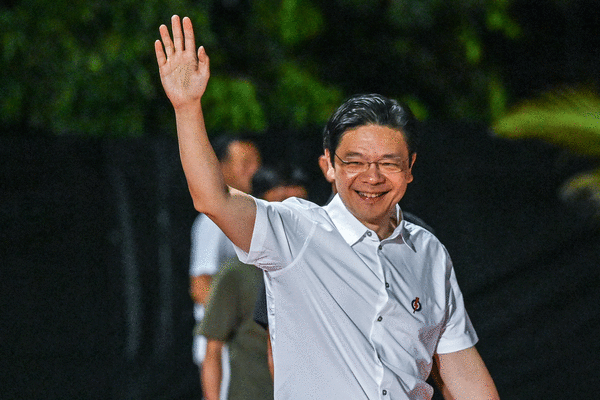
Singapore Prime Minister Lawrence Wong announced a package of childcare benefits to support families as the city-state grapples with a record-low birth rate and rising concerns over the cost and pressures of raising children.
Each Singaporean child will receive almost S$70,000 ($55,150) in direct assistance through age 17, starting with a S$10,000 baby gift, Wong said during his National Day Rally Speech on Sunday. The government will also significantly increase paid childcare leave and aims to cut monthly fees for subsidized full-day childcare to S$150.
“Today, families everywhere are under growing pressure,” Wong said during the annual address, which is typically used to set out the government’s key policy priorities. “We want to make a fundamental shift in how we support families.”
Family support has become a top priority for Singapore, with its total fertility rate falling to a record low of 0.87 last year. That prompted the government to set up a work group to review marriage and parenthood measures, and plans to spend nearly S$7 billion on related initiatives this fiscal year.
Singapore is also on track to become a super-aged society this year, with a fifth of its population aged 65 and above.
Wong said in June that his government would rely less on incentives to encourage Singaporeans to have more children and focus instead on making family life easier, after years of measures including baby bonuses and expanded paternity leave.
Under the new childcare leave policy, every working parent will get eight days with one child up to 12 years old, 10 days with two children and 12 days with three or more children. For a working couple with three primary school children, they would receive 24 days of leave, up from just 4 days.
Wong also said he wouldn’t rule out expanding paid parental leave, which now totals up to seven and a half months, but would leave the current arrangements in place for now to give employers time to adjust to the recently introduced changes.
“I have decided that the government will cover the cost of all statutory child related leave, up to the reimbursement limit,” he said. “This will reduce, of course, the financial burden on employers.”
Singapore will give preferred access to couples for every child they have or are expecting when applying for their first subsidized public housing, a key avenue for homeownership for most citizens. “We want to help growing families secure a home sooner,” Wong said.
The city state will raise from Monday the income ceiling for public Build-to-Order flats to S$16,000 from the current S$14,000, and for executive condominiums — a form of quasi public housing — to S$18,000 from S$16,000. The government will also consider additional housing support for those with larger families, Wong said.
The 53-year-old premier has already moved to cushion citizens from external shocks, rolling out nearly S$2 billion of support after the Middle East conflict pushed up energy costs. Meanwhile, Singapore’s economy has been riding the AI boom, which has boosted related manufacturing and trade sectors. It recently raised its 2026 economic growth forecast to 4.5%-5.5%.
Wong also said Sunday that the city-state would require stronger safety standards from social media platforms to protect children online. While he offered no specifics, he said the government would consider additional restrictions, including raising the minimum age for access above 13 years old to platforms whose safeguards remain inadequate.
Singapore has been considering stronger measures around social media for some time, following Australia’s world-first ban for children under 16, which took effect in December.
Today, the platforms “mostly rely on users to declare their own ages and we know this is not working well,” Wong said. “They will have to put in place robust and reliable checks so that the minimum age is properly set and enforced.”
In addition, Singapore plans to merge several islands south of Jurong Island into a larger island for new industries, including advanced manufacturing, and power infrastructure, Wong said. The government is also studying undersea tunnels to connect Pulau Tekong to the mainland, he said.
_____
©2026 Bloomberg L.P. Visit bloomberg.com. Distributed by Tribune Content Agency, LLC.






Comments