A Minneapolis church asks judge to hold Homeland Security in contempt
Published in News & Features
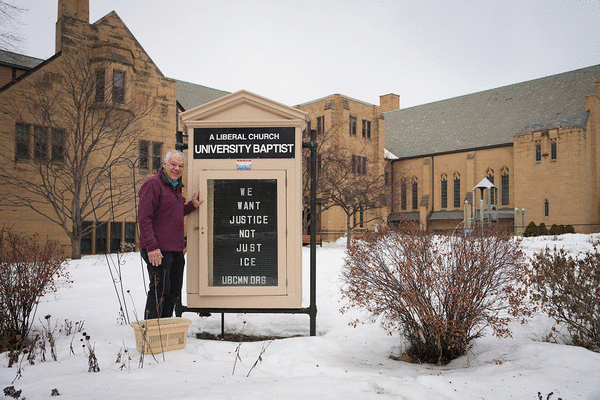
MINNEAPOLIS — A Minneapolis church is asking a federal judge to hold the Department of Homeland Security Investigations in contempt after it discovered the agency had infiltrated it as part of an effort to investigate alleged violence against federal immigration agents — despite a court order forbidding the feds from conducting immigration enforcement operations on church property.
The motion, filed in federal court in Massachusetts Thursday by a national coalition of churches on behalf of Minneapolis’ University Baptist Church, comes after HSI’s surveillance and undercover operations were revealed to be part of an ongoing federal case against protesters accused of being “Antifa.” The filing argues HSI’s activities violated an injunction put in place last year barring immigration enforcement activities on or near church premises.
“We should, as a society, agree that sacred places and the many and varied community activities taking place within them should not become targets of government infiltration,” said the Rev. Cody Sanders, interim pastor at University Baptist Church, in a statement.
Investigation notes turned over to defense lawyers in the “Minnesota 15“ case revealed that federal agents followed one of the defendants, Cameron Kennedy, as he drove to and from University Baptist Church this summer. While Kennedy didn’t worship at the church, he and friends were part of an invitation-only group called Left Jab, which offered free mixed martial arts classes out of the church’s basement gym.
From April to June, Homeland Security, or HSI, agents watched people entering and leaving the church and took down their license plate information. Then, in May, an undercover agent attended a Left Jab boxing and sparring training on church property, according to government records.
During the training, the agent’s body-worn audio recorder “erroneously fell to the floor of the gymnasium,” according to investigation notes. After leaving the gym, the agent “realized she no longer had the device, and returned to the gymnasium to retrieve the device.”
Kennedy suspects undercover agents also attended a fundraiser for detained anti-ICE protesters that was held at the church.
In response to questions from the Minnesota Star Tribune, Homeland Security officials said they do not comment on specific investigations or investigative methods.
The church has a strong claim that the government violated the previous court order barring immigration enforcement on or near church premises given that HSI has essentially conceded to doing the things that the church takes issue with, said Prof. Thomas Berg of University of St. Thomas School of Law’s Religious Liberty Appellate Clinic.
While courts have generally been reluctant to hold government officials in contempt, Berg said that has begun to change amid the mass deportation campaign of Trump’s second term.
“We know that judges have stopped giving the government the same kind of deference that they used to give it because of their experience with this administration stretching the truth, at best, and trying to evade orders.”
The injunction is part of a lawsuit filed by a number of Christian churches in federal court last year, arguing that a Trump administration policy allowing for unbridled immigration enforcement at churches violated their religious rights.
Previous federal policies discouraged agents from targeting religious institutions in all but the most extreme circumstances, such as an immediate threat to public safety.
“The prospect that a street-level law-enforcement agent — acting without a judicial warrant and with little or no supervisory control — could conduct a raid during a church service, or lie in wait to interrogate or seize congregants as they seek to enter a church, is profoundly troubling,” Judge F. Dennis Saylor IV wrote in his order granting the injunction in February.
Saylor’s order defined enforcement as any action by the federal government to enforce immigration laws, including searching church premises, questioning visitors and conducting investigations.
The injunction bars “unbridled” access to churches by immigration officials, but they can enter the churches that filed the lawsuit, though they must prove there’s an extreme need to.
While Homeland Security has not yet responded to the church’s motion, the agency believed some individuals were exploiting peaceful demonstrations against ICE to engage in criminal activity, such as assault against law enforcement officers, according to internal HSI investigative reports.
”This investigation is focused on identifying and disrupting sophisticated, organized campaigns supporting and engaging in this behavior," noted HSI reports turned over to defense lawyers in the Minnesota 15 case. “This investigation will prioritize the identification of funding sources, organization structures, and predicate actions behind these campaigns.”
While Homeland Security has argued that agents’ actions did not qualify as “immigration enforcement,” but rather investigation of anti-ICE protesters, the churches believe that claim makes an insignificant distinction because the primary mission of the HSI division is the enforcement of immigration laws.
“DHS’s multiple undercover operations at University Baptist Church — including an ICE agent’s intrusion into the church itself — constitute clear and egregious violations of the Court’s preliminary injunction order,” the church alliance wrote in their new motion.
Doug Donley, a recently retired University Baptist Church pastor, said that after the Trump administration ended Homeland Security’s prior policy to tread carefully around religious institutions, the church saw an immediate decline in attendance as many congregants stayed home out of fear of profiling by federal agents.
The church responded by marking areas as private, training staff to recognize judicial warrants and locking doors during services, despite their belief that churches should always be open and welcoming.
“We expected our government to follow the law,” Donley said. “We were quite surprised. We had certainly thought that we were safe within our congregation and in our church building.”
He said he was angry, frustrated and sad to learn that federal agents were entering and surveilling University Baptist Church as late as June.
There have been at least three major lawsuits by religious organizations challenging the Trump administration’s overturning the sensitive locations policy, said Berg, the religious law expert. Churches have won in two of the cases, and one was just affirmed by an appeals court.
The law that governs conflicts between the rights of religious groups and government needs is the Religious Freedom Restoration Act, which puts a thumb on the side of religious freedom by saying the government must have a compelling reason to burden religious activity. The old policy guiding immigration enforcement at churches, which the Trump administration threw out, tried to strike that balance, the professor said.
“Churches have a strong argument under RFRA, which has been used by both conservative and liberal religious groups over the last 30 years,” Berg said. “There have been controversies about RFRA when it’s protected some evangelical Christians, but it’s also protecting groups pursuing progressive understanding of the faith.”
In mid-June, the U.S. Attorney’s Office accused 15 Minnesota protesters of being members of “Antifa,” which President Donald Trump designated as a domestic terrorist organization following the murder of Charlie Kirk.
Dan Rosen, U.S. Attorney for the District of Minnesota, alleged at the time of the indictments that the defendants engaged in a campaign of violence, but declined to identify any instances of federal agents being harmed.
Kennedy told the Minnesota Star Tribune that his group Left Jab was geared toward “leftists, queer folk” and others seeking self-defense training against right-wing violence.
The exercises that undercover agents seemed especially interested in included “swarm training,” said Kennedy, who described it as honing situational awareness in large groups and to help people avoid getting arrested or injured by law enforcement projectiles.
Left Jab did nothing illegal, he said.
“When we look at these documents, it’s very clear that the federal government is trying to scorch the earth around us and burn our community. Anybody who would support us, anybody who would support resistance,” Kennedy said. “It’s straight, clear political reprisal.”
The U.S. Attorney’s Office is expected to respond to defense motions in the Minnesota 15 case Aug. 21.
_____
©2026 The Minnesota Star Tribune. Visit at startribune.com. Distributed by Tribune Content Agency, LLC.




Comments