Abbott Laboratories to pay $670 million to settle cases, claims over its formula for premature babies
Published in News & Features
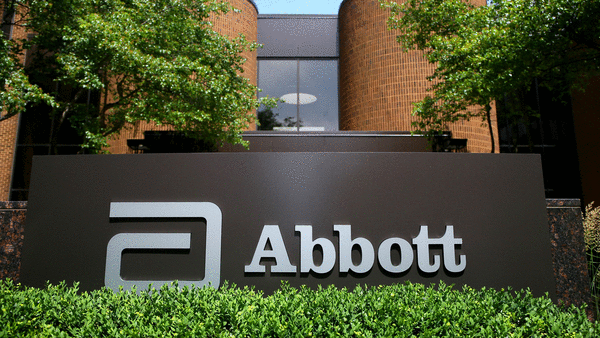
Abbott Laboratories has agreed to pay $670 million to settle a high-profile lawsuit and claims made on behalf of thousands of others related to allegations that its formula for babies born prematurely causes a dangerous intestinal disease.
The settlement comes after an appeals court upheld a $495 million judgment against Abbott in the high-profile case earlier this year.
Even after the settlement, north suburban-based Abbott continues to face 1,700 lawsuits across the country over whether its formula for preterm infants causes necrotizing enterocolitis, or NEC, in which tissue lining the intestine becomes inflamed and dies. Those 1,700 lawsuits involve claims made on behalf of roughly 12,700 infants.
Abbott said in a news release Thursday that the settlement is not an admission of any liability and that it stands by the safety of its products and their “essential role” in the care of preterm infants.
“While Abbott remains confident in the safety of these products and the science supporting them, the company believes these agreements are in its best long-term interest and represent a constructive step toward substantially resolving the overall litigation,” Abbott said in the news release.
Attempts to reach attorneys for Margo Gill, who brought the case that resulted in a $495 million judgment, were not immediately successful Thursday afternoon.
That case originally went to trial in Missouri Circuit Court in St. Louis in 2024, with Gill, an Illinois resident, alleging that her daughter Robynn Davis developed NEC after she was given Abbott’s cow’s milk-based infant feeding products as a premature infant.
Davis, who was born in 2021, had about 75% of her intestine removed after she was diagnosed with NEC, and she suffered brain damage from the illness, an attorney for Gill previously said.
The jury awarded $95 million in compensatory damages and $400 million in punitive damages — the largest verdict by far, at this point, in a case over whether preterm infant formulas cause NEC.
Abbott appealed that decision, and earlier this year, a Missouri appellate court affirmed the earlier judgment. Abbott had been in the process of asking the Missouri Supreme Court to take up the case when the settlement was announced in court documents Wednesday.
Although Abbott and Mead Johnson Nutrition — another manufacturer of cow’s milk-based formula for babies born prematurely — continue to face many more similar lawsuits across the country, only a handful have so far gone to trial.
A trial in a similar case against Mead Johnson is now underway in federal court in Chicago, where hundreds of the cases have been centralized. It is considered a bellwether case, meaning its outcome is meant to help guide how all the other cases in federal court in Chicago might proceed, and/or how to settle those cases. Three previous bellwether cases in federal court in Chicago were thrown out before they went to trial.
Many of the other cases against Abbott and Mead Johnson are in state courts rather than federal courts.
In April, a Cook County jury awarded $70 million in damages in four cases against Abbott brought by mothers who alleged that the company’s formula for premature infants caused their babies to become severely ill.
In another trial, Abbott and Mead Johnson were found not liable, but a St. Louis judge later granted a motion for a new trial citing “errors and misconduct.” Abbott is also appealing that decision. In a case against Mead Johnson in Illinois state court, a jury reached a $60 million verdict against the company, but an appeals court recently reversed that decision and sent the case back to the lower court for a new trial.
Abbott CEO Robert Ford had previously suggested that the company could pull the formula altogether because of the flood of litigation, alarming doctors who worry that would mean fewer nutritional options for babies born prematurely.
Doctors agree that mother’s milk should be the first choice of nutrition for infants born very prematurely. But they worry that not all premature babies have access to their mother’s milk or donated breast milk, and, in those cases, they need the specialized formulas.
Research has shown an association between consumption of cow’s milk-based formula by preterm babies and higher rates of NEC. But it remains unclear exactly what causes NEC. Some preterm babies who drink only breast milk also develop the disease.
In 2024, three major government agencies — the U.S. Food and Drug Administration, the Centers for Disease Control and Prevention and the National Institutes of Health — released a joint statement on NEC and premature infants, following a report by a group of experts who were asked to compile information about the science behind the issue.
In that statement, the agencies said, “There is no conclusive evidence that preterm infant formula causes NEC.”
©2026 Chicago Tribune. Visit chicagotribune.com. Distributed by Tribune Content Agency, LLC.




Comments