More sanctions: US targets Cuban foreign-influence operations and mining sector
Published in News & Features
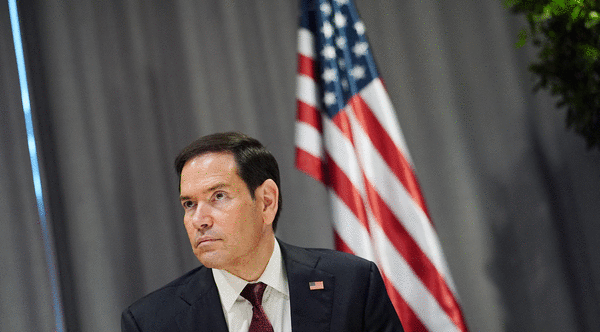
The Trump administration on Thursday imposed sanctions on nine Cuban state companies and the three top officials of the island’s main organization for cultivating foreign sympathizers, extending a pressure campaign that has now reached Cuba’s nickel industry, its construction ministry and the state agency that hires out Cuban labor to foreign companies.
The State Department said the designations target the leadership of the Cuban Institute of Friendship with the Peoples, known by its Spanish acronym ICAP, along with a cluster of state enterprises in the metals and mining sector and three trading companies controlled by Cuba’s foreign-trade conglomerate.
“The Cuban regime has spent decades using front groups to infiltrate, corrupt, and radicalize Americans. Today, I’m sanctioning the leadership of ICAP, which is one of the primary organizations involved in these efforts — including convicted Cuban spy Fernando González Llort — and nine entities that sustain and fund the regime’s repressive apparatus,” Secretary of State Marco Rubio said.
Gonzalez Llort was one of the members of a Cuban spy ring dismantled in the late 1990s in South Florida. He served 15 years in prison and was deported to Cuba in March 2014.
Rubio warned that “anyone supporting, sponsoring, or providing services to these sanctioned actors is at risk of being sanctioned themselves. Foreign banks and other companies that provide services to, or hold funds for, these entities should take immediate action to cease their support.”
The State Department also sanctioned Noemí Ramona Rabaza Fernández, the Institute’s first vice president, and Leima Martínez Freire, its North America director. ICAP itself was sanctioned in early June.
The State Department framed Thursday’s action as building on its earlier report, “Cuba: The Capital of 21st Century Communism,” which it released earlier this month, arguing that Havana has spent decades exporting revolution through solidarity brigades and ideological networks.
The State Department said the designations were issued under a new executive order that President Donald Trump signed in May that allows the U.S. government to freeze the assets and block transactions of Cuban and foreign individuals and companies involved in repression on the island or which are seen as threats to U.S. national security and foreign policy.
Cuban Foreign Minister Bruno Rodriguez quickly reacted to the announcement. In a publication on X he said: “The U.S. Secretary of State continues to penalize Cuban companies with the deliberate aim of harming our economy and preventing the Cuban government from guaranteeing basic services to the population —services that are already in a critical state due to the blockade,” he said in a reference to the U.S. embargo.
Thursday’s sanctions also target Cuba’s metal mining industry and nickel exports.
The State Department announced that it had designated Empresa de Níquel Comandante Ernesto Che Guevara, the state-owned plant in Moa, in the eastern Holguín province, which extracts and processes nickel and cobalt.
The sanctions come at a delicate moment, as two rival groups of American investors compete for control of Sherritt International Corporation, the Toronto-based company whose Moa operation is a 50-50 joint venture with the Cuban government. The operation is the island’s largest nickel and cobalt asset. Washington is blacklisting the state-run plant a few kilometers from the mines and the Pedro Alba Soto facility U.S. investors are trying to buy into.
The Trump administration also sanctioned Empresa Importadora Exportadora y Comercializadora de Metales, known as MetalCuba, which the State Department said imports heavy industrial products, including specialized fuel and metal components, and Acinox Comercial, which handles imports and exports of metallurgical goods and industrial equipment.
Grupo Empresarial Geominero Salinero, or Geominsal, which develops and markets mineral resources and provides technical services to those industries, was also designated for sanctions Thursday.
Also blacklisted are:
—The Ministry of Construction.
—Agencia de Contratación a Representaciones Comerciales S.A., or Acorec, the state entity that supplies Cuban labor to foreign companies operating on the island. Foreign investors in Cuba are barred from hiring Cubans directly and must go through agencies like Acorec, which collect the hard-currency wage and pay the worker a fraction of it in pesos. The State Department said Acorec “is reported to have garnished over 90 percent of the wages paid by foreign entities for Cuban labor.” The Cuban government recently said it was going to get rid of that practice.
—Three companies that are part of the previously sanctioned Cuban foreign trade conglomerate GECOMEX: Coratur S.A., which manages international trade, import-export operations and foreign market partnerships; Transimport, which the State Department said has imported more than $5 million worth of vehicles, automotive parts and industrial equipment in recent years, and Consumimport, which trades in appliances, construction materials and other goods.
—
©2026 Miami Herald. Visit miamiherald.com. Distributed by Tribune Content Agency, LLC.




Comments