Chaplain says Lindsay Clancy reported hearing 'voice' after killings
Published in News & Features
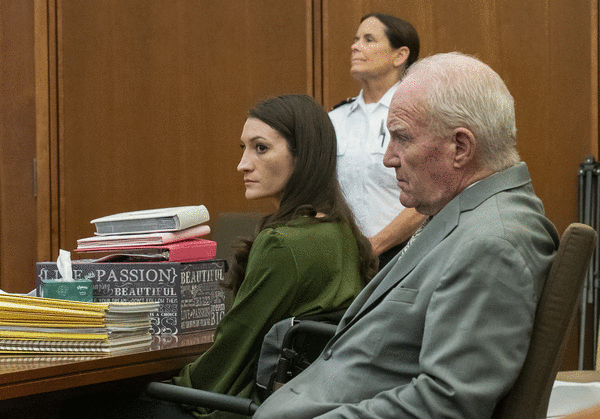
BOSTON — A chaplain who visited with Lindsay Clancy in the hospital told jurors Thursday that Duxbury mom reported hearing a voice that urged her to kill her children and herself.
Sheila Cavanaugh, a board certified chaplain at Brigham and Women’s Hospital, said that Clancy told her about the voice on Jan. 31, 2023, about a week after Clancy strangled her children, Cora, 5, Dawson, 3, and Callan, eight months, then jumped out her bedroom window, leaving her paralyzed.
The chaplain had visited her a few times starting the day after the killings and prayed with Clancy while she was intubated.
By Jan. 31, the tubes had been removed from Clancy and she could speak.
Cavanaugh recalled that Clancy’s affect was flat: “her emotional state was very neutral.”
“She had heard me for a couple of days, we had prayed together,” Cavanaugh said. “She said to me, as I held her hand, ‘I am so glad that my children are safe.’”
Cavanaugh said that she comforted Clancy, and spoke “theologically,” telling her that they were safe now.
“She alluded to having heard a voice and the voice, according to Lindsay, if she did not follow the command, neither she nor her children would be safe,” Cavanaugh said, testifying the voice was male, “and it was persistent.”
The date Clancy reported the voice to Cavanaugh was of note because the prosecution had claimed the first time the defendant reported auditory hallucinations was Feb. 6, to Dr. Paul Zeizel, a psychologist working with the defense.
Clancy’s attorney Kevin Reddington isn’t disputing that Clancy did the killings. Instead, he is arguing that his client was suffering from postpartum psychosis and isn’t criminally responsible for the deaths.
The chaplain said that she met with Clancy more than 200 times from her original visit, including at Brigham and Women’s, Spaulding Rehabilitation Hospital, and Tewksbury Hospital.
“The voice conversation came up several times during our visits,” she said.
“You wrote very detailed notes,” Plymouth Assistant District Attorney Jennifer Sprague said on cross examination. “In all of these notes, you never once that she told you that she heard a voice?”
“The chaplain notes are not verbatim,” Cavanaugh said. “I’m there to bear witness to their suffering.”
Sprague also asked about Cavanaugh’s notes from moments when Clancy appeared to be concerned about never being able to walk again and hopeful when she made physical improvements in February 2023.
On redirect, Reddington asked about privileged communication with a chaplain.
“Because I am not a medically trained clinician, I approached patients in a vortex of trust,” she said. “There is this understanding that when a patient talks to a chaplain, it’s confidential.”
The chaplain was the only witness to take the stand and jurors were excused by the late morning.
Before proceedings got started, the jurors had been brought in one-by-one, sworn in, and questioned by the judge.
The media couldn’t hear what they were being asked.
Protesters wearing pink to support Clancy gathered early Thursday morning, as the defendant and jurors arrived to the courthouse.
After jurors were gone for the day, the judge heard arguments on possible jury instructions.
Judge William Sullivan suggested that they use the most recent model instruction from the Supreme Judicial Court for criminal responsibility in homicides.
“Criminal responsibility is a legal term,” the instructions say. “A person is not criminally responsible for his conduct if he has a mental disease or defect, and, as a result of that mental disease or defect, lacks the substantial capacity either to appreciate the criminality or wrongfulness of his conduct or to conform his conduct to the requirements of the law.”
Sprague asked Sullivan to instruct on both first and second degree murder, but to exclude components about intoxication, saying that Clancy only took large quantities of pills after killing the children when she tried to commit suicide.
The prosecutor noted that evidence about side effects from Clancy’s medications were reported before her trip to McLean Hospital and those had been “out of her system for three weeks,” by the time of the killings.
Reddington said that the overmedication they’ve argued during the trial could constitute as “involuntary intoxication,” and those instructions should stay.
He also asked that the judge instruct on involuntary manslaughter, which is “an unlawful killing unintentionally caused by wanton or reckless conduct,” according to Massachusetts law.
Sprague said that there was no evidence of that because “there was a specific intent to cause the death.”
Judge Sullivan told the attorneys that he would give them a “rough draft” of the instructions by tomorrow.
The trial will continue Friday morning. Sullivan said that there would be more expert testimony both from the defense and Commonwealth and that closing arguments could come on Monday or Tuesday.
------------
©2026 MediaNews Group, Inc. Visit at bostonherald.com. Distributed by Tribune Content Agency, LLC.






Comments