Underwater data center proposed for Alaska's Cook Inlet by East Coast company
Published in News & Features
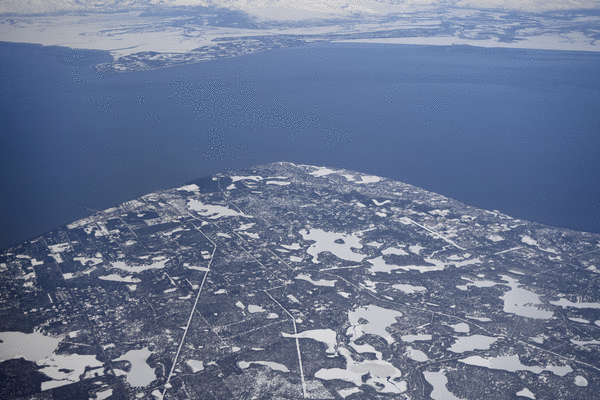
An East Coast company has proposed building an underwater artificial intelligence data center, powered by the strong tides of Cook Inlet, off the shore of Nikiski.
Delaware-based DeepGreen Cook Inlet SPV LLC released plans for a 100-megawatt data center project with as many 350 underwater turbines and 66 "hives" housing AI servers, both powered and cooled by water of Cook Inlet. While countries like China are pursuing similar projects in response to the AI boom, it appears this project, if successful, would be among the first of its kind in the United States.
"The basic concept is straightforward: land-based data centers face major constraints because they take up large plots of real estate, strain local power grids, and consume millions of gallons of fresh water daily for cooling," said Louis Wolfson, a managing member for DeepGreen Cook Inlet and luxury real estate developer based in Needham, Massachusetts.
DeepGreen has proposed using some of the same concepts Microsoft used to run Project Natick, Wolfson said. The multi-phase Microsoft research project sought to understand the feasibility of deploying subsea data centers through test sites off the Pacific Coast and in the North Sea near Scotland starting in 2015.
The cold seawater would cool the systems naturally without fresh water or land use, while the tides provide "clean, predictable power," he said.
While the state is encouraging the development of data centers, Alaskans have been more hesitant to welcome the local-energy-hungry technology. The Anchorage Assembly in March preemptively adopted data center regulations ahead of any major project proposals in the city. In Houston, officials last week opposed a state land transfer that could be used for "scalable data centers."
DeepGreen Cook Inlet does not have a website or a project page with information about the company or the technology it plans to use. Its initial project application contained a number of errors that temporarily prevented its application from moving forward. The Alaska Energy Authority, listed as a possible future partner on the project, said they had never been contacted by the company.
DeepGreen Cook Inlet's parent company, DeepGreen Holdings LLC, formed in January, one month before Wolfson sent in an application to the Federal Energy Regulatory Commission to conduct preliminary environmental and engineering studies in Alaska's Cook Inlet.
The parent company is incorporated in Massachusetts as well as in Delaware, using a registered agent service with filings that do not disclose any ownership information.
DeepGreen Cook Inlet, the separate entity that applied through FERC, is also headquartered in Delaware through the same registered agent service. Companies frequently choose to be headquartered in Delaware because the state's laws allow a lack of ownership disclosure information for businesses.
Wolfson said DeepGreen does not have a public website yet because it's focused "strictly on baseline studies and the regulatory process."
A similar DeepGreen proposal has been met with resistance in Eastport, Maine, where the company submitted plans to submerge a data center at the mouth of the Bay of Fundy, known for some of the highest tides in the world. Because of the county's dependence on maritime industries, elected officials have labeled the project as "too risky" for the region, according to reporting by the Maine Monitor news outlet.
Last week, the Eastport City Council enacted a six-month moratorium to halt progress.
The company's Cook Inlet proposal has received less attention. Kenai City Manager Terry Eubank made city councilors aware of the Cook Inlet project during their August meeting as the city was recently noticed of the proposal, he told the body.
During the nearly 20 years Eubank has worked at the city, he said he's seen a number of projects proposing to use the local tides as a source of renewable energy.
"This is taking that to a new level," Eubank said Monday.
Harnessing the energy produced by the tides seems like a "viable idea," Eubank said, but would have to withstand the Cook Inlet's ice and heavy silt. Anytime something is built in the water, it also elicits concern for the health of the Kenai Peninsula's salmon populations, he said.
"I don't know that it'd be any more substantial than (the) oil and gas production out there, but I think it always has to be examined and looked at," Eubank said.
The project boundary covers an approximately 1,650-acre corridor in the Cook Inlet west of the Nikiski shoreline, with depths ranging from 45 feet to 166 feet. Its location provides a "safe navigational" buffer from the Nikiski shoreline, the application states. Silt-protection "scour skirts" have been engineered to protect the infrastructure from the harsh tides.
DeepGreen estimated preliminary engineering studies, expected to take four years to complete, to cost $4.5 million, according to FERC filings. The company plans to pay for the work through private equity and "Green-AI" investors and will rely on "management's expertise in real estate development and appraisal," DeepGreen's application states.
FERC found a number of "deficiencies" in DeepGreen's original proposal.
DeepGreen failed to provide the dimensions and physical composition of many of the data center's underwater infrastructure components, including an underwater platform, "subsea-compute hives" and its silt protection systems, according to a June 18 letter from the Northwest Branch Division of Hydropower Licensing.
The commission's regulations requires applicants to provide names and mailing addresses to any municipality within a 15-mile radius of the project with a population of 5,000 people or more. DeepGreen did not notify the City of Kenai and failed to identify all tribes and Alaska Native corporations that may have interest in or be affected by the project, according to the commission.
DeepGreen corrected its mistakes in a letter sent a week later.
In its main application, DeepGreen said its project is designed to tie in with the Alaska Energy Authority's ongoing $400 million Cook Inlet PowerLink project, a 38-mile submarine transmission line planned between Nikiski and Beluga. If built, the new data center would serve as a "primary renewable energy source and stabilizing load for the Alaska Railbelt Grid," the application states.
Alaska Energy Authority CEO Curtis Thayer said the organization had never heard of DeepGreen nor received any contact from the company. Thayer said DeepGreen's letter to FERC also has some of the project's facts "dead wrong."
"It's extremely disappointing that they would send something to FERC without contacting us," he said.
DeepGreen's application is still under review, FERC spokesperson Celeste Miller said last week. After staff determine the application is complete, the commission will request comments from the public, she said.
_____
© 2026 Anchorage Daily News. Visit www.adn.com. Distributed by Tribune Content Agency, LLC.






Comments