Empty classrooms, quieter streets: Baltimore faces drop in child population
Published in News & Features
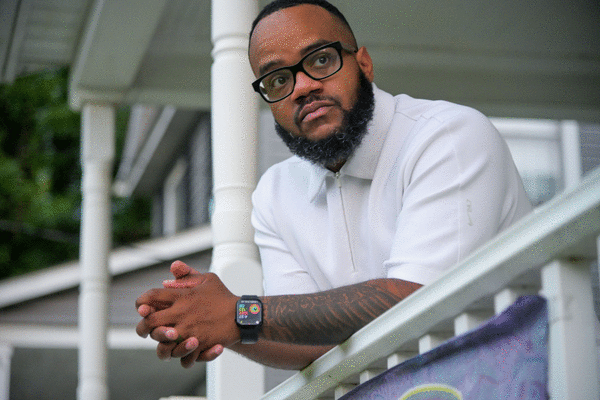
BALTIMORE — LaFayette Boone Jr. imagined a childhood for his son much like his own in Baltimore, attending Catholic school and playing with other kids in the neighborhood.
The plan hit an early hiccup: Amid declining enrollments, St. Michael — St. Clement School in Overlea closed in June after his 5-year-old son’s first and only year there.
It’s certainly not the only school to shutter, as birth rates continue a decades-long decline in the U.S.The number of children living in Baltimore city dropped 13% between 2015 and 2025, while going down less than 1% statewide and about 2% nationally, according to the Annie E. Casey Foundation’s Kids Count Data Center.
The number of under-18-year-olds remained roughly level in Baltimore, Harford and Howard counties, and increased to about 3% in Anne Arundel and Carroll counties. Only Frederick County saw a substantial gain in children by 17%.
“Families are moving out of the city,” said Boone, who lives in Hamilton and grew up amid hordes of kids in the southeast and northeast Baltimore neighborhoods of his youth. “When I was growing up, we were outside sometimes until 10 or 11 o’clock at night. Now when I come home late, what I’ve noticed is how quiet it is in the neighborhood.”
Boone and his wife found another Catholic school, a little farther away in Towson, for their son to attend this fall. But he said he’ll miss being part of the STMSTC school community, located just over the city line into the county, just minutes away from his home.
“We were very active. It was so convenient for us,” he said. “My mom, who doesn’t even live in the neighborhood, went there for bingo.”
The closure “is very sad,” said Friar Timothy Patrick Dore, a previous pastor of the school’s church, St. Michael’s the Archangel, which remains open, and has merged with two other parishes.
As family sizes have shrunk — the Baltimore native is one of seven siblings — so too have schools, he said. His own childhood schools closed years ago, as did the school for the parish in Brooklyn, New York, where he had served for 17 years.
The effect of a school closing ripples beyond the students, he said, with parents becoming active members of the church and activities beyond the classrooms.
“You’re not just there to go to class,” said Dore, who is now with the Shrine of St. Anthony in Ellicott City. “You have Girl Scout and Boy Scout troops. It’s one big harmonious organism.”
The decline in the child population hits all schools. Baltimore City Public Schools has seen its enrollment drop almost 9% in the past decade, although officials say the decline has leveled off in recent years.
Michael Bader, a sociologist and faculty director of the 21st Century Cities Initiative at Johns Hopkins University, said “right-sizing” schools is a challenge when child populations shift, in either direction.
“School construction and right-sizing is something that’s very expensive and also emotionally fraught for good reasons,” he said, “and so it’s difficult to do.”
Bader said the demographic shift has been underway for some time, with the population aging and people having fewer children.
“There’s always been some movement from city to suburbs,” he said. “This was a huge part of what happened with white flight, especially in the ’40s through ’70s in places like Baltimore.”
The population of the city, which has been losing Black residents as well, has been trending downward for years but rose slightly in 2024, something Mayor Brandon Scott attributed to his administration’s investments in reducing crime and vacant housing.
Despite the overall population being down, young people are moving to the city, which, compared to its counterparts on the East Coast, continues to be more affordable, Bader said.
“I meet young people all the time moving to Baltimore,” said Kari Fulton, who herself moved to the city from Washington in 2018.
“I wanted to buy a house. I wanted to be somewhere I could get in on something in the midst of growth and change,” she said.
Settling in the Upton neighborhood, which attracted her with its community energy, she enrolled her son, now 13, at Eutaw Marshburn Elementary School. But citing declining enrollments and deteriorating buildings, officials closed it and two other public schools in 2023.
“Every day I drive by it, and it’s just sad,” said Fulton, whose son now goes to ConneXions, a charter middle and high school in the Mondawmin area. “There are still people who want to be here.”
Cities can, and do, change. Bader pointed to how in the past, he wouldn’t have predicted that Washington’s child population would have gone up. But it has, something he attributed to the district’s solid economy, good housing stock and a focus on modernizing its schools.
“I don’t think it’s impossible for Baltimore to do the same,” he said.
Baltimore could focus on job creation, improving its transportation and keeping young people here who might move once they start families. The city already has a sizable college-aged population that could be convinced to stay and develop roots, he said.
“There is kind of a tipping point where if enough families stay, then you kind of build a community,” Bader said. “And you can build at least at a neighborhood level communities where kids come back.”
Some of those children who used to populate Baltimore area schools are now in Frederick County, which has drawn families who say they can buy more house — and yard — and still be within commuting distance of Baltimore and Washington.
A query on a popular Facebook group, Frederick Mommas, which has about 9,600 members, drew Baltimore area expatriates who left to raise children in a less urbanized locale.
Natalie Mays grew up mostly in Carroll County, spending part of her time in Baltimore’s Federal Hill, where her father lives. She and her husband owned a townhouse in Owings Mills before moving to Frederick last year with their 2-year-old daughter.
“We wanted more space,” she said. “We definitely have more yard space — we had no yard space before.”
Mays said she feels she has “the best of both worlds,” living in a child-friendly neighborhood that is just 10 minutes from downtown Frederick.
Lindsey and Josh Canale had been living in a townhouse as well, in their case, Middle River, and moved several years ago in search of a home with a more “neighborly feel.” They found it in Mount Airy, where they now live with their 21/2-year-old son in a home on a half-acre of land with a backyard and a deck.
“Night is night here,” Lindsey Canale said. “And we love, love our neighbors.”
Still, there are tradeoffs, she said, noting that there’s less access to health care if you need something above the “run of the mill” level.
Tish Belton moved to Walkersville when she and her husband, who have a 4-year-old daughter, were looking for a newer house than they could find in Baltimore or Howard counties. They love their house and the small-town feel of the community, but think maybe they’ve already “outgrown” it.
She could see herself moving back at some point.
“I do think we’re just not used to driving an hour to do something,” Belton said, “or the amount of driving we have to do to see family.”
©2026 Baltimore Sun. Visit baltimoresun.com. Distributed by Tribune Content Agency, LLC.






Comments