Placer County warns Legislature goat herder wage change could hurt wildfire grazing
Published in News & Features
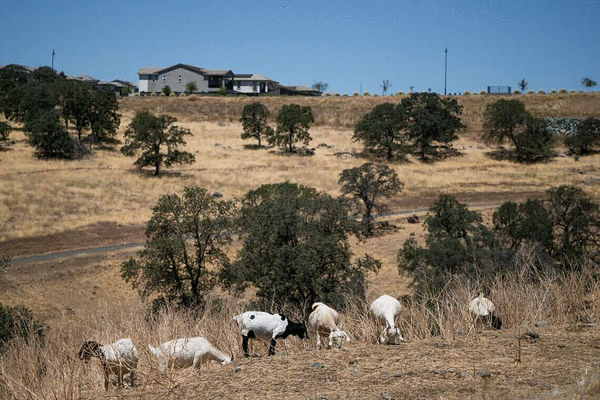
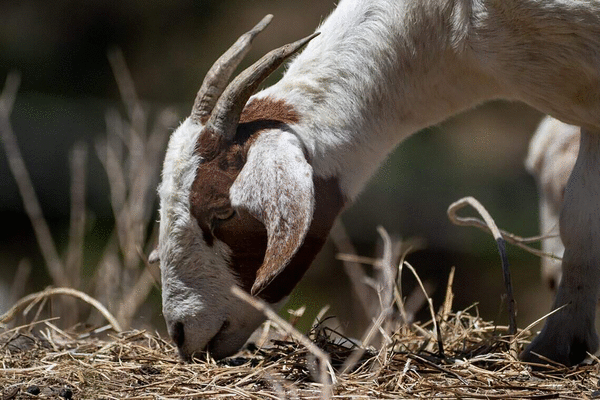

SACRAMENTO, Calif. — The Placer County Board of Supervisors urged California lawmakers to quickly address a wage disparity between sheep and goat herders that county officials said threatened prescribed grazing programs used to reduce wildfire risk.
In a letter to the county’s representatives in the state Legislature, board chair and Supervisor Shanti Landon said the disparity was putting significant financial strain on grazing companies that use sheep and goats.
The issue arose after a temporary state law allowing goat herders to be paid under the same wage structure as sheep herders expired June 30. Without that exemption, goat herders became subject to standard overtime requirements, while sheep herders remained eligible for an alternative monthly wage.
Grazing companies said the change could push annual wages for a goat herder to about $240,000, compared with roughly $60,000 under the previous structure.
The county’s request came after a University of California, Davis study required by law and finalized in March found that sheep and goat herders performed similar work that often overlapped. Employers, worker advocates and other stakeholders agreed the same alternative monthly wage should apply to both, though they disagreed over how much herders should be paid.
Ranchers sought changes to reduce labor costs, while worker advocates opposed wage reductions and called for increased enforcement of labor laws.
“This creates an unsustainable financial burden for prescribed grazing operators,” Landon wrote. She warned that without a change in the law, some grazing companies could reduce or end their operations.
Prescribed grazing has become an increasingly common wildfire prevention tool in California.
County officials said sheep and goats remove dry vegetation that could fuel wildfires and can reach terrain where machinery is difficult or unsafe to operate, including steep hills, rocky areas and communities near wildlands.
Goats also can consume some vegetation that sheep are less likely to eat. The UC Davis study said many grazing businesses use both animals because of their different feeding preferences.
Placer County already uses prescribed grazing to remove fire-prone vegetation from county-owned land, especially in parks. The county regularly hires grazing companies for the work.
The practice has expanded across California. The UC Davis study estimated that about 20% of California’s roughly 500,000 sheep and an even larger share of its 125,000 goats are used for targeted grazing, which includes wildfire fuel reduction and vegetation management on solar farms, orchards and vineyards.
California has also made prescribed grazing part of its broader wildfire prevention efforts. Cal Fire uses animals in some fuel-reduction projects, and the Governor’s Wildfire and Forest Resilience Task Force identified expansion of prescribed grazing as a priority in its 2025 plan.
The current dispute dates to 2022, when goat herders were temporarily brought under the alternative monthly wage already used for sheep herders. Senate Bill 143 later extended that provision through June 30, 2026, and required the state to study the two jobs.
With that provision now expired, Placer County asked lawmakers to restore the same wage structure for sheep and goat herders, arguing that higher costs could force grazing operators to scale back or close and make it harder for the county to reduce wildfire fuels on public land.
©2026 The Sacramento Bee. Visit sacbee.com. Distributed by Tribune Content Agency, LLC.






Comments