Despite new contract, Washington ICE detention center population shrinks
Published in News & Features
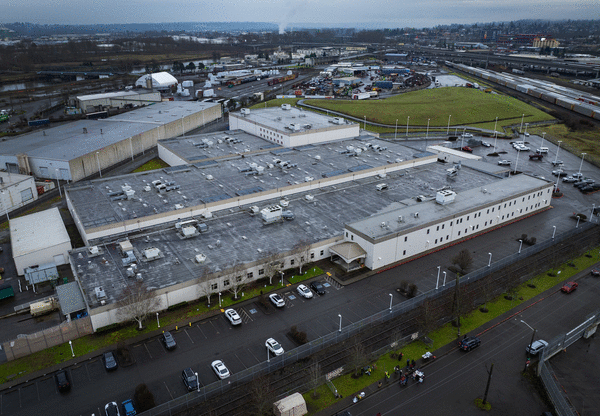
Last June, the federal government's immigrant detention center in Tacoma — then supposed to hold a maximum of 1,575 people — was so full amid the Trump administration's immigration crackdown that several dozen were transferred to an Alaska jail. As of Friday, the number of people detained at the Tacoma facility had dropped to 919, according to a spokesperson for U.S. Rep. Suzan DelBene, a Medina Democrat who visited the facility that day.
The sharp decrease happened even as U.S. Immigration and Customs Enforcement agreed to a new contract with the GEO Group that ups the jail-like facility's capacity to 1,635, according to a source familiar with the agreement who requested not to be named because the person isn't authorized to speak to the press. The contract runs from late March through Oct. 27.
The immigrant advocacy group La Resistencia, which also announced news of a contract for the facility Wednesday, provided The Seattle Times with a copy of a government document showing GEO will be paid $69 million. ICE has not confirmed the contract.
"I don't know what's going on," said Lydia Zepeda, a member of Tacoma's Commission on Immigration and Refugee Affairs. Zepeda, who visits people held at the detention center several times a week, has been told residential pods have consolidated while at least two of the units have closed. A pod typically holds dozens of people.
ICE and GEO, the Florida-based corporation that has run the facility since 2005, declined interview requests, offering no explanations. Others suggest the administration may be temporarily scaling back immigration enforcement after a massive surge in recent months — particularly in Minneapolis, where ICE killed two U.S. citizens — sparked public backlash that could influence the midterm elections and fueled a congressional shutdown of Department of Homeland Security funding.
Indeed, the Tacoma facility's shrinking population corresponds with declining detention numbers nationally as well as a dip in ICE arrests and deportations in Washington state and across the country in the last few months.
A Seattle Times analysis of new ICE data provided to the Deportation Data Project through Freedom of Information Act Requests shows arrests in Washington dropped by more than half since December, to 226 in February. That's about 50 fewer than ICE arrested under the Biden administration in April 2023.
Washington deportations and "voluntary departures," which allow people to leave the U.S. without removal orders on their record that can bar them from returning for up to 10 years, fell from about 370 in December to 255 in February.
An ICE statement says the Deportation Data Project, based at the University of California, "relies on information releases that have not been reviewed, audited or given context."
The datasets the project regularly publishes on its website contain some obvious errors and inconsistencies. Still, with ICE failing to answer many questions about its enforcement efforts, the project's datasets offer the most comprehensive information available.
Deborah Fleischaker, a onetime ICE chief of staff under the Biden administration, said current officials seem to have recognized that recent forceful immigration enforcement tactics have made the public uncomfortable.
"They're clearly trying to take the temperature down," she said. "That doesn't mean that they still aren't aggressively looking to arrest and deport people, or that the temperature stays down."
"There's a midterm election coming up," Fleischaker continued. The administration is also trying to overcome the holdup of Department of Homeland Security funding caused by congressional Democrats, she noted.
The funding stoppage did not stop the department's law enforcement officers or private detention contractors like GEO from being paid. But it did halt paychecks for other department personnel that help process arrested immigrants — another possible reason for the enforcement slowdown, Fleischaker said.
"It isn't beyond imagining that the pace picks up again as soon as the midterms are over," especially if Homeland Security funding has come through, she said. Fleischaker added she's seen no change in the administration's stated goal to arrest and deport as many immigrants without legal status as possible.
While the administration has promised to target the "worst of the worst," Fleischaker said no one has been taken off the table.
In Washington, 47% of people arrested by ICE between the start of President Donald Trump’s second term and March 10 have neither criminal convictions nor pending charges, according to the Deportation Data Project figures. Those taken into ICE custody ranged in age from 2 to 71, including roughly 200 minors.
Kathleen Carson, president of the activist group Seattle Indivisible, speculates ICE activity will return to full speed before long. She said federal agents will likely be out in force when Seattle hosts World Cup games this summer.
“We don’t want to be lulled into a false sense of complacency,” Caron said.
While the number of ICE arrests in Washington is far lower than in some states, local immigration lawyers are swamped. “We’re not seeing any decrease in the amount of work,” said Matt Adams, legal director of the Northwest Immigrant Rights Project.
Since September, the legal nonprofit has filed 300 habeas petitions in U.S. District Court charging that people are being wrongfully held at ICE's Tacoma facility.
Two hundred of those concern immigrants denied bond allowing them to be released while their cases are pending. A U.S. District Court judge in Tacoma ruled in September that a novel legal theory espoused by the administration was wrongfully denying bond hearings. But immigration judges, subject to the authority of the administration, have continued the practice unless habeas petitions for specific individuals are granted.
Private attorneys and the Federal Public Defender's office have also filed habeas petitions, Adams noted. All those habeas petitions has won the release of some people held at the Tacoma facility. Still, Adams said, that's unlikely to fully account for the drop in the population.
The 255 deportations and voluntary departures from Washington in February, while fewer than the number a few months ago, still represent a dramatic increase from the roughly 40 reported in the final full month of the Biden administration, according to the Deportation Data Project.
There used to be one ICE deportation flight a week out of Boeing Field, noted Josefina Mora-Cheung of La Resistencia. Now, there are several.
At its most basic level, the drop in the detention center population boils down to this: More people are leaving the facility than are being brought in.
_____
© 2026 The Seattle Times. Visit www.seattletimes.com. Distributed by Tribune Content Agency, LLC.






Comments