Trump's attacks fuel Supreme Court's sinking public approval
Published in News & Features
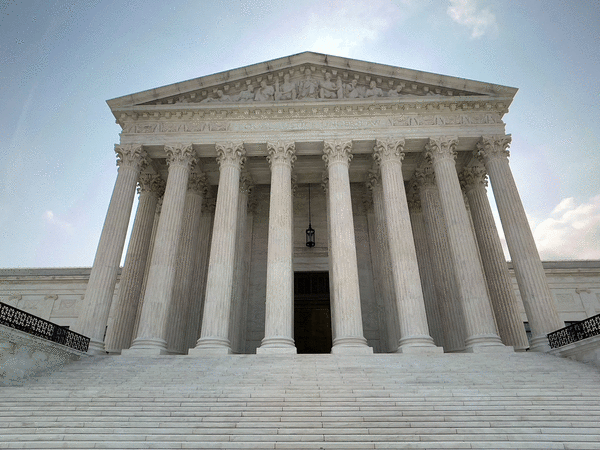
The U.S. Supreme Court has a reputation problem. And Donald Trump’s attacks are making it worse.
In the weeks since an ideologically divisive term ended, polls show the court getting poor approval ratings, with one survey finding record low support. The president’s tirades after losing cases have fueled a slide among Republicans, notwithstanding the strong conservative bent of a court that has three Trump appointees.
The polls come with the country hurtling toward a midterm election in which the court is already playing a central role as Democrats try to recapture Congress. The court will enter that season with a majority of Americans believing the justices tend to act for political reasons, not legal one — a dynamic that experts on both sides of the divide see as unhealthy if not dangerous.
“We expect the justices to do their best to keep some distance from the day-to-day politics of the country, precisely so that people feel that they are getting a fair shake, no matter the outcome of the case,” said Jesse Wegman, a senior fellow at New York University’s progressive Brennan Center for Justice. “Increasingly, millions of Americans, as we’re seeing based on these polls, do not feel that way.”
The court’s reputation has taken a pounding in recent years, driven by a hyper-partisan confirmation process, polarizing decisions and ethics controversies that include Justice Clarence Thomas’ acceptance of lavish trips funded by a Republican megadonor. Democrats have been particularly unhappy amid blockbuster rulings from the court’s conservative supermajority on abortion, elections and governmental power.
Those factors have driven calls for Congress to try to impose term limits on justices or expand the court to offset the 6-3 advantage conservatives now enjoy.
Sliding approval
A Gallup survey conducted in July painted an especially stark picture, pegging approval at 33%, the lowest since the pollster started measuring the Supreme Court’s standing in 2000. The poll showed Republican support dropping 21 percentage points since September, falling from 79% to 58%. The survey had a margin of error of plus or minus 4 percentage points.
The GOP drop came despite a term that saw the court move aggressively to address longstanding Republican priorities. The court bolstered presidential power, enhanced gun rights, eliminated campaign spending restrictions and blunted the Voting Rights Act as a force for Black and Hispanic representation in Congress.
But the court also ruled against Trump in three major cases, striking down his global tariffs, voiding his birthright citizenship restrictions and at least for now thwarting his effort to fire Fed Governor Lisa Cook.
Trump responded by lashing out at members of the court who voted against him, including justices he appointed. Trump called Justices Neil Gorsuch and Amy Coney Barrett “an embarrassment to their families” after they helped invalidate his tariffs.
“I’m not surprised to hear that the drop is because of Republicans, and I attribute that to Donald Trump,” said John Malcolm, vice president of the Edwin Meese III Institute for the Rule of Law at the conservative Advancing American Freedom Foundation. When Trump and his acolytes attack the court, “there are going to be a lot of people who are going to say, ‘Oh, this is terrible,’” Malcolm said.
Other surveys show less of a drop-off. A new poll from Marquette Law School found that 74% of Republicans approve of the job the court is doing, down from 81% in July 2025. The court’s overall approval rating stood at 47%, falling from 49% a year earlier. The survey had a margin of error of plus or minus 3.2 percentage points.
Curiously, the court’s work proved to be more popular than the institution itself. The Marquette poll asked about 13 recent Supreme Court decisions, and a majority of people said the justices had made the right decision in 11 of those case.
The seeming disconnect reflects the limited attention the court garners most of the year, says Charles Franklin, director of the Marquette poll.
“The public is not extremely well-informed about the court, and not intensively focused on the court,” Franklin said. “It’s the big decisions that get their attention.”
The poll also found that 58% of people believe the court’s decisions are mainly based on politics, rather than the law. And 63% of Republicans held the inaccurate belief that the Supreme Court rarely or never sides with Trump.
Legitimacy concerns
Justices have long insisted that they don’t worry about polls.
“The judicial branch derives its legitimacy, not from following public opinion, but from deciding by its best lights whether legislative enactments of the popular branches of government comport with the Constitution,” Justice Samuel Alito wrote in the blockbuster 2022 ruling that overturned the national right to abortion, quoting a 1992 opinion by then-Chief Justice William Rehnquist.
Then-Justice John Paul Stevens put it more succinctly in 2002, writing that “it is the business of judges to be indifferent to unpopularity.”
But justices have also made clear they understand the importance of broad-based confidence in the court as an institution. The court can function effectively only if other government officials and the public at large are willing to accept even those rulings they dislike.
After the abortion ruling, liberal Justices Elena Kagan and Sonia Sotomayor suggested the court was undermining the country’s faith in the legal system by rushing to overturn precedents. More recently, Kagan pushed back against criticisms that the court was operating as an arm of the Trump administration.
“On quite a number of occasions we’ve said to this administration, to this president: ‘You can’t do that,’” she said at a judicial conference in July.
That pushback against Trump isn’t mollifying critics. An overhaul of the court could become a central issue in the 2028 presidential campaign, with potential Democratic candidates Pete Buttigieg and Kamala Harris already pressing the idea of adding seats.
“This court is not going to change its behavior. It was instituted precisely for this behavior,” said the Brennan Center’s Wegman. “The way I think you solve it is structurally.”
_____
©2026 Bloomberg L.P. Visit bloomberg.com. Distributed by Tribune Content Agency, LLC.






Comments