Iran rejects US talks for now as wait for Hormuz deal drags on
Published in News & Features
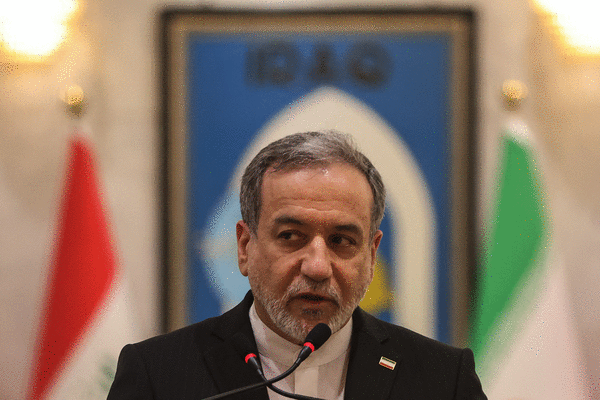
Iran and Oman remained short of a final deal to reopen the Strait of Hormuz, although President Donald Trump signaled patience, saying the U.S. could wait for Tehran’s economic suffering to soften its stance.
For its part, Iran ruled out direct talks with the U.S. for now, citing what Foreign Minister Abbas Araghchi described as repeated violations of a short-lived interim peace agreement signed in June.
“As long as the American violation of the Memorandum of Understanding continues and the U.S. does not make amends for its violations, there is no possibility of resuming negotiations,” Araghchi was cited as saying by state TV. Araghchi also said a pact with Oman to establish a shipping route through the strait was “very close.”
That didn’t seem to bother Trump, who on Sunday told Axios in a short phone call that the U.S. was now “low-keying it.”
“We are only semi-negotiating with them,” he said. “We are just watching Iran with its huge inflation and the fact they have no money.” Sunday’s remarks follow weeks of Trump threatening massive airstrikes on Iran only to pull back, saying he wanted to give negotiations a chance.
Iranian year-on-year inflation reached 77% recently, according to Iran’s central bank.
Tehran on Saturday upped the ante by renewing a hefty list of demands for Washington as conditions for a full reopening of Hormuz, indicating any immediate respite for oil and gas supplies may be limited.
The Strait of Hormuz, through which one-fifth of the globe’s oil and gas is shipped, has become a key factor in the war the U.S. and Israel started on Feb. 28. Trump has demanded the resumption of open navigation for months.
With a deal elusive, the situation in the Middle East stayed volatile on Sunday. Iranian-backed Houthi rebels claimed they’d struck Saudi Aramco’s Jizan oil refinery in the kingdom. Saudi authorities earlier reported a fire at the facility but it was quickly extinguished and no injuries reported.
U.S. Vice President JD Vance on Saturday suggested there’d been recent progress in talks, but he remained skeptical. The question, he said, is whether Iran will be able “to give the things that are necessary for us to be happy, for us to feel like we’ve gotten what we need out of this particular engagement,” he told Fox News.
Washington has repeatedly suggested it’s part of negotiations over the management of Hormuz, which Iran disputes.
“Some intermediary countries are trying to re-establish the ground for negotiations,” Araghchi was quoted as saying on Sunday. “At present, we are not negotiating with the U.S. — the exchange of messages is taking place through intermediaries.”
Oman, which borders the strait across from Iran, said its talks with Tehran were progressing in “a positive and constructive atmosphere.” In a post on X, authorities called for a halt on actions in the strait to give space for diplomatic efforts.
Iran’s demands include that the U.S. lifts its naval blockade on Iranian ports, withdraws military forces from around Iran, removes sanctions, releases frozen assets and pays compensation for war damage, according to Mohammad Bagher Zolghadr, a hard-liner who heads the Supreme National Security Council.
Traffic through the choke point has been largely blocked since the start of the war, but some ships have continued to ferry cargoes as part of a shuttle program involving U.S. military help.
Oil prices swung between gains and losses last week, with Brent eventually settling above $83 a barrel as traders weighed the prospects of a deal that’s expected to clear the way for the restoration of millions of barrels of supply from the Persian Gulf.
Tensions flare
Tensions have flared in the southern Red Sea in recent weeks, with the Houthi rebels in Yemen announcing a blockade on Saudi Arabia’s ports, a key alternative export route for the kingdom’s oil.
The blaze at the Jizan refinery would be at least the second in the past month at the Aramco facility. Satellite images showed a fire at a tank in the 400,000 barrel-a-day complex in late July after the Houthis claimed to have attacked.
Any Hormuz deal will need the approval of Iran’s Supreme Leader Mojtaba Khamenei, who hasn’t been seen in public since the start of the war.
Khamenei said on Sunday he’d met with President Masoud Pezeshkian, whose support of a ceasefire deal with the U.S. has earned him criticism from Iranian hard-liners. The two discussed the war and economy, the leader said on X.
Months of conflict have left thousands of people dead, mainly in Iran, and are shaking up security arrangements across the region.
_____
(With assistance from Salma El Wardany and Michael Gunn.)
_____
©2026 Bloomberg L.P. Visit bloomberg.com. Distributed by Tribune Content Agency, LLC.




Comments